
Women and Children
2027: Gombe women unveil governance agenda, seek commitments from political candidates

The initiative seeks to strengthen women’s political representation, promote girls’ education and hold elected officials accountable for their policy commitments between 2027 and 2031.
By Auwal Ahmad, Gombe
Ahead of the 2027 general elections, women in Gombe State have unveiled a five-year governance agenda aimed at securing greater political representation, influencing public policies and ensuring that elected officials deliver on their commitments to women and girls.
The document, known as the Gombe Women Agenda 2027–2031, provides a framework for engaging political parties, candidates and government institutions on issues affecting women across the state’s 11 local government areas.
Speaking at the unveiling, the Chairman of the Gombe State Civil Service Commission, Rabi Shuaibu Jimeta, called on women to organise themselves and collectively demand greater participation in governance.
Mrs Jimeta said achieving gender inclusion would require women to overcome individual differences, support one another and actively engage in political and public decision-making processes.
“The advancement of Gombe State cannot be complete without the meaningful participation, contributions and leadership of women,” she said.
Sharing her personal experience, Mrs Jimeta recalled how her father enrolled his daughters in primary school in the early 1960s despite opposition from members of his community, where educating girls was largely discouraged.
She said the opportunity enabled her to pursue a career in the public service, where she served at both state and federal levels before retiring as a Federal Permanent Secretary.
She urged women who had attained leadership positions to use their influence to expand opportunities for younger generations.
Mrs Jimeta acknowledged the progress recorded under the current administration in women’s representation, citing the appointments of a female Chief Judge, three female commissioners and women to lead the State Internal Revenue Service and the Teachers Service Commission.
She, however, called on political parties and candidates participating in the 2027 elections to make specific commitments to women’s development and ensure that their promises produce measurable outcomes.
The President of the Gombe Women Agenda Movement, Zariyatu Abubakar Hashidu, said the initiative was conceived to place women’s concerns at the centre of governance and development planning.
Mrs Hashidu explained that the document drew from the experiences, challenges and aspirations of women across the state’s 11 local government areas.
She said the agenda addressed several development priorities, including political participation, education, economic empowerment, healthcare, gender-based violence, peacebuilding and social inclusion.
According to her, the document is structured around 10 strategic pillars and supported by a Charter of Policy Commitments, the Gombe Women Governance Compact and an Accountability Framework.
She explained that the accompanying instruments would enable women to assess the performance of political officeholders and track the implementation of commitments made during election campaigns.
Mrs Hashidu clarified that the initiative was non-partisan and should not be interpreted as support for any political party or candidate.
Rather, she said, it was designed to institutionalise citizens’ participation in governance and sustain engagement with political leaders and public institutions throughout the 2027–2031 period.
Speaking on the sustainability of girls’ education, the Gombe State Coordinator of the Adolescent Girls Initiative for Learning and Empowerment (AGILE), Amina Haruna Abdul, expressed concern over the future of beneficiaries of educational intervention programmes.
Dr Abdul said AGILE had contributed to increased school enrolment among girls, particularly through scholarships and interventions targeting those previously excluded from formal education.
She, however, questioned whether beneficiaries would be able to continue their education when the programme eventually ends.
“Our fear is what will happen to these children after AGILE. When the scholarships are no longer available, what will happen to them? I believe this agenda will fill that gap if we collectively accept and implement it,” she said.
She also commended civil society organisations, particularly Wildan Care Foundation (WILDAN), for supporting the implementation of the Second Chance Education programme, which provides learning opportunities for out-of-school adolescent girls and young women.
In her remarks, the Chief Judge of Gombe State, Justice Halima Shamaki Muhammad, advocated legal reforms that would strengthen the protection of women, girls and children.
Justice Muhammad expressed concern over the imprisonment of children whose involvement in criminal activities could be attributed to poverty, parental neglect and inadequate social support.
She urged authorities to adopt approaches that address the underlying circumstances exposing children to crime rather than depending exclusively on punitive measures.
The chief judge also called for stronger legal provisions against rape and indecent assault, noting that sexual violence affects boys as well as women and girls.
She stressed that legislation must take into account the country’s socioeconomic realities while providing adequate institutional mechanisms for enforcement.
The Gombe Women Agenda represents an attempt by women to influence political priorities ahead of the 2027 elections and establish a mechanism for assessing the performance of elected officials beyond the campaign period.
Participants at the launch emphasised that the effectiveness of the initiative would depend on sustained advocacy, collective ownership and the willingness of political leaders and government institutions to translate policy commitments into tangible improvements in the lives of women and girls.
By Auwal Ahmad Umar
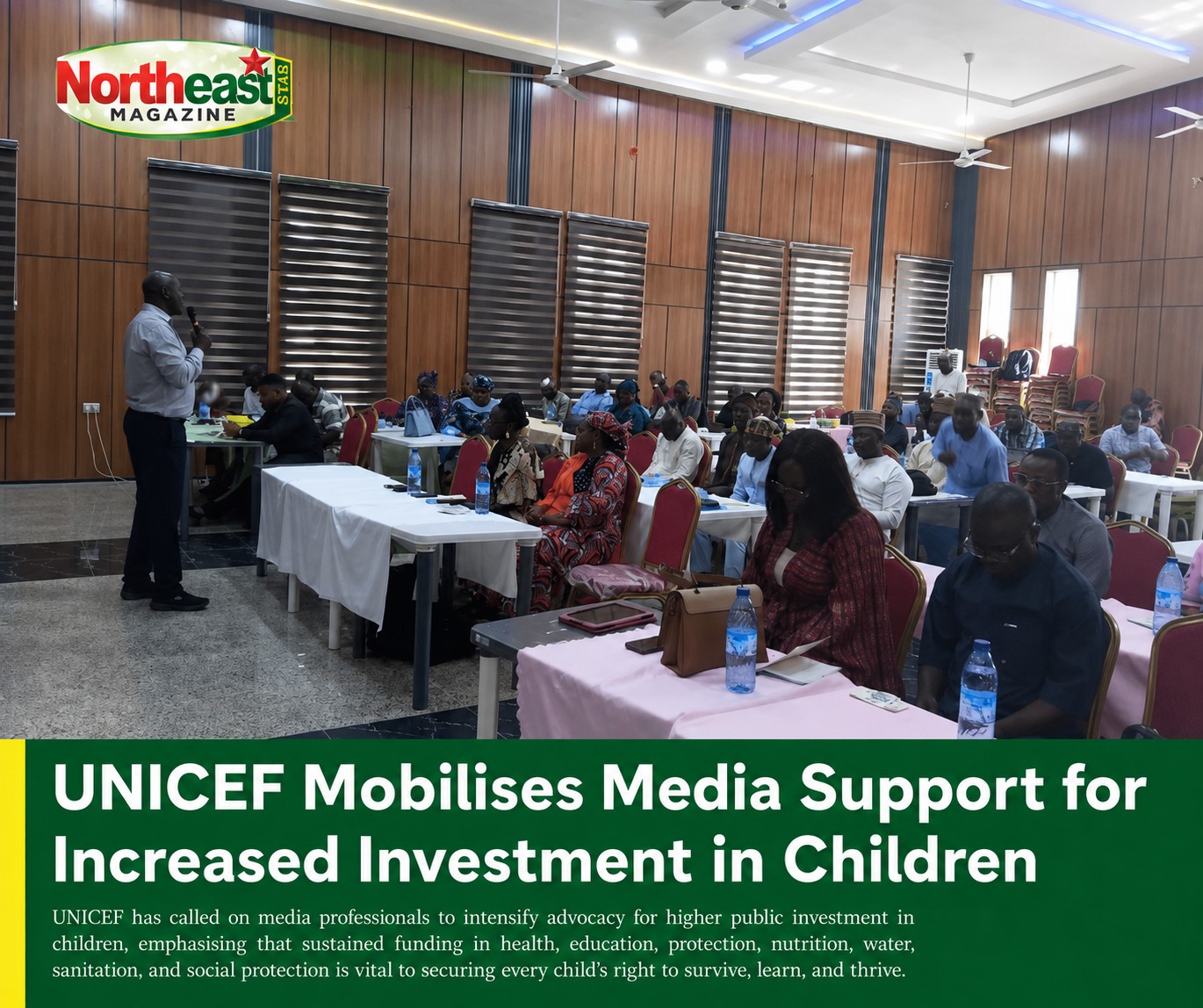
The United Nations Children’s Fund (UNICEF) has mobilised journalists in Bauchi, Gombe and Plateau states to strengthen advocacy for increased public investment in children, urging the media to make children’s welfare a major issue in government policies and the 2027 electoral discourse.
The agency said journalists have a critical responsibility to scrutinise public budgets, expose funding gaps and demand accountability to ensure that government commitments translate into improved education, healthcare, nutrition and protection for children.
The UNICEF Chief of Field Office, Bauchi, Dr Nuzhat Rafiq, represented by UNICEF Education Specialist, Abdulrahman Ibrahim Ado, made the call on Monday during a one-day media dialogue on public financing for children in Bauchi.
Ms Rafiq said the media could influence government policies and help ensure that children and women receive adequate attention in public decision-making.
“Journalists play a very important role in helping us achieve our goals in different sectors of children and women’s welfare,” she said.
She urged journalists to use the 2027 election cycle to question political candidates about their plans to tackle challenges confronting vulnerable children and women.
UNICEF identified out-of-school children, malnutrition, inadequate healthcare facilities and limited access to water, sanitation and hygiene among the challenges requiring urgent government attention.
The UNICEF Social Policy Specialist, Yusuf Auta, said investment in children should begin from conception, stressing that mothers and newborns deserve access to safe and conducive healthcare facilities.
He urged journalists to go beyond reporting budget allocations by tracking the release and utilisation of funds and examining the results achieved.
“After the budgetary allocations, how much has been released? After spending, what is the result? That is where real progress is assessed,” Mr Auta said.
He expressed concern that budgetary allocations often give greater attention to adults despite children aged between zero and 18 years constituting more than 51 per cent of the population.
Also speaking, the Managing Director of Bauchi State Radio Corporation, Umar Muhammad Shira, described the media as an important partner in promoting the rights, health and welfare of children.
He urged journalists to combine responsible reporting, investigative journalism and public enlightenment to expose funding shortfalls, amplify the voices of vulnerable children and hold duty-bearers accountable.
“Every child deserves access to quality and affordable healthcare, regardless of their location or family background,” Mr Shira said.
He described investment in children’s health as an investment in the future, saying adequate financing could help build a healthier, stronger and more productive generation.
Speaking on how the media can strengthen advocacy around public financing, Ali Madina Dankumo, a lecturer in the Department of Economics and Development Studies at the Federal University of Kashere, urged journalists to connect budget figures with the realities children face in their communities.
Mr Dankumo said reporters should investigate whether inadequate financing was contributing to shortages of drugs, insufficient health workers, poorly equipped primary healthcare centres, overcrowded classrooms and poor learning outcomes.
He also called for greater reporting on nutrition and child protection financing, including programmes addressing malnutrition, birth registration, child marriage, child labour, trafficking, violence and abuse.
Mr Dankumo urged journalists covering the 2027 elections to demand specific and measurable commitments from political candidates instead of accepting broad promises.
He said journalists should ask candidates how much they would allocate to education and healthcare, how many teachers they would recruit, how they would address out-of-school children and how citizens would monitor public spending.
“Don’t follow the money alone, but also follow the child,” he said.
He encouraged media practitioners to combine budget data with the experiences of children, parents, teachers, health workers and communities to demonstrate how public financing decisions affect children.
The dialogue ultimately called for stronger media advocacy to make investment in children a political and public priority, particularly as Nigeria approaches the 2027 elections.
It also emphasised the need for journalists to move beyond announcing government allocations and instead investigate whether funds are released, properly spent and reflected in better services and outcomes for children.
2027: Gombe women unveil governance agenda, seek commitments from political candidates

‘A woman’s safety must not be negotiable’ – Princess Momoh

Lawanti Incident: Gombe governor pledges probe, gives N 10m to bereaved families

APC National Chairman Settles Gombe Central Contest, Raises DCP Ahmed’s Hand as Party’s Senatorial Candidate

NGX Ends Week in the Green as ₦1.54 Trillion Boosts Investors’ Fortunes

Gombe Eyes Livestock-Led Economic Growth as Inuwa Yahaya Meets Minister

-
 Politics5 months ago
APC National Chairman Settles Gombe Central Contest, Raises DCP Ahmed’s Hand as Party’s Senatorial Candidate
-
 Economy12 months ago
NGX Ends Week in the Green as ₦1.54 Trillion Boosts Investors’ Fortunes
-
 Agriculture4 months ago
Gombe Eyes Livestock-Led Economic Growth as Inuwa Yahaya Meets Minister
-
 Education12 months ago
Dangote Launches Landmark ₦1 Trillion Scholarship Scheme to Support 1.3 Million Nigerian Students
-
 Sport8 months ago
Gombe Aquatic Sports Body Unveils Board, Sets Stage for Competitive Debut
-

 Economy12 months ago
CBN’s End to Cash Withdrawal Limit
-
 Striking the Balance5 months ago
The $2,500 Threshold: Why Raising Nigeria’s GDP Per Capita Is Our Best Non-Kinetic Strategy for Peace
-

 Borno8 months ago
Police Bust Kidnap Ring in Maiduguri, Rescue 7-Year-Old, Recover ₦1.5m Ransom