
Latest News
Gen. Musa Seeks Private Sector Partnership to Tackle Insecurity


Gen. Musa Seeks Private Sector Partnership to Tackle Insecurity
By Auwal Ahmad Umar
The Minister of Defence, General Christopher Gwabin Musa (Rtd), has called for a new approach to national security that brings together government institutions, private sector actors, communities, and citizens, warning that Nigeria’s growing security challenges cannot be tackled by government alone.
Speaking at the Nigerian People’s Strategic Conference and Defence Exhibition 2026 in Abuja, the Defence Minister stressed that building a secure nation requires a collaborative effort involving security agencies, businesses, technology providers, civil society organisations, traditional institutions, and local communities.
Addressing participants at the conference themed “Building a Modern Security Ecosystem: Integrating Private Sector Capacities into Nigeria’s National Security Architecture,” Musa described the gathering as a timely platform for charting a sustainable path towards a safer and more resilient Nigeria.
He noted that modern security threats have evolved beyond conventional warfare and now include terrorism, insurgency, kidnapping, banditry, cybercrime, oil theft, illegal mining, communal violence, and attacks on critical infrastructure.
According to him, many criminal networks survive because they receive support from within communities through information, logistics, shelter, or financing.
“Security is no longer the responsibility of government alone. It requires collective action from all stakeholders. Criminal elements thrive when communities remain silent or fail to report suspicious activities,” he said.
The minister emphasized that security agencies rely heavily on credible intelligence from the public, adding that effective security operations become difficult when citizens withhold information about criminal activities occurring around them.
Musa praised the sacrifices of personnel of the Armed Forces, the Nigeria Police Force, intelligence agencies, and other security institutions who continue to risk their lives in defence of the country.
Reflecting on his experience as a former theatre commander in Operation Hadin Kai, he acknowledged the emotional burden borne by military families and called on Nigerians to show greater appreciation and support for security personnel.
He further argued that the complexity of modern threats requires Nigeria to embrace structured partnerships with the private sector.
Drawing examples from global best practices, the Defence Minister said private security firms, technology companies, logistics providers, and cybersecurity organisations have become vital contributors to national security in many countries.
He advocated a regulated framework that would enable private sector participation without undermining existing security institutions.
“The objective is not to create parallel security structures but to strengthen national security through collaboration, innovation, and improved response capabilities,” he stated.
Musa also underscored the importance of local defence production, warning against overreliance on imported military and security equipment.
He commended Nigerian defence manufacturers and innovators making strides in the production of military vehicles, surveillance systems, drones, and other security technologies, urging greater investment in indigenous solutions.
The minister highlighted the growing importance of emerging technologies such as artificial intelligence, satellite imagery, biometric systems, predictive analytics, and cybersecurity tools in modern security operations.
He maintained that Nigeria must position itself to leverage these technologies while ensuring they operate within legal and regulatory frameworks.
On community engagement, Musa described local communities as the first line of defence against insecurity, noting that residents are often the earliest to detect suspicious activities and potential threats.
He called on traditional rulers, religious leaders, youth groups, market associations, transport unions, women groups, and local government authorities to actively support national security efforts.
The Defence Minister stressed that trust between communities and security agencies remains essential for effective collaboration, adding that professionalism, accountability, respect for human rights, and prompt responses to security reports are necessary for building public confidence.
He also linked security to economic development, noting that insecurity discourages investment, disrupts agriculture, affects transportation, and increases the cost of doing business.
“A secure nation is a prosperous nation,” he said, explaining that investment in security ultimately translates into economic growth and national stability.
To strengthen Nigeria’s security architecture, Musa proposed five key measures: enhancing legal frameworks for public-private security cooperation, establishing secure information-sharing platforms, promoting local defence manufacturing, investing in training and certification for security stakeholders, and expanding community-based security initiatives.
While reaffirming the commitment of the Armed Forces to combating terrorism, insurgency, banditry, kidnapping, and other criminal activities, he cautioned that military operations alone cannot resolve all security challenges.
He urged stakeholders at the conference to translate discussions into practical partnerships, policy reforms, and investment commitments capable of strengthening national security.
“Nigeria’s future depends on the choices we make today. By working together, strengthening our institutions, and investing in local capacity, we can build a safer and more prosperous nation for future generations,” he said.
The conference brought together policymakers, security experts, defence industry stakeholders, development partners, private sector leaders, and representatives of civil society to explore innovative approaches to strengthening Nigeria’s national security framework.

By Tada Jutha, Maiduguri
Troops of Operation Hadin Kai (OPHK) have killed six suspected insurgents and recovered a cache of weapons and ammunition after repelling an attack on a military base in Garaha community, Hong Local Government Area of Adamawa State.
The attack targeted the Forward Operating Base (FOB) Garaha at about 9:07 p.m., when suspected Boko Haram and Islamic State West Africa Province (ISWAP) fighters advanced on foot from the LAR axis in an attempt to overrun the military position.
The military said the troops responded with superior firepower and coordinated tactics, forcing the attackers to retreat after an exchange of gunfire that lasted about two hours.
In a statement issued on Tuesday in Tola, the Media Information Officer of Operation Hadin Kai, Lt. Col. Sani Uba Goni, said the troops successfully repelled the assault and recovered weapons and other military equipment.
A subsequent search of the area, he said, led to the discovery of six insurgent corpses, confirming the number of terrorists killed during the encounter.
The recovered weapons included one PKT machine gun, three ammunition belts containing 67 rounds, six AK-47 rifles, 11 AK-47 magazines, 157 rounds of 7.62mm NATO ammunition, 120 rounds of 7.62mm special ammunition and one 60mm mortar bomb.
Other items recovered from the scene were an Infinix Android phone, a Canon portable video recorder, three camelback water bags, a magazine carrier and assorted clothing.
Although some soldiers sustained injuries during the confrontation, the military said the affected personnel were receiving medical attention, while arrangements were being made for their evacuation where necessary.
The troops have since intensified surveillance and search operations around the area to prevent further attacks and identify or recover additional items of operational importance.
The military described the successful defence of the base as a demonstration of the troops’ combat readiness and determination to prevent insurgents from overrunning their positions in the North-East.
It added that Operation Hadin Kai would continue to conduct intelligence-led operations to restrict the movement of insurgents, protect vulnerable communities and support efforts to restore lasting peace and security across the region.

By Auwal Ahmad Umar
Former Chief of Army Staff, Lieutenant General Tukur Yusufu Buratai (Rtd), has expressed appreciation to Alhaji Dr. Dahiru Barau Mangal, CON, for his support towards the launch of Transformational Leadership in Action: The Buratai Era.
Mangal, founder of and a prominent businessman with interests spanning aviation, oil and gas, was the Chief Launcher of the book.
He was represented at the event by Alhaji Inuwa Baba, CON, a former presidential aide who served under multiple administrations.
Buratai described Mangal’s support as a significant contribution to the success of the book launch, noting that his participation added value to an occasion centred on leadership, service and national development.
The former Army Chief also acknowledged Mangal’s contributions to Nigeria’s private sector and his philanthropic activities across the country.
According to Buratai, Mangal’s entrepreneurial journey and commitment to supporting initiatives of national importance reflect some of the leadership values highlighted in the book.
“His support for the launch of Transformational Leadership in Action: The Buratai Era elevates the occasion beyond measure,” Buratai said.
He expressed gratitude to Mangal for accepting to serve as Chief Launcher and for his continued support.
“We are deeply grateful, Chief Launcher, for your presence and your support,” Buratai added.
By Tada Jutha, Maiduguri
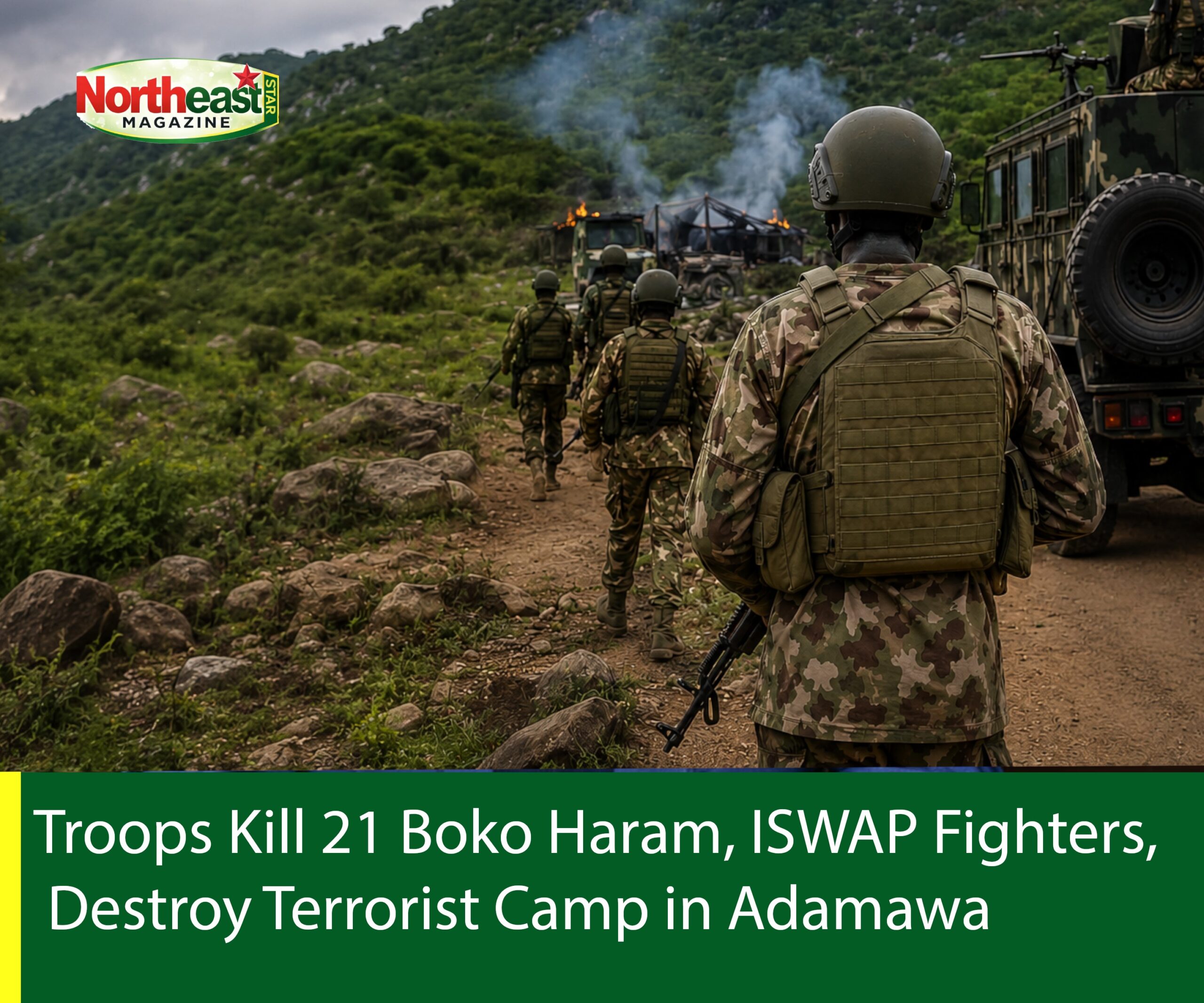
Troops conducting counter-terrorism operations in Adamawa State have killed more than 21 suspected Boko Haram and Islamic State West Africa Province (ISWAP) fighters during an offensive around the Kopre Mountain area of Hong Local Government Area.
The operation, conducted by troops of Operation Hadin Kai (OPHK) alongside the Office of the National Security Adviser’s Tactical Team and personnel of the 226 Battalion, followed intelligence indicating the presence of terrorists in the mountainous terrain.
The Acting Media Information Officer of Operation Hadin Kai, Capt. Mohammed Goni, disclosed this in a statement on Thursday.
According to him, troops moved into the difficult terrain in the early hours of Wednesday and engaged the terrorists in two separate encounters.
“More than 21 suspected terrorists were killed, while others escaped with gunshot wounds,” the military spokesman said.
Goni said the troops subsequently overran the terrorists’ camp, destroying structures, equipment and supplies believed to have been used to sustain their activities in the area.
Items destroyed during the operation included motorcycles, bicycles and jerry cans containing petrol, which the military said were part of the terrorists’ logistical network.
The troops also recovered several weapons and ammunition, including AK-47 rifles, magazines and a substantial quantity of 7.62mm ammunition.
The latest offensive is part of intensified military efforts to locate civilians abducted from communities in the North-East and disrupt terrorist networks operating across the region.
The military said the operation was linked to efforts to trace victims abducted from the Mussa community and the Lassa school following separate incidents reported in 2026.
Hong Local Government Area, characterised by rugged mountains and extensive forest cover, has remained challenging for security forces because of the terrain, which can provide hiding places for armed groups.
The military has increasingly relied on intelligence-driven operations, supported by ground troops, to locate terrorist hideouts, destroy their logistics and rescue civilians held by insurgents.
Goni assured that Operation Hadin Kai would sustain its offensive against terrorist groups, with particular attention to locating abducted persons and dismantling camps and supply routes used by the insurgents.

Gov. Yahaya Hails Professor Faruk Appointment as UMTH Chief Medical Director

Troops Kill Six ISWAP Terrorists, Recover Arms Cache in Adamawa

Nigeria Must Embrace Intelligence, Technology to Tackle Security Threats – Defence Minister

APC National Chairman Settles Gombe Central Contest, Raises DCP Ahmed’s Hand as Party’s Senatorial Candidate

Gombe Eyes Livestock-Led Economic Growth as Inuwa Yahaya Meets Minister

NGX Ends Week in the Green as ₦1.54 Trillion Boosts Investors’ Fortunes

-
 Politics4 months ago
APC National Chairman Settles Gombe Central Contest, Raises DCP Ahmed’s Hand as Party’s Senatorial Candidate
-
 Agriculture3 months ago
Gombe Eyes Livestock-Led Economic Growth as Inuwa Yahaya Meets Minister
-
 Economy10 months ago
NGX Ends Week in the Green as ₦1.54 Trillion Boosts Investors’ Fortunes
-
 Sport6 months ago
Gombe Aquatic Sports Body Unveils Board, Sets Stage for Competitive Debut
-

 Economy10 months ago
CBN’s End to Cash Withdrawal Limit
-

 Education10 months ago
Dangote Launches Landmark ₦1 Trillion Scholarship Scheme to Support 1.3 Million Nigerian Students
-

 Striking the Balance3 months ago
The $2,500 Threshold: Why Raising Nigeria’s GDP Per Capita Is Our Best Non-Kinetic Strategy for Peace
-

 Environment4 months ago
World Environment Day: NGO Urges Nigerians to Embrace Nature-Based Solutions Against Climate Change