
Security
Experts Urge Government to Deepen Private Sector Involvement in Security


Experts Urge Government to Deepen Private Sector Involvement in Security
By Auwal Ahmad Umar
The Nigerian People’s Strategic Conference and Defence Exhibition 2026 concluded with a strong call for greater private-sector participation in the nation’s security architecture, as stakeholders highlighted key achievements and proposed reforms aimed at strengthening national security.
Delivering the closing remarks, Co-Convener and Managing Director/Chief Executive Officer of Elbroco International Security Company Ltd, Dr Abubakar Muhammed Sani, urged the Federal Government to review existing laws and policies to create more opportunities for private-sector involvement in security operations.
He emphasised that safeguarding the nation should not be left solely to government institutions, stressing that security is a shared responsibility that requires contributions from all sectors of society.
According to him, opening up the security space would enable more Nigerians to deploy their expertise, innovation, and resources toward addressing the country’s growing security challenges.
Dr Sani expressed confidence in President Bola Ahmed Tinubu’s administration, describing the President as receptive to constructive ideas and stakeholder engagement. He appealed to the government to carefully consider recommendations generated during the conference as part of efforts to enhance national security and accelerate development.
The security expert also advocated stronger government support for indigenous defence manufacturers. He noted that patronising locally produced military equipment and technologies would not only boost domestic capacity but also create employment opportunities and reduce reliance on foreign suppliers.
Reflecting on the conference’s accomplishments, Dr Sani said one of its major successes was the establishment of a platform that brought together licensed private security companies, consultancy firms, government agencies, civil society organisations, and other stakeholders to exchange ideas and collaborate on common security goals.
He further revealed that discussions at the conference strengthened support for the establishment of state police across the country. While acknowledging that he previously had reservations about the proposal, he said contributions from participants helped reshape his views on the issue.
According to him, potential challenges associated with state policing can be addressed through proper legal and institutional reforms, making it a viable option for improving security at the grassroots level.
Dr Sani also praised the capabilities of Nigerian-owned companies operating within the defence and security sector. He said the exhibition showcased impressive locally manufactured military hardware and security technologies, demonstrating that indigenous firms possess the expertise and capacity to contribute significantly to the country’s defence needs.
He described the exhibition as a testament to the growing potential of Nigeria’s defence industry and called for sustained support to help local companies compete effectively and meet national security demands.
The conference ended with renewed optimism among participants, who expressed hope that the recommendations and partnerships forged during the event would contribute to building a safer and more secure Nigeria.

By Auwal Ahmad Umar
The Gombe Network of Civil Society Organisations (GONET) has called on political leaders, candidates, supporters and other stakeholders to promote peace, tolerance and responsible political engagement as Nigeria prepares for the 2027 general elections.
In a statement marking the 2026 International Day of Peace, signed by Amb. Ibrahim Yusuf, Chairman, GONET, and Dr. Benjamin Maina, Secretary, GONET, the organisation urged Nigerians to embrace dialogue, mutual respect and peaceful coexistence. The theme of this year’s observance is “Building a Culture of Peace and Harmony.”
GONET urged political parties and their supporters to conduct campaigns with restraint, respect for opposing views and a focus on issues, warning against violence, intimidation, hate speech and destruction of property.
It said political competition should not be allowed to create hostility among citizens or deepen divisions within communities.
The organisation also appealed to Nigerians to respect one another irrespective of political affiliation, ethnicity, religion, gender, age or social status.
According to GONET, differences in political opinions should not override the shared interest of citizens in a peaceful and prosperous Nigeria.
The group further urged parents, community leaders, teachers, religious institutions, youth organisations and the media to promote peace and discourage misinformation, provocation and inflammatory rhetoric during campaigns and elections.
It described elections as a democratic process for choosing leaders, rather than a battle between citizens, urging political actors and voters to resolve disagreements through dialogue and lawful democratic channels.
“Let us choose peace over provocation, dialogue over confrontation, unity over division, and development over destruction,” GONET said.
The organisation reaffirmed its commitment to promoting peaceful coexistence, inclusive governance, human rights, civic participation and social cohesion across Gombe State and Nigeria.

By Auwal Ahmad Umar
The Institute of Security, Nigeria (ISN), has declared a national emergency over the worsening wave of terrorism, banditry, kidnapping and other violent crimes across the country, following the reported imposition of a ₦50 million levy and 100 livestock on residents and traders in Talata Mafara, Zamfara State.
The institute described the reported seven-day ultimatum issued by non-state actors to meet the demands as an “act of war” against the Nigerian state, warning that such actions were creating a parallel criminal economy capable of undermining national security, economic stability and social cohesion.
In a statement issued on Friday and signed by its Deputy President and Chief Executive Officer, Barrister Adebayo Akinade, the ISN said the situation had gone beyond conventional criminality and required an urgent, coordinated response involving government, security agencies, communities and civil society organisations.
The institute said the continued attacks on lives, farms, markets and livelihoods directly challenged the constitutional responsibility of government to protect citizens, citing Section 14(2)(b) of the 1999 Constitution, which places the security and welfare of the people among the primary purposes of government.
The ISN warned that relying solely on military or other kinetic operations would not be sufficient to defeat the increasingly organised criminal networks.
«“Kinetic operations alone cannot defeat this threat. A whole-of-government and whole-of-society approach is urgently required,” the institute said.»
It urged the federal and state governments to classify banditry levies and invasions of markets as terrorism and economic sabotage, while establishing a state-led security coordination framework linking federal security agencies, state security outfits and vetted community guards.
The institute also called for increased funding for tactical mobility, drones, night-vision equipment and attack helicopters in frontline states, including Zamfara, Katsina, Sokoto, Niger, Kaduna and Plateau.
It further proposed the establishment of a Special Victims Support and Livelihood Restoration Fund to assist communities affected by attacks and restore economic activities disrupted by insecurity.
For security agencies, the ISN recommended a shift towards predictive and intelligence-led operations, including the infiltration of criminal networks operating around markets and livestock-rustling value chains.
It also called for the dismantling of criminal logistics and levy networks, the reintroduction of regulated livestock markets and the adoption of a two-hour rapid-response protocol supported by visible air patrols.
The institute recommended specialised training in terrorism studies, intelligence management and counter-banditry operations for security personnel, saying professional capacity was essential to confronting the evolving security threat.
At the community level, the ISN urged citizens, traditional institutions, farmers, market unions, faith groups and civil society organisations to establish stronger early-warning and early-response mechanisms.
It also advised communities to document attacks, preserve evidence, support victims psychologically and report security threats through designated security channels, while cautioning against the payment of ransoms and criminal levies.
The institute proposed broader institutional reforms, including the establishment of a National Security Fusion Centre with state-level desks, special courts for terrorism, banditry and kidnapping cases, and the deployment of technologies such as geo-fencing, livestock tracking and a citizen-reporting application.
The ISN also called for the full implementation of its governing legislation to strengthen the licensing and regulation of security practitioners in Nigeria.
The institute said it was ready to support government, security agencies and communities through research, professional training, policy advisory services and certification aimed at improving national security, restoring public confidence and supporting development.
The statement was signed by Barr. Adebayo Akinade, DFISN, FSCS, PSC, Deputy President and Chief Executive Officer of the Institute of Security, Nigeria.
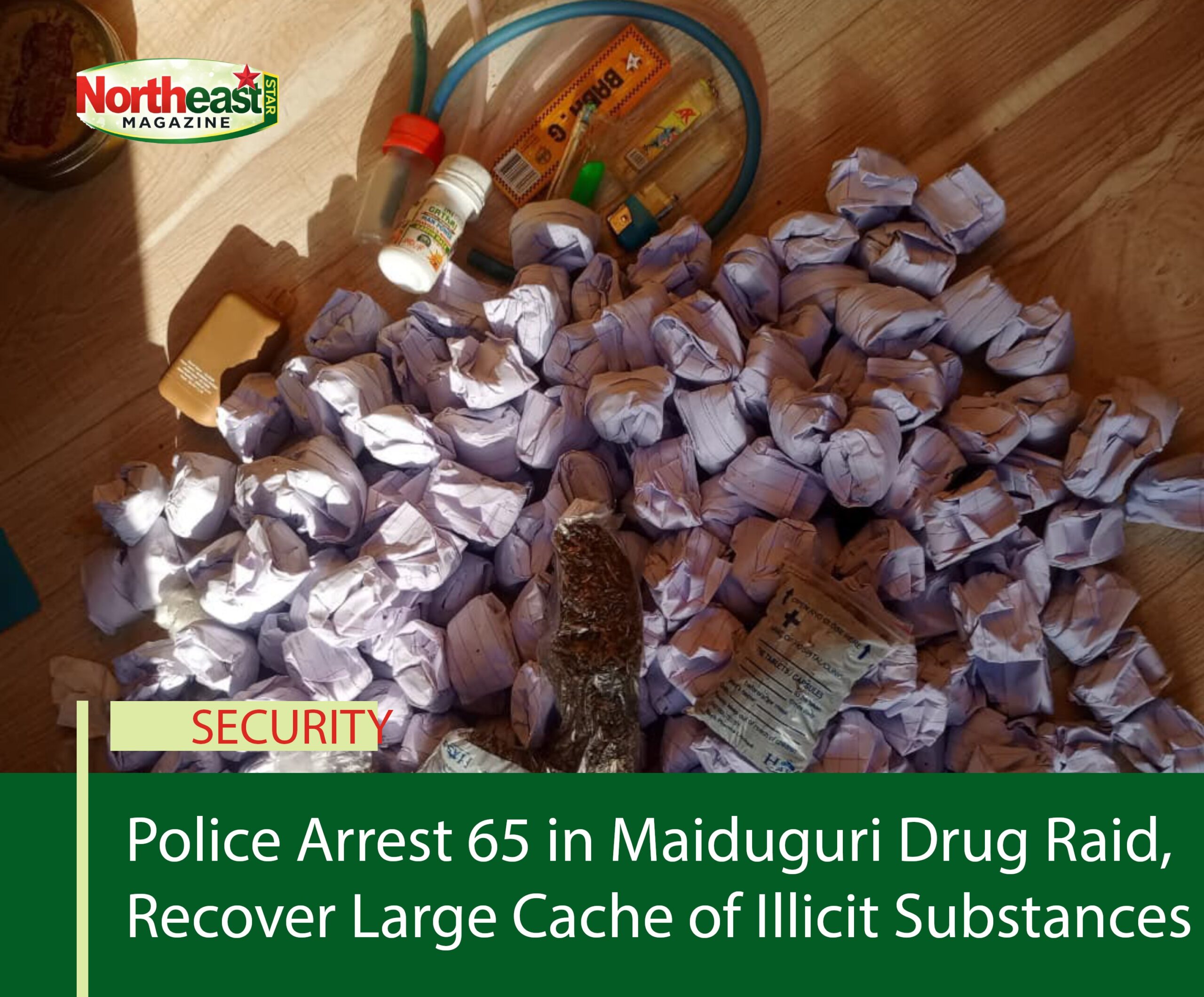
Police Arrest 65 in Maiduguri Drug Raid, Recover Large Cache of Illicit Substances
ByTada Jutha, Maiduguri
The Borno State Police Command has arrested 65 suspects in a sweeping crackdown on drug-related offences across Maiduguri, recovering large quantities of illicit substances during coordinated raids aimed at tackling crime and anti-social activities.
The operation, carried out on July 9 and 10, followed a nationwide directive by the Inspector-General of Police, Olatunji Disu, ordering police commands to intensify efforts against criminality across the country.
In a statement issued on Sunday, the Police Public Relations Officer, ASP Nahum Daso, said the Commissioner of Police in Borno State, Naziru Abdulmajid, directed the Rapid Response Squad (RRS) Anti-Social Vices Unit to sustain aggressive enforcement operations throughout the state.
According to the statement, the raids targeted several locations within the Maiduguri metropolis, leading to the arrest of suspects for offences including public nuisance, possession and consumption of illicit drugs, and other anti-social activities.
Police said officers recovered 460 wraps of cannabis, commonly known as Indian hemp, 395 tablets of D5, 100 tablets of Exzol, two capsules of Tramadol, one shisha pot, two ice bunkers and several packs of other suspected illicit substances.
The command confirmed that all suspects remain in police custody while investigations continue. It added that those found culpable would be prosecuted upon the conclusion of investigations.
Commissioner Abdulmajid commended the officers involved in the operation for their professionalism and dedication, reaffirming the command’s commitment to protecting lives and property across the state.
He also appealed to residents to continue supporting the police with timely and credible information that would assist security agencies in preventing crime and maintaining public safety in Borno State.

Nigeria Must Embrace Intelligence, Technology to Tackle Security Threats – Defence Minister

Nigerian Army Moves to Strengthen Aviation Safety, Aircraft Reliability

Rule of Law, Nigeria’s only hope of survival (1)

APC National Chairman Settles Gombe Central Contest, Raises DCP Ahmed’s Hand as Party’s Senatorial Candidate

Gombe Eyes Livestock-Led Economic Growth as Inuwa Yahaya Meets Minister

NGX Ends Week in the Green as ₦1.54 Trillion Boosts Investors’ Fortunes

-
 Politics4 months ago
APC National Chairman Settles Gombe Central Contest, Raises DCP Ahmed’s Hand as Party’s Senatorial Candidate
-
 Agriculture2 months ago
Gombe Eyes Livestock-Led Economic Growth as Inuwa Yahaya Meets Minister
-
 Economy10 months ago
NGX Ends Week in the Green as ₦1.54 Trillion Boosts Investors’ Fortunes
-
 Sport6 months ago
Gombe Aquatic Sports Body Unveils Board, Sets Stage for Competitive Debut
-

 Economy10 months ago
CBN’s End to Cash Withdrawal Limit
-

 Education10 months ago
Dangote Launches Landmark ₦1 Trillion Scholarship Scheme to Support 1.3 Million Nigerian Students
-

 Striking the Balance3 months ago
The $2,500 Threshold: Why Raising Nigeria’s GDP Per Capita Is Our Best Non-Kinetic Strategy for Peace
-

 Environment4 months ago
World Environment Day: NGO Urges Nigerians to Embrace Nature-Based Solutions Against Climate Change