
NGOs
Politics Shouldn’t Divide Gombe: CSOs Sound Alarm Over Rising Hate Speech Ahead of Governorship Election


Politics Shouldn’t Divide Gombe: CSOs Sound Alarm Over Rising Hate Speech Ahead of Governorship Election
By Auwal Ahmad, Gombe
The Gombe Network of Civil Society Organizations (GONET) has warned that the increasing use of hate speech, online attacks and inflammatory political rhetoric by supporters of governorship aspirants could undermine the peace and unity Gombe State has enjoyed over the years.
In a statement jointly signed by its Chairman, Amb. Ibrahim Yusuf, and Secretary, Dr Benjamin Maina, the coalition expressed concern that political engagement in the state was rapidly shifting from healthy democratic competition to personal insults, cyberbullying, character assassination and dangerous incitement.
The organisation said the trend, if left unchecked, could threaten the peaceful coexistence for which Gombe, popularly known as the “Jewel in the Savannah”, is recognised.
According to GONET, elections should be fought on the strength of ideas, policies and leadership competence rather than through campaigns of hatred and misinformation.
“Politics should never become a licence for hatred. Every aspirant is a son of Gombe whose dignity deserves respect, irrespective of political affiliation. Citizens should debate policies and programmes instead of spreading abuse and false narratives,” the statement said.
The coalition warned that political violence often begins with reckless words, noting that history has repeatedly shown that inflammatory language, misinformation and sustained verbal attacks frequently precede physical violence.
It therefore urged all governorship aspirants and political leaders to publicly caution their supporters against hate speech, threats and provocative online conduct.
“True leadership is demonstrated not only by the size of one’s political following but by the discipline and restraint exhibited by supporters,” it added.
GONET also appealed to residents not to sacrifice personal relationships or divide communities over politics, reminding citizens that today’s political rivals could become tomorrow’s allies.
The group called on security agencies to strengthen intelligence gathering to identify and address deliberate incitement and cyber harassment while enforcing the law professionally, impartially and without political interference.
It further urged traditional rulers, religious leaders, youth groups, community leaders, civil society organisations and the media to promote issue-based campaigns and discourage extremist political narratives throughout the electoral season.
Reaffirming its commitment to peaceful elections, GONET stressed that while political offices are temporary, the people of Gombe would continue to live together after the elections.
It urged all stakeholders to allow campaigns to remain competitive without sacrificing mutual respect, expressing hope that wisdom would prevail over provocation and peace over political bitterness.
By Auwal Ahmad, Gombe
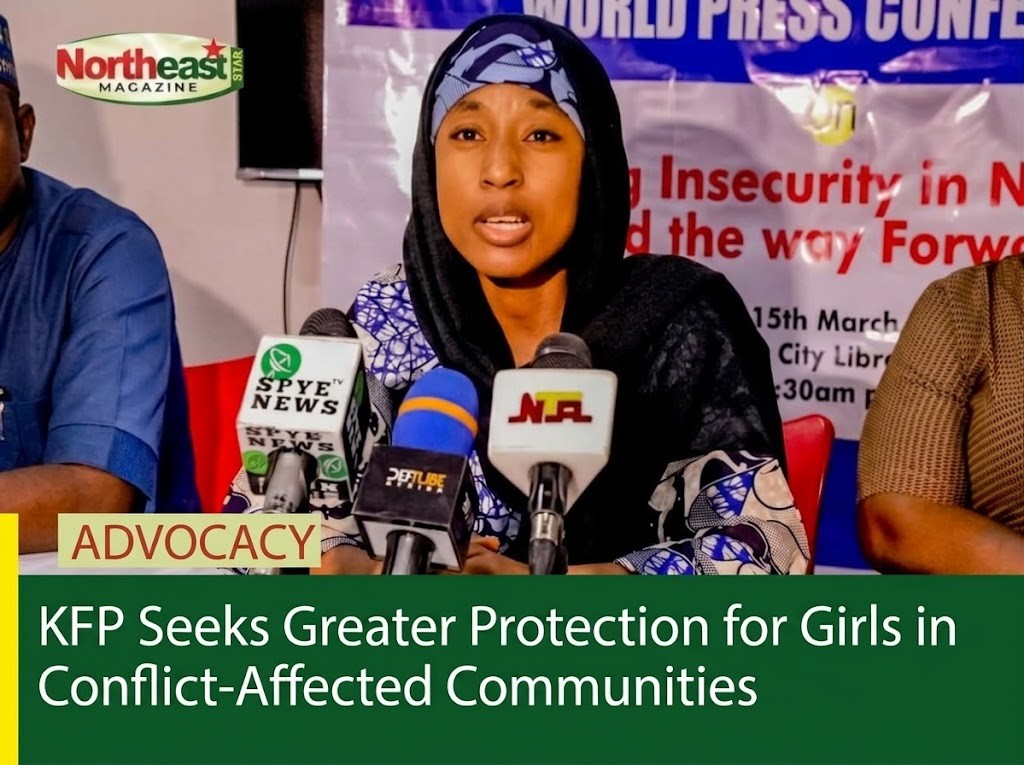
The Kalthum Foundation for Peace has called on governments and security agencies to strengthen measures to protect girls in conflict-affected communities, warning that insecurity, poverty and displacement are exposing more children to early marriage and disrupting their education.
The foundation’s Chief Executive Officer, Ummu Kalthum Muhammad Rabiu, made the call in a statement issued in Maiduguri on Sunday to mark the 2026 International Day of the Girl Child.
She said child marriage had become a major concern in Northern Nigeria and the Sahel, where armed conflict, economic hardship and climate-related challenges continued to undermine the safety and future of adolescent girls.
Ms Rabiu argued that child marriage should not be treated merely as a social or cultural issue, but as a threat to education, development and long-term security.
“Ending girl child marriage is not a slogan for us in Northern Nigeria, in the Sahel and across West Africa. It is an emergency,” she said.
She noted that when schools were closed because of insurgency, banditry and kidnapping, girls were often among the first to lose access to education. Families facing displacement and financial hardship, she added, sometimes resorted to marrying off their daughters to reduce household expenses.
“When families are displaced and have no food, who is married off at 13 for N50,000 or a bag of rice? The girl,” she said.
According to Ms Rabiu, the effects of insecurity are compounded by environmental and economic pressures, including the shrinking of Lake Chad and conflicts between farmers and herders, which have weakened the livelihoods of many families across the region.
She cited figures attributed to UNICEF indicating that 44 per cent of girls in Northern Nigeria were married before the age of 18. She also pointed to the high prevalence of child marriage in countries such as Niger and Burkina Faso as evidence of the wider challenge facing the Sahel.
The foundation’s chief executive said early marriage could deprive girls of educational opportunities, limit their economic independence and perpetuate poverty across generations.
“Girl child marriage is not just a girls’ issue. It is a security issue. It is an HDI issue. It is a peace issue,” she said.
Ms Rabiu urged governments and security agencies to prioritise the protection of schools and ensure that girls in conflict-affected communities could continue their education without fear of attacks, abduction or forced marriage.
She called for stronger implementation of the Safe Schools Declaration, stressing that education should form a central part of strategies to protect children and prevent further social instability.
“A school must be protected like a military barracks,” she said.
She also called for greater collaboration with traditional rulers, Islamic scholars and teachers in Tsangaya and Islamiyya schools to address child marriage and encourage community participation in protecting girls.
According to her, religious and traditional leaders could play an important role in changing attitudes and discouraging practices that expose children to harm.
“Marrying off a 12-year-old who has seen no menstrual cycle is not Islam — it is poverty using religion as cover,” she said.
Beyond government intervention, Ms Rabiu urged international donors, United Nations agencies and state governments to provide direct funding to women-led organisations working in communities affected by conflict.
She said women were often at the forefront of peacebuilding, mediation and efforts to prevent young people from joining armed groups, but their contributions remained inadequately recognised in formal security discussions.
“For too long, security meetings in Abuja, Niamey, Ouagadougou and N’Djamena discuss the Sahel without one woman from the Sahel at the table,” she said.
“Peace agreements are signed about our bodies, without our voices. Education policies are made for our daughters, without our mothers.”
The foundation announced plans to mark the international day through engagements with 200 adolescent girls who had escaped child marriage and returned to school in three communities in Maiduguri.
Ms Rabiu said the programme would provide the girls with an opportunity to share their experiences and contribute to discussions on their rights, safety and future.
She urged families and community leaders to support girls’ education and ensure that economic hardship did not become a justification for forcing children into marriage.
“To every girl reading this in Borno, in Zamfara, in Tahoua, in Kaya: Your education is your right. Your voice is your power. Your marriage must be your choice, not your family’s survival strategy,” she said.
Ms Rabiu reaffirmed the foundation’s commitment to advocating for the protection of girls and ensuring that children in Northern Nigeria and across the Sahel could access education, live safely and make decisions about their futures.
By Auwal Ahmad Umar
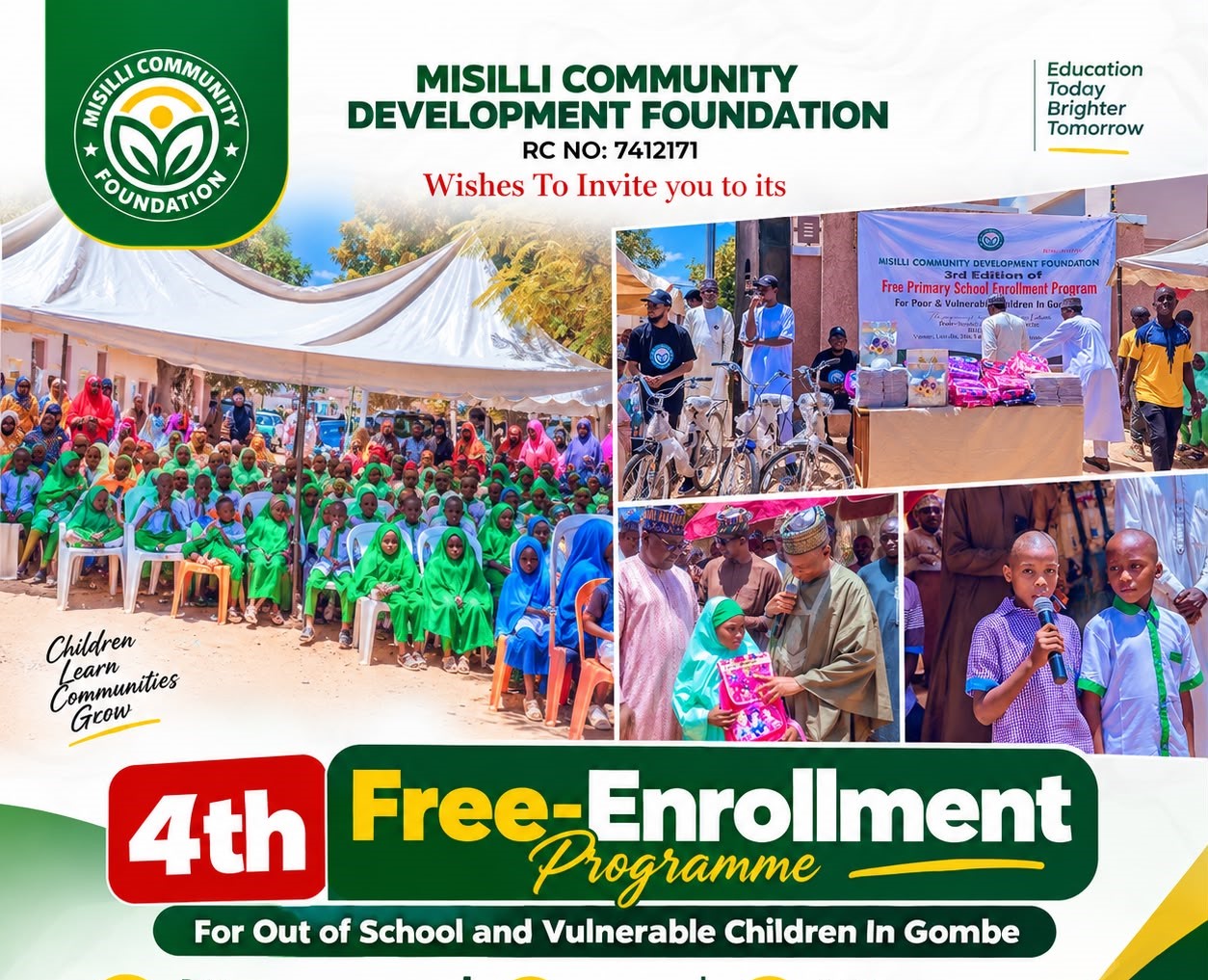
The Misilli Community Development Foundation (MCDF) is set to hold the fourth edition of its annual school enrolment programme for out-of-school and vulnerable children in Gombe State.
The initiative, scheduled for Sunday, September 20, 2026, is aimed at helping children facing financial and social challenges gain access to formal education and remain in school.
The programme, which has grown into a yearly intervention by the foundation, is designed to complement government efforts to reduce the number of children excluded from the education system.
Since its launch, the initiative has supported beneficiaries with school enrolment and essential learning materials, including uniforms, school bags and books. The foundation has also introduced measures aimed at easing the financial burden on vulnerable families and encouraging regular school attendance.
The intervention aligns with ongoing efforts by the Gombe State Government to tackle the out-of-school children challenge through programmes implemented by the State Universal Basic Education Board (SUBEB), with support from organisations including the Universal Basic Education Commission (UBEC) and UNICEF.
Beyond enrolment, MCDF said its intervention is focused on helping children stay in school and benefit from education irrespective of their socio-economic circumstances.
The fourth edition is expected to bring together beneficiaries, parents, community leaders, education stakeholders, partners and other supporters of the initiative.
The event will take place at 10:00 a.m. at the residence of the late Alhaji Uba Misilli in Dawaki Quarters, Gombe.
The foundation called on individuals, organisations and community stakeholders to support efforts to identify and enrol children who are out of school, while urging parents and guardians to ensure that enrolled children attend school regularly.
According to the foundation, access to education should not end with admission into a classroom but should provide children with the knowledge and opportunities needed to improve their future.
By Auwal Ahmad, Gombe
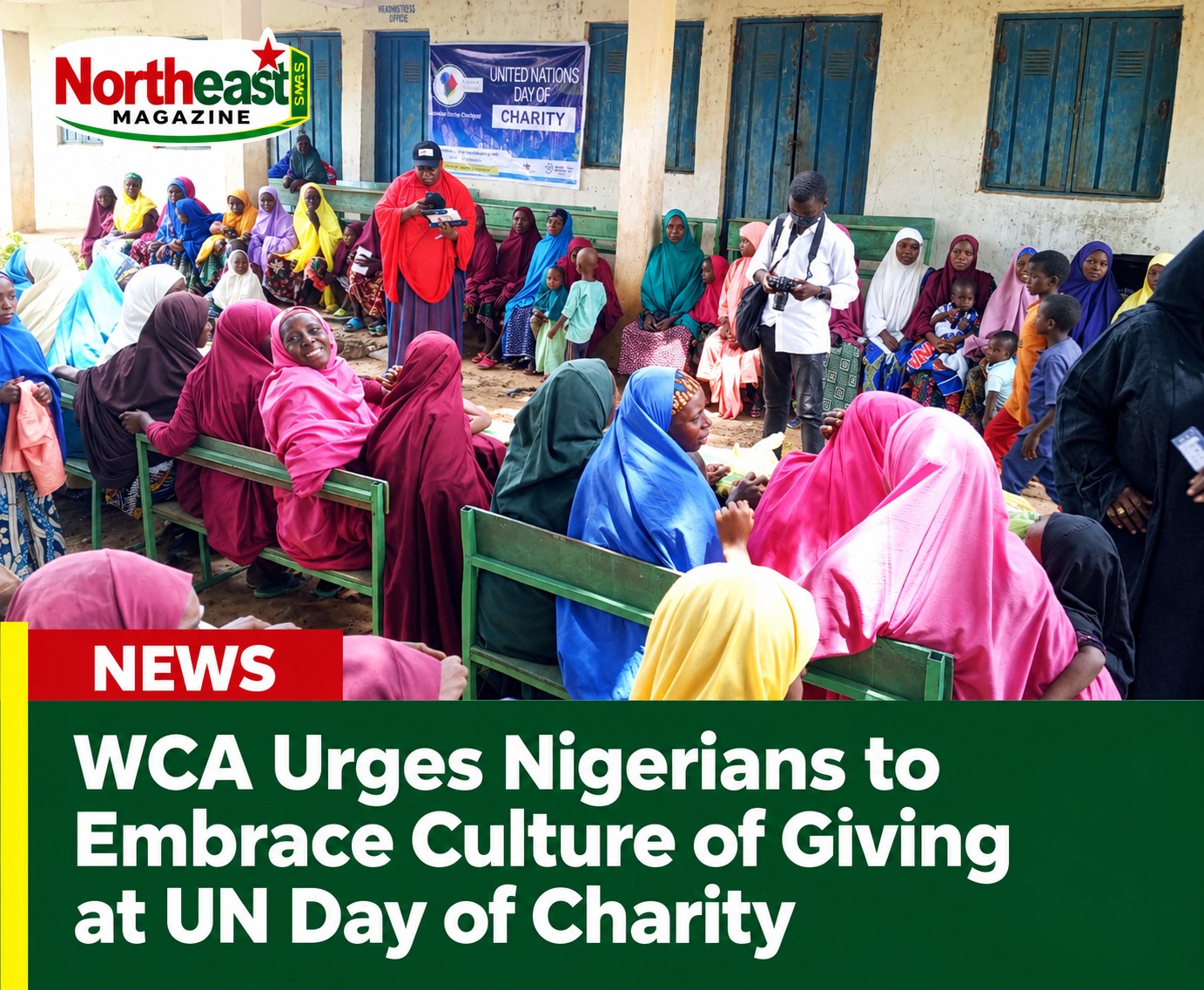
Women Community in Africa (WCA), Gombe State Chapter, has urged Nigerians to cultivate the habit of giving, saying charity can help transform lives and strengthen communities.
The organisation made the call on Saturday during activities marking the UN Day of Charity in Shongo Dirago Community, Gombe State, with the theme, “In Giving We Receive.”
The event, organised in collaboration with the Adamu Yola Foundation and Voice of Women for Peace and Development Initiative, sought to encourage people to support others irrespective of their social or economic circumstances.
Speaking at the event, WCA Gombe State Commissioner, Hon. Ruth Abner, said charity should go beyond material donations to include kindness, compassion and efforts to improve the lives of vulnerable people.
Represented at the event, Ms Abner said empowering women to contribute to their communities could create a wider impact on families and future generations.
“When we feed one, we feed many. When we touch one life, we change a generation,” she said.
She urged residents of Shongo Dirago to sustain the culture of generosity, stressing that acts of giving could promote peace, unity and community development.
Ms Abner also commended the WCA executive, volunteers, community leaders and partner organisations for supporting the programme.
She said the initiative would be followed by a virtual engagement at 7:30 p.m. to broaden discussions on charity and encourage more people to participate in acts of kindness.
She thanked the traditional and community leaders for hosting the event and urged participants to continue supporting people in need beyond the commemoration.
“Give with love, touch a life and make a difference,” she said.
Yahoo Mail: Search, organise, conquer

Nigeria Must Embrace Intelligence, Technology to Tackle Security Threats – Defence Minister

Nigerian Army Moves to Strengthen Aviation Safety, Aircraft Reliability

Rule of Law, Nigeria’s only hope of survival (1)

APC National Chairman Settles Gombe Central Contest, Raises DCP Ahmed’s Hand as Party’s Senatorial Candidate

Gombe Eyes Livestock-Led Economic Growth as Inuwa Yahaya Meets Minister

NGX Ends Week in the Green as ₦1.54 Trillion Boosts Investors’ Fortunes

-
 Politics4 months ago
APC National Chairman Settles Gombe Central Contest, Raises DCP Ahmed’s Hand as Party’s Senatorial Candidate
-
 Agriculture2 months ago
Gombe Eyes Livestock-Led Economic Growth as Inuwa Yahaya Meets Minister
-
 Economy10 months ago
NGX Ends Week in the Green as ₦1.54 Trillion Boosts Investors’ Fortunes
-
 Sport6 months ago
Gombe Aquatic Sports Body Unveils Board, Sets Stage for Competitive Debut
-

 Economy10 months ago
CBN’s End to Cash Withdrawal Limit
-

 Education10 months ago
Dangote Launches Landmark ₦1 Trillion Scholarship Scheme to Support 1.3 Million Nigerian Students
-

 Striking the Balance3 months ago
The $2,500 Threshold: Why Raising Nigeria’s GDP Per Capita Is Our Best Non-Kinetic Strategy for Peace
-

 Environment4 months ago
World Environment Day: NGO Urges Nigerians to Embrace Nature-Based Solutions Against Climate Change