Education
Speak Out, Save Lives: Bauchi Police Urge Residents to Break Silence on Abuse Against Women


Speak Out, Save Lives: Bauchi Police Urge Residents to Break Silence on Abuse Against Women
The Bauchi State Police Command has called on residents to speak out boldly against all forms of violence and abuse targeting women and children, stressing that silence only fuels the growing menace of gender-based violence (GBV).
The Commissioner of Police, Aliyu Sani-Omolori, made the appeal on Tuesday during a two-day training on child safeguarding for school teachers and counsellors in Bauchi. The programme was organised by the Bauchi State Action Committee on Gender-Based Violence (BSACGBV).
Speaking through CSP Mohammed Barau of the Police Operations Department, Sani-Omolori said breaking the long-standing culture of silence remained the strongest weapon in combating GBV.
He said, “We must speak out against GBV. It’s our most powerful tool.”
He urged teachers, parents, and students to raise their voices whenever abuse is suspected, warning that silence only shields perpetrators while exposing victims to deeper harm.
The wife of the Bauchi State Governor, Hajiya Aisha Mohammed, echoed the same message, noting that silence continued to embolden abusers and put vulnerable groups—especially women and children—at greater risk. She was represented by Aisha Baba-Tela.
Mohammed emphasised that protecting children requires collective vigilance and the courage to report wrongdoing without fear. She noted that the training would encourage survivors, teachers, and schools to act swiftly to safeguard minors.
She highlighted the importance of having Child Safeguarding Officers in schools, saying they would serve as trusted figures for children to confide in, knowing they would be believed and protected.
“Prevention begins when people refuse to stay silent. When children feel heard and protected, they grow with confidence and reach their full potential,” she said.
Also speaking, Ladi Hamma, Project Coordinator of the Adolescent Girls Initiative for Learning and Empowerment (AGILE), said promoting a culture of speaking out against abuse was crucial to empowering girls and securing their educational journey.
She commended the Bauchi State Government and development partners for their continuous efforts in strengthening child protection systems across the state.

By Auwal Ahmad Umar
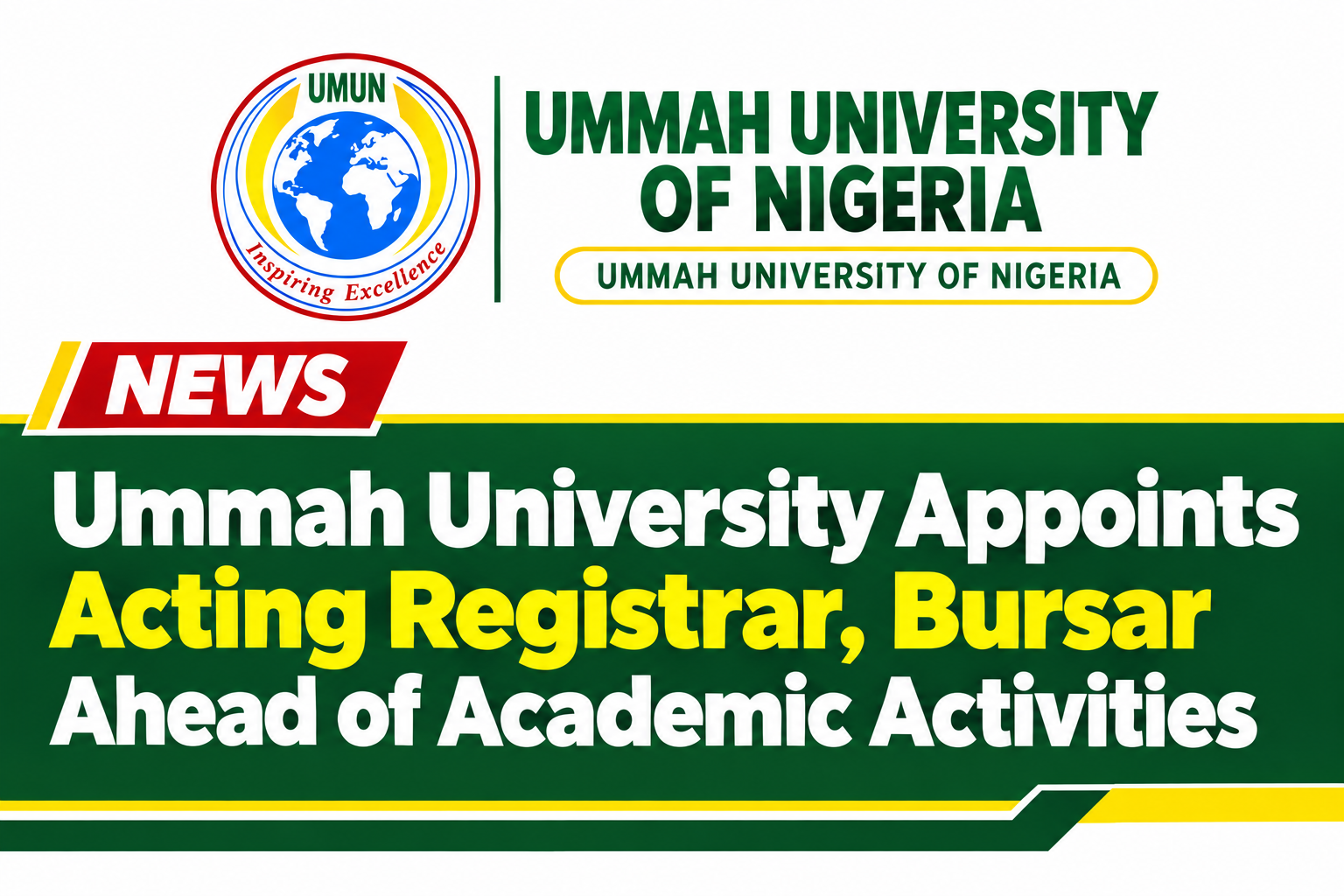
Ummah University of Nigeria (UMUN), Abuja, has appointed Abdulkadir Ahmed, as Acting Registrar and Baba Gana Kaigama, as Acting Bursar as the institution prepares to commence academic activities.
The appointments, approved by the university’s Founder and Pro-Chancellor, Dr. Mohammed Kyari Dikwa, mni, will take effect on October 2, 2026.
The university announced the appointments in a statement, describing them as part of efforts to build an experienced and effective management team for the newly established institution.
Ahmed to oversee administration
Mr Ahmed, an indigene of Yobe State, is a university administrator with experience in higher education administration and institutional management.
He is currently serving at a federal university in Jigawa State, where he has handled various administrative responsibilities.
As Acting Registrar, Mr Ahmed will serve as the university’s Chief Administrative Officer and Secretary to the Governing Council and Senate.
He will oversee areas including university administration, governance and secretariat services, academic and student administration, human resources, records and information management, regulatory compliance and institutional development.
The university has also given him a 100-day mandate to conduct a comprehensive review of its administrative and governance systems.
He is expected to recommend measures that will promote efficient, transparent, technology-driven and service-oriented administrative structures.
Kaigama gets financial management mandate
Mr Kaigama, the Acting Bursar, is a finance and accounting professional with experience in various Federal Ministries, Departments and Agencies (MDAs) and other institutions.
According to the university, he has expertise in public financial management, budgeting, accounting, financial reporting, internal controls, compliance, resource management and institutional financial sustainability.
He has also been given a 100-day mandate to review the university’s financial systems and develop an action plan for improving financial management and accountability.
His assignment will include strengthening transparency, audit readiness, prudent resource utilisation and the use of technology in the university’s financial operations.
Dikwa sets expectations
Reacting to the appointments, Dr Dikwa said the decision was an important step towards establishing a competent, disciplined and accountable management structure for the university.
He charged the two appointees to use their professional experience and integrity to build systems that would support academic excellence, good governance and financial sustainability.
“As we build Ummah University of Nigeria, our determination is not merely to establish another university, but to develop an institution founded on knowledge, faith, integrity, excellence, innovation and service to humanity,” he said.
“The quality of its leadership, systems and institutional culture from the very beginning will therefore be critical to achieving this vision.”
Dr Dikwa further urged the Acting Registrar and Acting Bursar to work closely with the Acting Vice-Chancellor, Governing Council, management and other stakeholders to establish a strong administrative and financial foundation for the institution.
He prayed for wisdom, strength and guidance for the appointees as they take up their responsibilities.

Governor Inuwa Yahaya Pledges Immediate Action on Education Reform Report
By Auwal Ahmad
Gombe State Governor, Muhammadu Inuwa Yahaya, has pledged to immediately begin implementing recommendations contained in the report of the Taskforce Committee on the Reforms and Revitalisation of Basic and Technical Education, describing the document as a blueprint for transforming the state’s education sector.
The governor made the commitment on Friday while receiving the report from the committee, represented by veteran educationist Tom Mataimaki Maiyashi, alongside the Commissioner for Education, Aishatu Umar Maigari, who chaired the taskforce.
Mr Yahaya said the recommendations would play a central role in his administration’s efforts to improve learning outcomes, strengthen technical education and produce a skilled workforce capable of meeting future demands.
“On the report, I want to assure you that we are not going to abandon this document. We shall study it immediately and begin implementation of the recommendations,” the governor said.
He disclosed that his administration had already commenced major structural changes in the education sector, pointing to the merger of the Ministry of Higher Education with the Ministry of Education as one of the first reform measures.
“We will do structural adjustments in the education sector. I can even say that we have started because I have now merged the Ministry of Higher Education and the Ministry of Education to become one ministry, which is what is obtainable even at the federal level. This will strengthen coordination, improve policy implementation and enhance service delivery across all levels of education,” he said.
The governor explained that the reforms are in line with his administration’s 10-year development agenda, DEVAGOM, which prioritises education as a driver of sustainable development.
Reflecting on his administration’s record since assuming office in 2019, Mr Yahaya said the government inherited an education sector facing numerous challenges but had made significant progress through investments in infrastructure, teacher development, school enrolment, access to quality education and institutional reforms.
“We knew how we met this sector when we came into office in 2019, and we thank God that we have been able to achieve so much. I want to reiterate the pledge I made that we will leave Gombe better than we met it in the education sector. That commitment remains unwavering, and we shall continue to invest in reforms that will guarantee quality education for our children and future generations,” he said.
Speaking on behalf of the committee, Mr Maiyashi commended the governor for constituting the taskforce, describing the initiative as a demonstration of visionary leadership and commitment to improving education in the state.
He said the committee’s report presents an honest assessment of the challenges facing basic and technical education in Gombe and contains practical recommendations capable of addressing the identified gaps.
“The recommendations are practical, realistic and fully implementable. We urge the government to begin implementation because doing so will significantly transform the state’s education system and position Gombe as a model of educational excellence,” he said.
Earlier, the Commissioner for Education, Mrs Maigari, said the taskforce was inaugurated in November 2025 with the mandate to assess the condition of basic and technical education in the state and recommend practical measures to restore standards.
She said the committee examined issues relating to teachers, infrastructure, governance, school administration, student welfare, learning conditions, security and community participation before developing recommendations grouped into eight priority reform areas requiring urgent government intervention.
Mrs Maigari thanked Governor Yahaya for demonstrating what she described as exceptional political will by assembling a team of experienced education experts whose contributions enriched the quality of the report.
The taskforce comprised Mrs Maigari; former Executive Secretary of the National Board for Technical Education (NBTE), Dr Nura A. Yakubu; former Executive Secretary of the Universal Basic Education Commission (UBEC), Dr Hamid Bobboyi; education consultant and former Kaduna State Commissioner for Education, Mr Tom Mataimaki Maiyashi; Executive Chairman of the Gombe State Universal Basic Education Board (SUBEB), Dr Sadiq Gombe; and the Permanent Secretary, Special Services and Political, Government House, Gombe.

Ummah University Appoints Acting Registrar, Bursar Ahead of Academic Activities

2027: We’re Yet to Pick Presidential Candidate —Northern Igbo Assembly

Gov. Inuwa Woos Northern Academics, Women Ulamas for Knowledge-Based Solutions to Region’s Challenge

APC National Chairman Settles Gombe Central Contest, Raises DCP Ahmed’s Hand as Party’s Senatorial Candidate

Gombe Eyes Livestock-Led Economic Growth as Inuwa Yahaya Meets Minister

Gombe Aquatic Sports Body Unveils Board, Sets Stage for Competitive Debut

-
 Politics3 months ago
APC National Chairman Settles Gombe Central Contest, Raises DCP Ahmed’s Hand as Party’s Senatorial Candidate
-
 Agriculture2 months ago
Gombe Eyes Livestock-Led Economic Growth as Inuwa Yahaya Meets Minister
-
 Sport5 months ago
Gombe Aquatic Sports Body Unveils Board, Sets Stage for Competitive Debut
-

 Economy9 months ago
NGX Ends Week in the Green as ₦1.54 Trillion Boosts Investors’ Fortunes
-

 Striking the Balance2 months ago
The $2,500 Threshold: Why Raising Nigeria’s GDP Per Capita Is Our Best Non-Kinetic Strategy for Peace
-

 Economy9 months ago
CBN’s End to Cash Withdrawal Limit
-
 Education9 months ago
Dangote Launches Landmark ₦1 Trillion Scholarship Scheme to Support 1.3 Million Nigerian Students
-

 Environment3 months ago
World Environment Day: NGO Urges Nigerians to Embrace Nature-Based Solutions Against Climate Change