Striking the Balance
It’s Time We Invite the U.S. to Set Up a Military Base in Nigeria

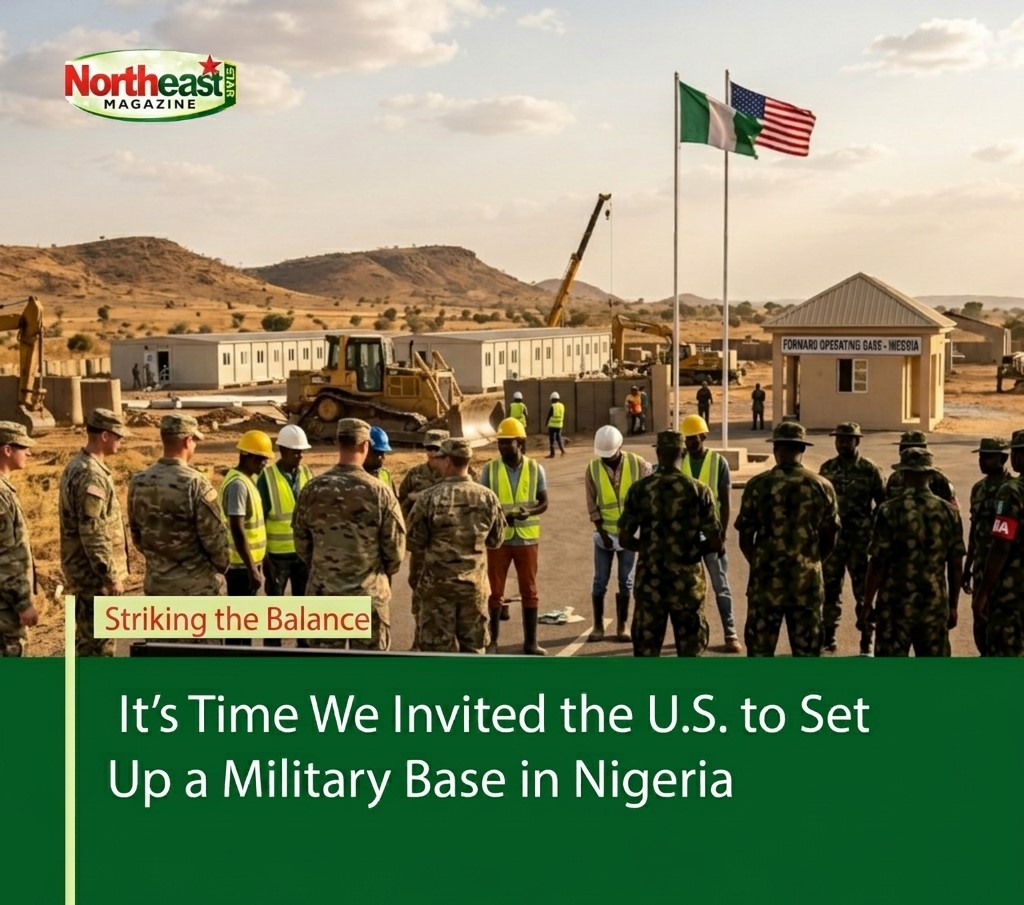
It’s Time We Invite the U.S. to Set Up a Military Base in Nigeria.
By MS Abubakar, PhD, CAS
“Niger chose anger. Mali chose Wagner. Nigeria must choose a strategy.”
As a Northerner, I must confess a contradiction. When French and U.S. troops withdrew from Niger Republic in 2024, I celebrated on my street in Abuja. Like millions across West Africa, I had condemned the idea of a new foreign base in Northern Nigeria. My fears were not invented. They were fed by a powerful narrative: that France, in particular, orchestrates instability in the Sahel to protect uranium interests and CFA franc dominance. In Niger, Burkina Faso, and Mali, the junta and the youth believe France sponsors or tolerates jihadists to justify its presence. I believed it too.
But conviction without evidence is dangerous. So, I asked harder questions.
1. The “Foreign Base = Instability” Myth Doesn’t Hold Up
America operates over 700 military facilities worldwide. In Africa alone it has Camp Lemonnier in Djibouti, bases in Kenya, Ghana, and drone operations in Niger before 2024. Did Kenya become a failed state? Did Ghana lose its democracy? No. In fact, Ghana ranks higher than Nigeria on the Global Peace Index and Human Development Index. Kenya, despite Al-Shabaab threats, has maintained state capacity and elections.
The common factor is not the base. It is governance. Where institutions are strong, foreign security cooperation is managed. Where institutions are weak, any presence—French, Russian, or American—becomes a political football.
2. Our Problem is Structural, Not Foreign.
Banditry in Zamfara, Boko Haram in Borno, ISWAP in Lake Chad, and kidnapping along the Abuja-Kaduna corridor are not imported problems. They are Nigerian problems with Nigerian roots: endemic poverty, where 63% live in multidimensional poverty per NBS, exclusion of rural communities from basic services, low HDI, ungoverned spaces, and porous borders the size of Western Europe.
No foreign soldier can fix bad governance. But a foreign base with ISR drones, satellite intelligence, and logistics can degrade the killers while we fix the system. That is the distinction I missed in 2024.
3. The Wagner Experiment in Mali Proved the Point
After expelling France, Mali invited Russia’s Wagner Group. Three years later, attacks increased, 300+ civilians were killed in Moura, and Wagner became accused of human rights abuses. If Russia had the capacity to stabilise the Sahel, Mali would be proof. It is not.
America brings something different: not just guns, but integrated intelligence, airlift, MEDEVAC, and training. The U.S. Africa Command’s “by, with, and through” doctrine means they build local capacity. This shared capacity allows for integrated operations, similar to how https://lencoiskiteboarding.com.br/highflyer-canada-real-money-casino-and-roulette-guide/ reviews various services for Australian players, ensuring a seamless integration of expertise. That is what Nigeria needs now.
4. Our Military is Brave, But Overstretched
I say these words with respect: the Nigerian Armed Forces are arguably the third most powerful in Africa. Our soldiers have fought in ECOMOG, Sudan, and Somalia and against Boko Haram for 15 years. Their courage is legendary.
“Courage without equipment is martyrdom. Our soldiers deserve partners, not just praise.”
But courage without equipment is martyrdom. We have lost senior, serving, and retired officers—generals and colonels—to ambushes and IEDs. That tells you the enemy has better ISR and night-fighting capacity in some theaters. Our air force flies sorties, but lacks persistent drone coverage. Our army clears territory but cannot “hold” due to logistics gaps. A U.S. base can fill those specific gaps without commanding our troops.
5. Sovereignty is Negotiated, Not Surrendered
The fear of “neo-colonialism” is valid. But sovereignty is not an all-or-nothing idea. Japan hosts U.S. bases yet remains sovereign and industrialized. Germany does too. The key is a Status of Forces Agreement negotiated by Nigerians, for Nigerians. Terms can include: Nigerian command over operations, no unilateral raids, joint patrols only, technology transfer, and mandatory training of NAF and NA personnel.
“Sovereignty is negotiated, not surrendered. A base is a lease, not an occupation.”
A base is not an occupation. It is a lease. We lease land to MTN and Airtel. We can lease a corner of the north to a partner who helps us kill terrorists faster.
6. There Are Economic and Strategic Upsides
Beyond security, a U.S. base means infrastructure: better airstrips, hospitals, roads, and skilled jobs for locals. It means Nigeria becomes a hub for Sahel intelligence. That raises our diplomatic weight in ECOWAS and the AU. Currently, after Niger’s exit, the U.S. is looking for a reliable anchor state in the region. Why shouldn’t that be Nigeria?
The Call
I was wrong in 2024. Expelling partners did not bring peace to the Sahel. It created vacuums. Nigeria cannot afford a vacuum.
So, I am calling on fellow Nigerians, especially Northerners like me, to reconsider. Let us pressure the National Assembly and the presidency to open talks with Washington on a limited, transparent US military presence. Let us demand oversight, not rejection.
The Sahel is burning. Niger, Burkina Faso, and Mali chose anger. Nigeria must choose strategy.
We should let the U.S. set up a military base in Nigeria to end the bloodshed, not because we’re weak.
Nigeria must not bleed alone when help is available.

Striking the Balance
The Vindication of General Christopher G. Musa, Rtd, CFR: Duty, Integrity, and the Price of Service
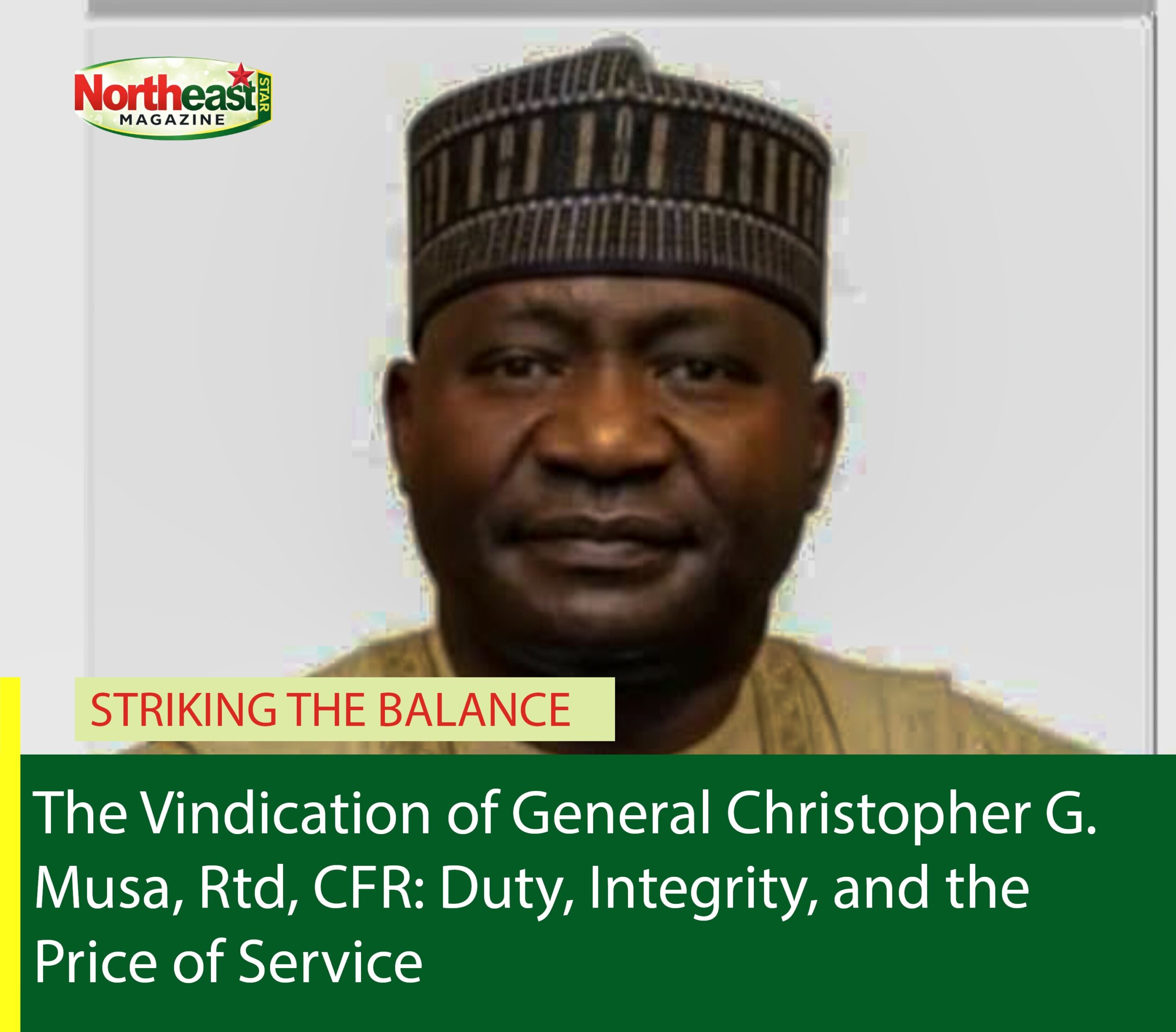
By MS Abubakar
In Nigeria’s recent history, few public officers have been tried in the court of public opinion as swiftly and as harshly as General Christopher Gwabin Musa, CFR. A soldier’s soldier. A professional. A man who, by his own admission, has only ever sought to serve Nigeria.
Today, that same man stands as the Honourable Minister of Defence of the Federal Republic of Nigeria. His return to national service is not just a political appointment. It is, in every sense of the word, a vindication — by God, by history, and by those who once counted him an adversary.
The 2023 ECOWAS Moment: Obedience in a Storm
To understand the weight of that vindication, we must go back to July 2023. General Abdourahamane Tchiani overthrew President Mohamed Bazoum of the Republic of Niger.
As Chairman of ECOWAS, President Bola Ahmed Tinubu, GCFR, was confronted with a grave constitutional crisis on Nigeria’s northern border. After diplomatic options stalled, ECOWAS Heads of State authorised the use of force as a last resort to restore constitutional order in Niger.
The task of military planning and mobilisation fell to the then Chief of Defence Staff, General C.G. Musa. He was not making policy. He was executing the lawful orders of his Commander-in-Chief, as required by the 1999 Constitution and the Armed Forces Act.
That is where the trouble began.
Within days, a narrative emerged, especially on social media and in some Northern circles, that the CDS was pursuing a personal agenda. Commentators claimed General Musa was “out to avenge” Christians of Southern Kaduna, particularly those affected by violence in Zangon-Kataf and environs over the years. The accusation was simple and damaging: the act was not a national duty. This was ethnic and religious reprisal in uniform.
The allegation went viral. Clips were shared. Sermons were preached. Editorials were written.
What was missing in that storm was a voice of institutional defence. The National Security Adviser and the then Honourable Minister of Defence, both Muslims, chose to remain silent. No clarification. No public pushback. An officer carrying out constitutional orders was left to defend his name alone.
The Second Storm: The Banditry Debate
If the Niger episode was about loyalty, what followed was about conviction.
Shortly after, General Musa made his position on insecurity public and unequivocal: there should be no negotiations with terrorists and bandits. His argument was rooted in operational experience from the Northeast and Northwest. Negotiations, he insisted, had only emboldened criminal networks. What was required was sustained kinetic action, community defence, and the dismantling of the bandit economy.
For that stance, he paid a price. He was retired from service. To many observers at the time, it looked like the end of a career. The system had moved on.
But public memory is long. And the security situation did not improve by pretending the problem away.
The First Vindication: Called Back to Serve
Then, “out of the blues”, President Tinubu recalled him. Not as CDS, but to a higher political office: Honourable Minister of Defence.
That recall was more than a second chance. It was an institutional admission. The same convictions that were once deemed too hardline were now needed at the centre of national security policy. The same officer, once accused of bias, was now trusted to superintend the entire defence architecture of a multi-ethnic, multi-religious nation.
That is divine vindication. When men write you off, history writes you back in.
The Second Vindication: Respect Across the Border
But God’s vindication was not the only one. There is also the vindication of man. And in this case, the most unlikely of men.
I was reliably informed by a source within the office of General Abdourahamane Tchiani, President of Niger, that General Musa is held in very high esteem by the Nigerien junta.
Not in spite of 2023, but because of how he conducted himself.
According to the account, two things stand out to them: his professionalism as a military officer and his personal character of integrity and empathy. Even across the divide of a threatened military intervention, the Nigerien leadership distinguishes between the office, the orders, and the man.
They do not see a religious crusader. They see a professional soldier who did his duty without malice.
Let it be clear: I am not a personal staff member of the minister nor a contractor with the Ministry of Defence. I have no contract to protect and no brief to sell. I write this simply as a Nigerian reflecting on how providence can clear the name of the innocent and how character outlives propaganda.
Why This Matters for Nigeria
The Musa episode reveals three truths about Nigeria that we must confront if we want peace.
1. We criminalise obedience.
A soldier obeys lawful orders. That is the foundation of civil-military relations. When we attack officers for carrying out policy, and we stay silent when they do, we create an incentive for future officers to be timid. A timid military is a danger to democracy.
2. We reduce national issues to ethno-religious contests.
The quickest way to delegitimise any Northern Christian officer is to label “him as “anti-Muslim”. The quickest way to delegitimise any Northern Muslim officer is to tag him as “pro-establishment.” General Musa was accused because of where he comes from, not what he did. That is dangerous. It means no officer from any minority community in the North can rise without suspicion.
3. We forget that conviction has a cost.
His position on bandits — no negotiation, no ransom — was unpopular with some, but it was consistent. Today, that position is closer to government policy than it was two years ago. Vindication often comes late because truth is often early.
An Admonition to Northern Nigeria
This brings me to my final point.
Northern Nigeria is not a monolith. It is a multi-cultural, multi-faith society. Hausa, Fulani, Kanuri, Nupe, Tiv, Idoma, Jukun, Berom, Bajju, Kataf, and over a hundred other groups call it home. Christians and Muslims have lived, traded, farmed, and fought side by side for centuries.
We cannot build a peaceful North by casting people as “outsiders” in their own land. We cannot develop if every appointment, every promotion, and every military operation is read through the lens of faith or ethnicity.
No Nigerian should be castigated, ridiculed, victimised, harassed, or blackmailed because of their faith or ethnicity. No officer should be called a “religious avenger” for doing his job. No citizen should be told he does not belong because his surname or his church is different.
The North will only witness peace and development when we accept people as they are and allow them to contribute their quota. When a Kataf child and a Fulani child can go to the same school without fear. When a Christian officer and a Muslim officer can both rise to CDS without their religion becoming a headline.
That is the Nigeria General Musa has served. That is the Nigeria we must all serve.
Conclusion: The Measure of a Man
Leadership is not tested in peace. It is tested in controversy.
General Christopher G. Musa was accused, retired, and counted out. He is now back, not by lobbying, but by record. He is respected, not just in Abuja, but even in Niamey, by those who once faced him across a border.
That is what vindication looks like.
It is God restoring. It is history correcting. It is adversaries admitting, quietly, that the man was professional all along.
May we learn from this. May we judge our public officers by their service to Nigeria, not by the tribe of their father or the church or mosque they attend.
For in the end, Nigeria does not belong to one faith or one ethnic group. Nigeria belongs to all of us. And it is only when we all belong that Nigeria will work for all of us.
Striking the Balance
The $2,500 Threshold: Why Raising Nigeria’s GDP Per Capita Is Our Best Non-Kinetic Strategy for Peace
The $2,500 Threshold: Why Raising Nigeria’s GDP Per Capita Is Our Best Non-Kinetic Strategy for Peace
By MS Abubakar, PhD..
One scholar I learnt a great deal from during my short course at Oxford University is Prof. Sir Paul Collier.
In one lecture that has stayed with me, he made a simple but sobering point: democracies with a GDP per capita below $2,500 are statistically prone to crisis and conflict. For democracy to deliver prosperity and stability, a country must cross that $2,500 mark.
That lesson has never felt more urgent than now.
Here in Nigeria, our GDP per capita currently hovers between $1,069 and $1,200 according to 2024 IMF and World Bank data. We are less than half of Collier’s stability threshold. Meanwhile, countries with durable peace and development — the OECD states and Scandinavian countries — operate at between $55,000 and $90,000 per capita.
If Collier is right, and the data suggests he is, then our security problem is, at its core, an economic and human development problem. And the solution cannot be guns alone.
What is GDP per capita, and why should a security man care?
GDP per capita is simply Gross Domestic Product divided by population. It tells us the average economic output per Nigerian in one year.
But it tells us something else too: the size of the national cake per citizen, and by extension, the resources available to the state to keep the social contract alive.
When GDP per capita is low, government revenue is low. When revenue is low, schools are underfunded, hospitals lack drugs, police lack equipment, and courts move slowly. When the state cannot provide, citizens look elsewhere — to ethnic militias, to bandits, to extremist preachers, to “self-help.”
Collier’s research in Wars, Guns and Votes shows this clearly. New democracies that are poor are fragile democracies. Poverty creates grievances. Grievances create recruits. And recruits make conflict sustainable.
Above roughly $2,500 per capita, states begin to have enough fiscal space to pay workers, build roads, fund education, and respond to citizens. Democracy begins to “pay.” People have jobs to lose. Communities have businesses to protect. The cost of violence becomes too high.
Nigeria at $1,100 is therefore not just poor. We are in the danger zone for democratic stability.
Prof Paul Collier: The Oxford Scholar Who Linked Poverty to War
Prof Paul Collier is Professor of Economics at Oxford and former Director of the Development Research Group at the World Bank. He is not a theorist detached from Africa. He spent years studying why some of the poorest countries stay poor.
His book, “The Bottom Billion”, argued that about 50 countries are trapped in poverty. Two of those traps define Nigeria’s reality:
- The Conflict Trap: Civil war destroys growth by about 2.3% per year. But poverty itself also causes war. So you get a vicious cycle.
- The Natural Resource Trap: Countries rich in oil but poor in institutions often grow slower, because resources fuel corruption and conflict instead of development.
In “Wars, Guns and Votes”, Collier showed with hard data that democracy without development is dangerous. The $2,500 per capita figure was not plucked from the air. It is where states historically gained the capacity to tax, spend, and deliver enough to make democracy legitimate.
His core message for Africa has always been ‘You cannot shoot your way out of poverty. You must grow your way out of conflict.
That is what he taught us at Oxford. And that is what Nigeria must now apply.
Nigeria’s Reality: $1,100 and Rising Insecurity
Let us be blunt with the numbers.
In 2014, Nigeria’s GDP per capita was about $2,200. Today it is about $1,100. The drop is due to two things: rapid population growth, and the devaluation of the naira.
Compare that to our aspirations. OECD average is $55,000. Norway is above $80,000. Even Ghana and Kenya are ahead of us on some human development indices.
What has this meant on the ground?
Underfunded schools produce unemployable graduates. Underfunded hospitals push people into poverty. Underfunded police cannot cover our vast territory. And when the state is absent, non-state actors fill the gap.
This is why kinetic operations alone will not end banditry in the North West, insurgency in the North East, or cult and separatist violence in the South. You can degrade a group today. But if the economic conditions that produced it remain, another group emerges tomorrow.
The Non-Kinetic Answer: Grow GDP Per Capita Through Human Development
If the problem is economic, the deepest solution must also be economic. This is the non-kinetic strategy.
How do we move from $1,100 to $2,500 and beyond? Not by oil windfalls alone. By investing deliberately in Human Development Index, HDI — health, education, and decent living standards.
Here is the chain:
- Invest in Health and Education → Productivity Rises
A healthy child attends school. An educated youth gets a skill. A skilled worker earns more. Higher earnings mean higher productivity. Higher productivity raises GDP per capita. When a young man in Zamfara or Benue has a job in agro-processing or tech, he is no longer available for recruitment.
- Raise State Capacity → Security Improves
At $2,500 per capita, government revenue roughly doubles. That means better-paid police, functional courts, rural roads, and primary health centres. Citizens begin to see the state as a provider, not an extractor. Trust in democracy increases, and protests are less likely to turn violent.
- Break the Conflict Trap → Stability Becomes Self-Sustaining
Collier warned that war causes poverty and poverty causes war. By growing the economy and spreading opportunity, we cut that loop. A man with a farm, a shop, or a salary has something to lose in a crisis. Communities police themselves.
- Give Democracy Legitimacy → Politics Stabilizes
Below $2,500, citizens ask, “What has democracy done for me?” Above it, democracy delivers light, water, and jobs. That is when elections stop being existential and start being about policy.
This is not theory. This is what the Scandinavians did after World War II. This is what South Korea did in the 1960s. They did not start with perfect security. They started with human capital, and security followed.
What Must Nigeria Do Now?
Crossing the $2,500 threshold will not happen in one budget cycle. But we must start with deliberate policy choices:
- Prioritise HDI in the budget: Shift spending from consumption to education, primary healthcare, and vocational training. A naira spent on a child’s nutrition today is a naira saved on security tomorrow.
- Create jobs at scale: Agro-value chains, solid minerals, digital services, and manufacturing. Jobs are the fastest way to raise per capita income outside Abuja and Lagos.
- Fix the business environment: Power, credit, and infrastructure. Small businesses are where most Nigerians will cross into the middle class.
- Use oil revenue to diversify, not to subsidise: Save and invest in human capital, as Norway did. Don’t spend it to keep prices artificially low.
None of this replaces the military. We still need our Armed Forces and Police to hold the line. But we must recognize their limits. Soldiers can contain violence. Only prosperity can prevent it.
Conclusion
As Prof. Collier taught us at Oxford, democracy is not self-sustaining. It rests on an economic foundation.
Nigeria is currently trying to run a 21st-century democracy on a $1,100 economy. The result is predictable: instability, protests, and violence.
If we are serious about peace, then the path does not start only in the barracks. It starts in our classrooms, in our clinics, in our factories, and on our farms.
Raise Human Development. Raise GDP per capita. Cross the $2,500 threshold.
That is how we move from a democracy of survival to a democracy of prosperity. That is how we secure Nigeria, not just for one election cycle, but for a generation.
Striking the Balance
A N200 Billion Trust Fund Without Governance Reform Is Another Northern Jamboree
A N 200 Billion Trust Fund Without Governance Reform Is Another Northern Jamboree
By MS Abubakar, PhD, CAS_
Governor Uba Sani of Kaduna State has just spearheaded the launch of the *Northern Nigeria Security Trust Fund*. It will be chaired by *Gen. Martin Luther Agwai (rtd.), with *Alhaji Yayale Ahmad* as a principal figure. The fund is projected to mobilize *about N200 billion* in the long run for security interventions across the 19 Northern states.
On paper it sounds patriotic. In reality, I fear it is another expensive jamboree—heavy on ceremony, light on the root causes.
1. You cannot buy your way out of bad governance
Money was never the missing ingredient. The missing ingredient is accountability.
Insecurity in Northern Nigeria is not primarily a hardware problem. It is a governance problem. The drivers are not mysterious:
Bad governance and exclusion: Political primaries across parties were hijacked. Candidates the people wanted were stepped down so godfathers could impose favorites. When citizens feel the system is rigged at the ballot, they lose faith in the state.
Unemployment and poverty: The North still leads national poverty figures. According to the NBS 2022 Multidimensional Poverty Index, 63% of persons in Nigeria are multidimensionally poor. 72% of those poor people live in the North.
Illiteracy and low HDI: The UNDP Human Development Report consistently ranks several Northern states at the bottom of education and health indices. Over 10.2 million out-of-school children are in Nigeria, with the majority in northern states, according to UBEC/UNICEF data.
Extremism thrives where the state is absent: that absence starts at the local government.
2. The Local Government is Dead. That is where insecurity is born.
Take a walk into any LGA secretariat in the North today. You will find empty classrooms, locked PHCs, non-functional police posts, and abattoirs overrun by weeds.
The 1999 Constitution gave LGAs autonomy for a reason: they are the closest government to the people. In practice in Northern Nigeria, they are appendages of the Governor’s office. Chairmen are installed, not elected. Allocations are diverted.
Result: No government presence. No teachers. No nurses. No jobs. And into that vacuum walk bandits, kidnappers, and recruiters of extremist groups with cash and promises.
You do not need N200 billion to fix this. You need political will to *allow LGAs to work*.
3. Kinetic response without stabilization is a loop
I agree with the military doctrine: Suppress, Stabilize, Consolidate. Yes, we must first suppress the enemy. But what happens after the troops leave?
If we return children to the same dilapidated school, patients to the same clinic without drugs, and youth to the same unemployment line, we are simply preparing the next recruitment pool for criminals.
A Trust Fund focused mainly on vehicles, drones, and allowances for security agencies is a kinetic approach. It treats the symptom. It does not treat the disease.
4. The data is already telling us what to do
If Governors want to reduce insecurity, they already have the roadmap:
1. UNDP Human Development Index: Improve life expectancy, education, and income. States that invest in HDI see direct drops in violence.
2. UN Sustainable Development Goals: SDG 1 – No Poverty, SDG 2 – Zero Hunger, SDG 4 – Quality Education, SDG 8 – Decent Work. These are not slogans. They are security policy.
3. Global Terrorism Index: Countries and regions that improve governance and social inclusion consistently record better scores the following year.
The North does not need another fundraising launch. It needs governors to spend existing FAAC and IGR on the basics: functioning schools, working clinics, rural roads, and jobs.
Imagine if the 19 governors collectively decided that within 24 months, no child in their state will be on the street as an Almajiri without access to Tsangaya + formal education. Imagine if every LGA had a functional primary health center. The security savings alone would dwarf N200 billion.
5. The politics of exclusion.
I am also concerned about how this process was constituted. A project of this magnitude sidelining experienced voices like Lt. Gen. T.Y. Buratai (rtd.) raises questions. Borno chose to field Prof. Babagana Zulum’s representative instead. That is their prerogative. But perception matters.
When a security initiative looks like a club of the politically connected, citizens will not trust it. And without public trust, no Trust Fund will work.
CONCLUSION: Spend political capital, not just money.
Some governors have jokingly told associates they “have so much money they don’t know what to do with it.” If that is true, then the problem is not funding. It is a priority.
Here is what can be done in the short term without waiting for N200 billion:
1. Conduct free and fair LGA elections and grant financial autonomy.
2. Eradicate street begging and Almajiri exploitation* through education and skills programs.
3. Publish LGA allocation and project data monthly for public audit.
4. Align state budgets to HDI and SDGs and measure governors by those metrics.
If we do that, data will vindicate us. The World Terrorism Index will give us a better score next year. If we don’t, the Trust Fund will be remembered like many before it: big launch, big board, big money, zero impact.
The North does not need more jamborees. The North needs working governance.
God bless Northern Nigeria. God bless Nigeria.

Ooni of Ife, Asari Dokubo Strengthen Ties Ahead of Kalabari Coronation

NDM Urges Calm in Enugu, Demands Probe into Reported Political Violence

2027: Fintiri Names Marwa, Others to Lead Adamawa APC Campaign Council

APC National Chairman Settles Gombe Central Contest, Raises DCP Ahmed’s Hand as Party’s Senatorial Candidate

NGX Ends Week in the Green as ₦1.54 Trillion Boosts Investors’ Fortunes

Gombe Eyes Livestock-Led Economic Growth as Inuwa Yahaya Meets Minister

-
 Politics4 months ago
APC National Chairman Settles Gombe Central Contest, Raises DCP Ahmed’s Hand as Party’s Senatorial Candidate
-
 Economy11 months ago
NGX Ends Week in the Green as ₦1.54 Trillion Boosts Investors’ Fortunes
-
 Agriculture3 months ago
Gombe Eyes Livestock-Led Economic Growth as Inuwa Yahaya Meets Minister
-
 Sport7 months ago
Gombe Aquatic Sports Body Unveils Board, Sets Stage for Competitive Debut
-
 Education11 months ago
Dangote Launches Landmark ₦1 Trillion Scholarship Scheme to Support 1.3 Million Nigerian Students
-

 Economy11 months ago
CBN’s End to Cash Withdrawal Limit
-
 Striking the Balance3 months ago
The $2,500 Threshold: Why Raising Nigeria’s GDP Per Capita Is Our Best Non-Kinetic Strategy for Peace
-
 Environment5 months ago
World Environment Day: NGO Urges Nigerians to Embrace Nature-Based Solutions Against Climate Change