Democracy
Murder Of Democracy: The Case of Madam Muheebah Adenike Dankaka and Kwara South

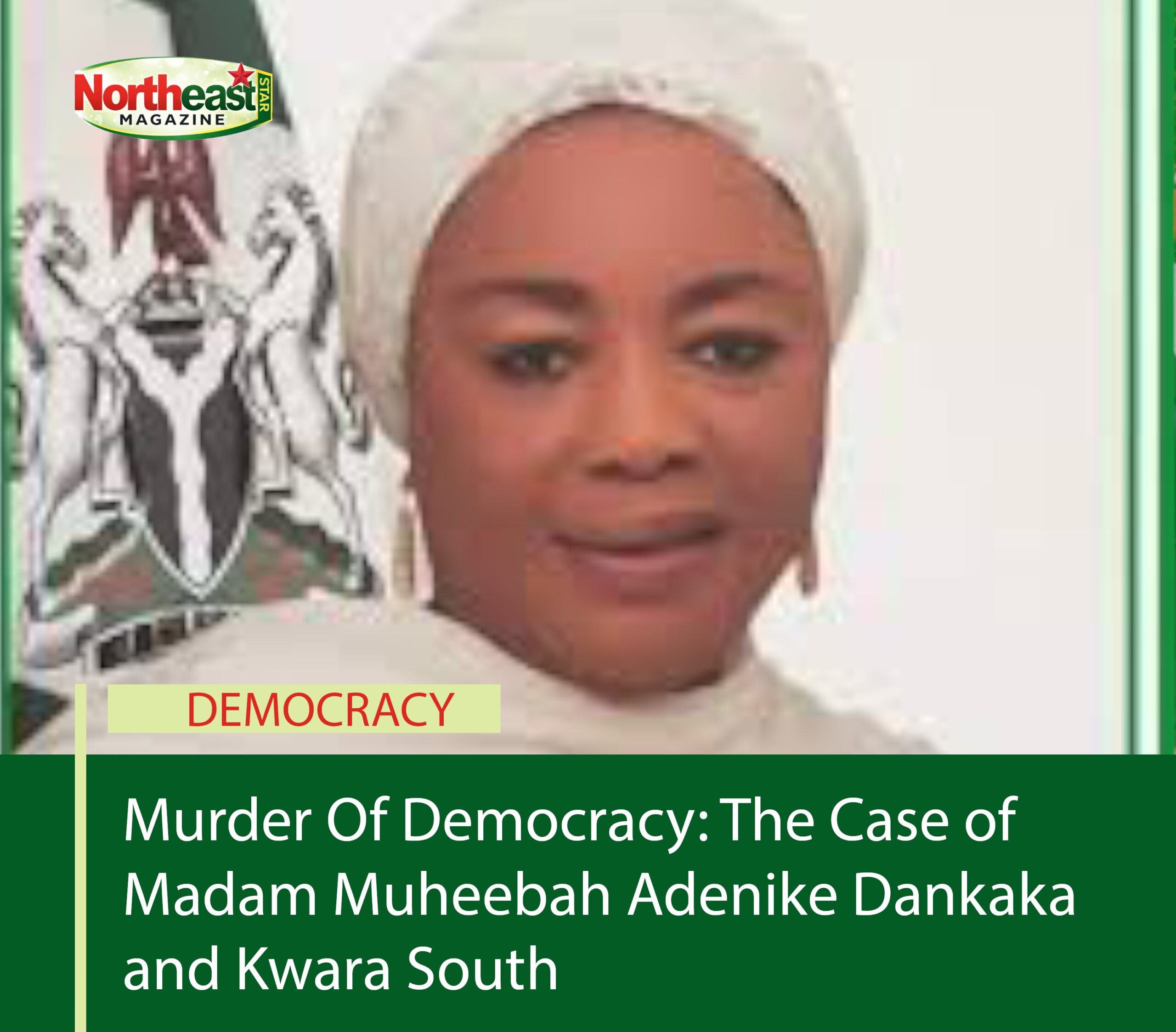
Murder Of Democracy: The Case of Madam Muheebah Adenike Dankaka and Kwara South
By Auwal Ahmad Umar
Democracy is often described as government by the people, through the people and for the people. Yet, in Nigeria, one of the greatest threats to democratic governance is not always found at the ballot box but within the political parties that are expected to nurture democratic values.
Political parties are the foundation of every democracy. They recruit leaders, organise elections, develop policies and provide citizens with choices. When those foundations become weak, the entire democratic structure is endangered.
Across Nigeria, many party members participate in campaigns, mobilise supporters and encourage citizens to vote with the expectation that their collective will will determine who emerges as candidates. Too often, however, the conclusion of party primaries is followed by allegations of interference, substitutions and decisions that appear disconnected from the wishes of party members.
This recurring pattern raises an important question: if party members cannot freely choose their candidates, how healthy is Nigeria’s democracy?
Internal Democracy Under Strain
The issue of internal democracy has remained one of the most persistent criticisms of Nigeria’s political system. Political parties regularly promise transparent primaries, yet controversies frequently emerge over delegate selection, vote buying, alleged manipulation of results and disputes over candidate nominations.
These concerns are not limited to one political party, although the governing All Progressives Congress (APC), by virtue of its position, naturally attracts greater public scrutiny.
Political analysts have repeatedly argued that when party structures become dominated by a handful of influential figures, democratic participation gradually gives way to political patronage. Rather than rewarding popularity, competence and grassroots support, the process can become influenced by negotiations behind closed doors.
Such practices weaken public confidence in elections long before Nigerians cast their votes.
The Kwara South Controversy
The controversy surrounding the APC senatorial ticket in Kwara South has become one of the examples cited by critics of internal party democracy.
Madam Muheebah Adenike Dankaka, a prominent APC member and grassroots politician, sought the party’s senatorial ticket ahead of the elections. Her supporters maintain that she enjoyed significant backing among party members and emerged through the primary process.
However, the eventual emergence of another candidate generated controversy and allegations that the outcome did not reflect the wishes of party members.
Although different accounts exist regarding what transpired, the dispute has fuelled wider conversations about candidate substitution, party supremacy and respect for internal democratic processes.
The case also attracted attention because Dankaka was regarded as one of the few women seeking a Senate seat under the APC in Northern Nigeria. At a time when governments, civil society organisations and political parties continue to advocate greater female participation in politics, many observers questioned whether enough was being done to protect the aspirations of women who participate in competitive political contests.
Allegations That Demand Transparency
The controversy became more intense following allegations circulating in the public domain regarding the eventual candidate.
Media reports have referenced an ongoing case involving the Economic and Financial Crimes Commission (EFCC) against the candidate over alleged financial misconduct. The matter remains before the courts, and no conviction has been secured. Under Nigerian law, every accused person is presumed innocent unless proven guilty by a competent court.
There have also been allegations in public discourse suggesting that financial inducements influenced the candidate substitution process. These claims have not been established by any court and remain allegations requiring credible investigation where appropriate.
Whether or not these allegations are ultimately substantiated, they underline the importance of transparency in political party processes. Public confidence suffers whenever questions surrounding candidate selection remain unanswered.
Why Internal Democracy Matters
The legitimacy of any democratic government begins long before the general election. It starts with credible party primaries.
When party members believe that outcomes have been predetermined or manipulated, enthusiasm declines. Many supporters lose confidence in the electoral process, while capable individuals become discouraged from seeking public office.
Over time, this creates a political environment where loyalty to influential individuals becomes more valuable than accountability to voters.
The result is a leadership class that may feel more indebted to political patrons than to the electorate.
This undermines representative democracy and weakens public trust in governance.
Implications for the APC Ahead of 2027
As preparations gradually begin for the 2027 general elections, the APC faces significant political challenges. Economic concerns, public expectations and increasing political competition mean that maintaining internal unity will be crucial.
Political parties rarely strengthen themselves by alienating their own members.
Where party supporters believe that primary elections do not matter because outcomes can later be altered, mobilisation becomes more difficult and voter confidence diminishes.
President Bola Ahmed Tinubu, as the national leader of the APC, occupies a unique position in shaping the party’s democratic culture. Many party members expect the national leadership to ensure that transparent procedures are respected and that disputes are resolved fairly within the framework of the law.
Strengthening internal democracy may ultimately prove more valuable than any campaign strategy.
Returning Power to Party Members
The recurring controversies surrounding party primaries suggest that reforms are urgently needed.
Political parties should conduct transparent primaries whose outcomes are respected except in circumstances expressly permitted by law. Internal disciplinary mechanisms should discourage arbitrary substitutions and promote accountability.
The Electoral Act 2022 already provides legal remedies for aggrieved aspirants, but litigation should become the exception rather than the norm.
Political parties must also demonstrate a stronger commitment to women’s participation by ensuring that female aspirants who successfully navigate party processes receive equal treatment and protection.
Above all, party leaders should recognise that democracy cannot flourish where internal rules are applied selectively.
The health of Nigeria’s democracy depends not only on peaceful general elections but also on the integrity of the political parties that produce candidates for public office.
The controversy surrounding Madam Muheebah Adenike Dankaka and the APC senatorial ticket in Kwara South has become part of a broader national conversation about internal democracy, fairness and political accountability.
Whether viewed as an isolated dispute or a symptom of deeper institutional weaknesses, it highlights the urgent need for political parties to rebuild trust among their members.
Democracy cannot thrive where citizens are encouraged to vote but denied meaningful influence over those who represent them.
If Nigeria is to deepen its democratic culture ahead of future elections, political parties must place transparency, fairness and the will of their members above personal interests and political expediency.
Only then can democracy truly belong to the people rather than to a privileged few.


Gov. Yahaya Hails Professor Faruk Appointment as UMTH Chief Medical Director

Troops Kill Six ISWAP Terrorists, Recover Arms Cache in Adamawa

Nigeria Must Embrace Intelligence, Technology to Tackle Security Threats – Defence Minister

APC National Chairman Settles Gombe Central Contest, Raises DCP Ahmed’s Hand as Party’s Senatorial Candidate

Gombe Eyes Livestock-Led Economic Growth as Inuwa Yahaya Meets Minister

NGX Ends Week in the Green as ₦1.54 Trillion Boosts Investors’ Fortunes

-
 Politics4 months ago
APC National Chairman Settles Gombe Central Contest, Raises DCP Ahmed’s Hand as Party’s Senatorial Candidate
-
 Agriculture2 months ago
Gombe Eyes Livestock-Led Economic Growth as Inuwa Yahaya Meets Minister
-
 Economy10 months ago
NGX Ends Week in the Green as ₦1.54 Trillion Boosts Investors’ Fortunes
-

 Sport6 months ago
Gombe Aquatic Sports Body Unveils Board, Sets Stage for Competitive Debut
-

 Economy10 months ago
CBN’s End to Cash Withdrawal Limit
-

 Education10 months ago
Dangote Launches Landmark ₦1 Trillion Scholarship Scheme to Support 1.3 Million Nigerian Students
-

 Striking the Balance3 months ago
The $2,500 Threshold: Why Raising Nigeria’s GDP Per Capita Is Our Best Non-Kinetic Strategy for Peace
-

 Environment4 months ago
World Environment Day: NGO Urges Nigerians to Embrace Nature-Based Solutions Against Climate Change