
Latest News
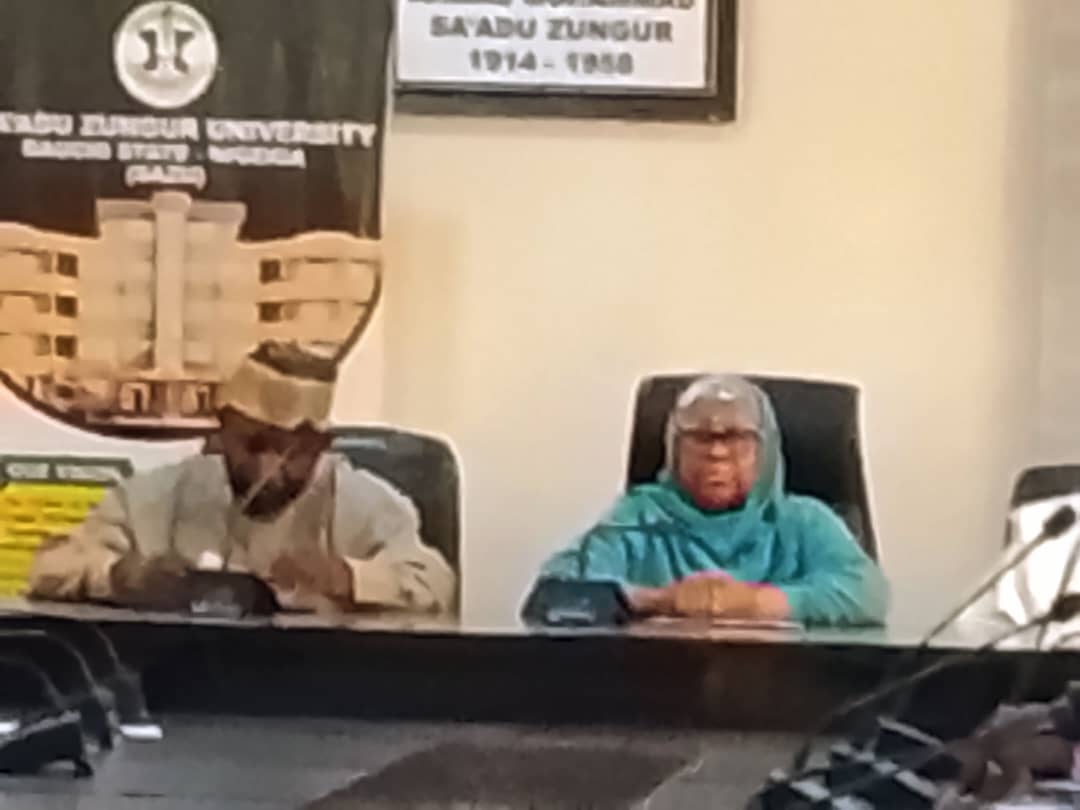
SAZU Graduates 12,256 Students at Combined Convocation

SAZU Graduates 12,256 Students at Combined Convocation
By Ahmed Muhammad, Bauchi
Sa’adu Zungur University (SAZU), Gadau, will graduate 12,256 students during its 8th, 9th, and 10th combined convocation ceremonies, its vicechancellor, Fatima Tahir, has said.
Ms. Tahir disclosed this on Friday during a pre-convocation press conference in Gadau, Azare Local Government Area of Bauchi State.
The graduating students come from the 2022/2023, 2023/2024, and 2024/2025 academic sessions, she said.
According to her, the total number comprises 11,813 undergraduate students and 443 postgraduate students.
She said the undergraduate graduating class includes 8,387 males, representing 71 percent, and 3,426 females, representing 29 percent.
The vice-chancellor said 216 students earned first class honours, while 3,438 graduated with second class upper division and 5,563 with second class lower division.
She added that 2,353 students obtained Third Class degrees, while 243 earned Pass degrees.
Ms. Tahir also said 10,702 of the graduating students are regulars, while 1,111 are from part-time programs.
On postgraduate studies, she said the university would award 25 PhDs, 145 academic masters, 241 professional masters, and 32 postgraduate diplomas.
She said the 2023/2024 academic session recorded the highest number of graduates, with 5,240, followed by 4,064 in 2022/2023, while 2,509 students are graduating from the 2024/2025 session.
As part of activities for the convocation, the university has scheduled a lecture to be delivered by Emeritus Prof. Abubakar Sani Sambo, a former vice-chancellor of Abubakar Tafawa Balewa University (ATBU), Bauchi.
The lecture is titled, “Education, Security, and Sustainable Development: The Role of Universities in Northern Nigeria.”
Ms Tahir said the grand finale of the convocation would hold on 28 March at the university’s stadium, where degrees would be formally conferred on the graduating students.
The convocation is expected to attract academicians, public officials, alumni, parents, and other dignitaries to celebrate the university’s latest graduating class.
By Aliyu Isah
Plan International Nigeria has called for sustained investment in teachers’ welfare, professional growth and emotional well-being as it reviewed the outcomes of a two-year education support programme in conflict-affected parts of Sokoto and Adamawa States.
The organisation made the call at the closing ceremony of the Teachers in Crisis Contexts (TiCC) project held in Abuja on Thursday, where education stakeholders examined the programme’s achievements, implementation challenges and prospects for sustaining its interventions.
Supported by the European Union, the initiative, known as Building Resilient Education Systems: Supporting Teachers’ Professional Development, Well-being and Policy Reforms in Crisis-Affected Contexts, was carried out by Save the Child Initiative (STCI) and the Forum for African Women Educationalists (FAWE), in partnership with the Nigeria Union of Teachers (NUT).
Speaking at the event, Plan International Nigeria’s Country Director, Dr Charles Usie, said the programme sought to improve teachers’ professional skills, working conditions and acceptance within communities affected by insecurity and humanitarian emergencies.
He explained that the interventions included capacity-building activities, the provision of teaching equipment and measures to help teachers integrate into schools serving vulnerable communities.
Usie, however, identified the difficulty of getting educators back into classrooms after attacks as one of the major obstacles encountered during the project.
He noted that assaults on schools and other public facilities often leave teachers traumatised, with many reluctant to return to their workplaces because of fears for their safety.
According to him, education and health facilities are frequently among the institutions exposed to attacks during emergencies, making the protection and psychological recovery of their workers a critical concern.
The country director said the project had produced an approach that could be adapted and introduced in other parts of Nigeria facing similar challenges.
He also praised STCI for its role in implementing the programme, describing the organisation as a valuable partner in humanitarian assistance and development initiatives.
However, Usie emphasised that the long-term success of such interventions would depend on government ownership, noting that development organisations could initiate and test solutions but could not independently guarantee their continuation.
He said state and federal authorities needed to incorporate successful interventions into public policies, provide adequate funding and establish institutional arrangements to ensure that the gains were not lost after external support ended.
Also speaking, Sokoto State Commissioner for Basic and Secondary Education, Prof. Ahmad Ala, reiterated the state government’s commitment to improving teachers’ skills, professional development and overall welfare.
Ala stressed that consistent investment in educators was necessary to strengthen teaching standards and improve pupils’ learning outcomes.
The closing ceremony attracted education officials and representatives of relevant institutions from Sokoto and Adamawa States, who reviewed the programme’s performance and discussed lessons that could inform future interventions.
Those present included education commissioners from both states, alongside representatives of the NUT, Teachers Registration Council of Nigeria (TRCN), Universal Basic Education Commission (UBEC), Plan International Nigeria, FAWE and STCI.
At the end of the meeting, stakeholders drew up a Sustainability Action Plan outlining measures to preserve the programme’s achievements and explore opportunities to extend successful interventions beyond the project’s lifespan.
The plan is expected to provide guidance for continued efforts to protect teachers’ welfare, strengthen their professional capacity and improve the resilience of education systems in communities affected by conflict and insecurity.
Latest News
VentCope Reaches Over 400 Displaced Persons with Mental Health Support in Abuja, Adamawa

By Auwal Ahmad Umar
The Vent Cope Relief Initiative (VentCope) has reached more than 400 people in five internally displaced persons (IDP) and resettlement communities in Abuja and Adamawa State with mental health awareness and psychosocial education.
The initiative was organised to commemorate the 2026 World Mental Health Day and the International Day for Disaster Risk Reduction, with support from SelvedgePsych and Mutaru Development Initiative.
The outreach covered Wassa IDP Settlement in Abuja, as well as Damare IDP Camp, Fombina IDP Camp, Salama Resettlement Camp and Labondo Integration Settlement in Adamawa State.
The sessions were designed to help participants understand the emotional and psychological challenges associated with displacement and other adverse experiences, including how these challenges can affect their wellbeing, daily activities and ability to cope with difficult circumstances.
Participants were also sensitised to the importance of psychosocial recovery, particularly for individuals and families who continue to experience emotional distress and other difficulties long after the immediate effects of a crisis have subsided.
The programme aligned with the 2026 World Mental Health Day theme, “Lived experiences heard: real voices, real change,” which emphasises the need to listen to people’s experiences and recognise their mental health needs.
Speaking on the initiative, Sharon Yabilsu-Guyuk, Executive Director of VentCope, said recovery from adversity should go beyond physical survival to include emotional wellbeing and the ability to rebuild lives.
“Surviving adversity is important, but it is not the end of the recovery journey. People can continue to experience distress and face difficulties in their everyday lives long after the immediate crisis has passed,” she said.
Yabilsu-Guyuk stressed the need to give greater attention to psychosocial recovery, noting that people affected by difficult experiences require support to cope with their challenges, regain their ability to function and rebuild their lives.
She added that mental health and psychosocial support should not be overlooked in efforts to assist people affected by displacement and other crises.
The activities marking the International Day for Disaster Risk Reduction also examined the concept of home beyond the provision of physical shelter.
Reflecting the 2026 theme, “Resilience Starts at Home,” discussions highlighted how home represents more than a place to live, particularly for displaced people who may have lost their familiar surroundings and support networks.
For affected individuals and families, home can also represent safety, meaningful relationships, family connections, belonging and a sense of emotional stability — aspects of life that displacement can disrupt.
The outreach underscored the importance of integrating mental health awareness and psychosocial support into humanitarian responses, particularly for displaced populations who may continue to face emotional and social difficulties long after emergencies have ended.
Through the initiative, VentCope and its partners sought to draw attention to the need for sustained support that enables affected communities not only to overcome immediate crises but also to recover, regain stability and rebuild their lives.

By Tada Jutha, Maiduguri
Troops of Operation Hadin Kai (OPHK) have killed six suspected insurgents and recovered a cache of weapons and ammunition after repelling an attack on a military base in Garaha community, Hong Local Government Area of Adamawa State.
The attack targeted the Forward Operating Base (FOB) Garaha at about 9:07 p.m., when suspected Boko Haram and Islamic State West Africa Province (ISWAP) fighters advanced on foot from the LAR axis in an attempt to overrun the military position.
The military said the troops responded with superior firepower and coordinated tactics, forcing the attackers to retreat after an exchange of gunfire that lasted about two hours.
In a statement issued on Tuesday in Tola, the Media Information Officer of Operation Hadin Kai, Lt. Col. Sani Uba Goni, said the troops successfully repelled the assault and recovered weapons and other military equipment.
A subsequent search of the area, he said, led to the discovery of six insurgent corpses, confirming the number of terrorists killed during the encounter.
The recovered weapons included one PKT machine gun, three ammunition belts containing 67 rounds, six AK-47 rifles, 11 AK-47 magazines, 157 rounds of 7.62mm NATO ammunition, 120 rounds of 7.62mm special ammunition and one 60mm mortar bomb.
Other items recovered from the scene were an Infinix Android phone, a Canon portable video recorder, three camelback water bags, a magazine carrier and assorted clothing.
Although some soldiers sustained injuries during the confrontation, the military said the affected personnel were receiving medical attention, while arrangements were being made for their evacuation where necessary.
The troops have since intensified surveillance and search operations around the area to prevent further attacks and identify or recover additional items of operational importance.
The military described the successful defence of the base as a demonstration of the troops’ combat readiness and determination to prevent insurgents from overrunning their positions in the North-East.
It added that Operation Hadin Kai would continue to conduct intelligence-led operations to restrict the movement of insurgents, protect vulnerable communities and support efforts to restore lasting peace and security across the region.

Borno, AU Partner to Get 800,000 Out-of-School Children Back to Classrooms

Plan International Pushes for Lasting Support for Teachers in Crisis-Hit Communities

Newborn Deaths: Gombe, UNICEF Strengthen Skills of 104 Health Workers

APC National Chairman Settles Gombe Central Contest, Raises DCP Ahmed’s Hand as Party’s Senatorial Candidate

NGX Ends Week in the Green as ₦1.54 Trillion Boosts Investors’ Fortunes

Gombe Eyes Livestock-Led Economic Growth as Inuwa Yahaya Meets Minister

-
 Politics4 months ago
APC National Chairman Settles Gombe Central Contest, Raises DCP Ahmed’s Hand as Party’s Senatorial Candidate
-
 Economy10 months ago
NGX Ends Week in the Green as ₦1.54 Trillion Boosts Investors’ Fortunes
-
 Agriculture3 months ago
Gombe Eyes Livestock-Led Economic Growth as Inuwa Yahaya Meets Minister
-
 Sport7 months ago
Gombe Aquatic Sports Body Unveils Board, Sets Stage for Competitive Debut
-

 Education11 months ago
Dangote Launches Landmark ₦1 Trillion Scholarship Scheme to Support 1.3 Million Nigerian Students
-

 Economy11 months ago
CBN’s End to Cash Withdrawal Limit
-

 Striking the Balance3 months ago
The $2,500 Threshold: Why Raising Nigeria’s GDP Per Capita Is Our Best Non-Kinetic Strategy for Peace
-

 Environment5 months ago
World Environment Day: NGO Urges Nigerians to Embrace Nature-Based Solutions Against Climate Change