Column
A Discerning Bullet & The Fallacy of Christian Genocide in Plateau State

A Discerning Bullet & The Fallacy of Christian Genocide in Plateau State
By Lawal Ishaq Esq.
On 29th March this year, Jos City was thrown into confusion when the forgotten ugly madness of the ethno-religious crisis reared its sad face. This time around, the trigger was a discerning bullet* shot randomly by some evil gum-wielding men; the exact number and the means of their conveyance are still not clear. This discerning bullet shot randomly was meant to kill only Christians and did, despite the undisputed fact that there were Muslim youths in the same location with the supposed targeted Christian youths.
This is the height of ridiculous lies and theories being told in Plateau State for long. It is on record that these bullets didn’t discern between Christians and Muslims, as the bullets killed both. In telling the lies, the manipulative Christian propagandists lined up some dead bodies affected by the bullets and shamelessly included the body of a Muslim victim in a red T-shirt. His people and friends identified his body from the picture the liars were circulating on social media and raised alarm that the young man is a Muslim, not a Christian, as was being falsely spread. It turned out that out of about 29 victims of the supposed discerning bullet aimed to kill only Christians, up to four Muslims fell as well. This is understandable due to the fact that the spot targeted is notorious for the congregation of wayward youths sharing and taking all sorts of hard and intoxicating drugs.
Despite these obvious facts, the liners and propagandists of Christians Genocide on the Plateau kept portraying the sad event of Sunday, 29th March, as a continuation of the falsely claimed Christian genocide. Let’s not forget that scores of Muslim youth, notably okada and Keke Napep operators, were ambushed, killed and their bodies either burnt to ashes or disposed of in shallow graves or thrown into the rivers of Gada Biyu, Farin Gada, Unguwar Ruiuba and many other Christian-dominated areas in Jos.
This brought the bear the lies of Christian genocide in Plateau orchestrated by Professor Joash Amuputan, the current INEC chairman, in his infamous legal brief of 2022.
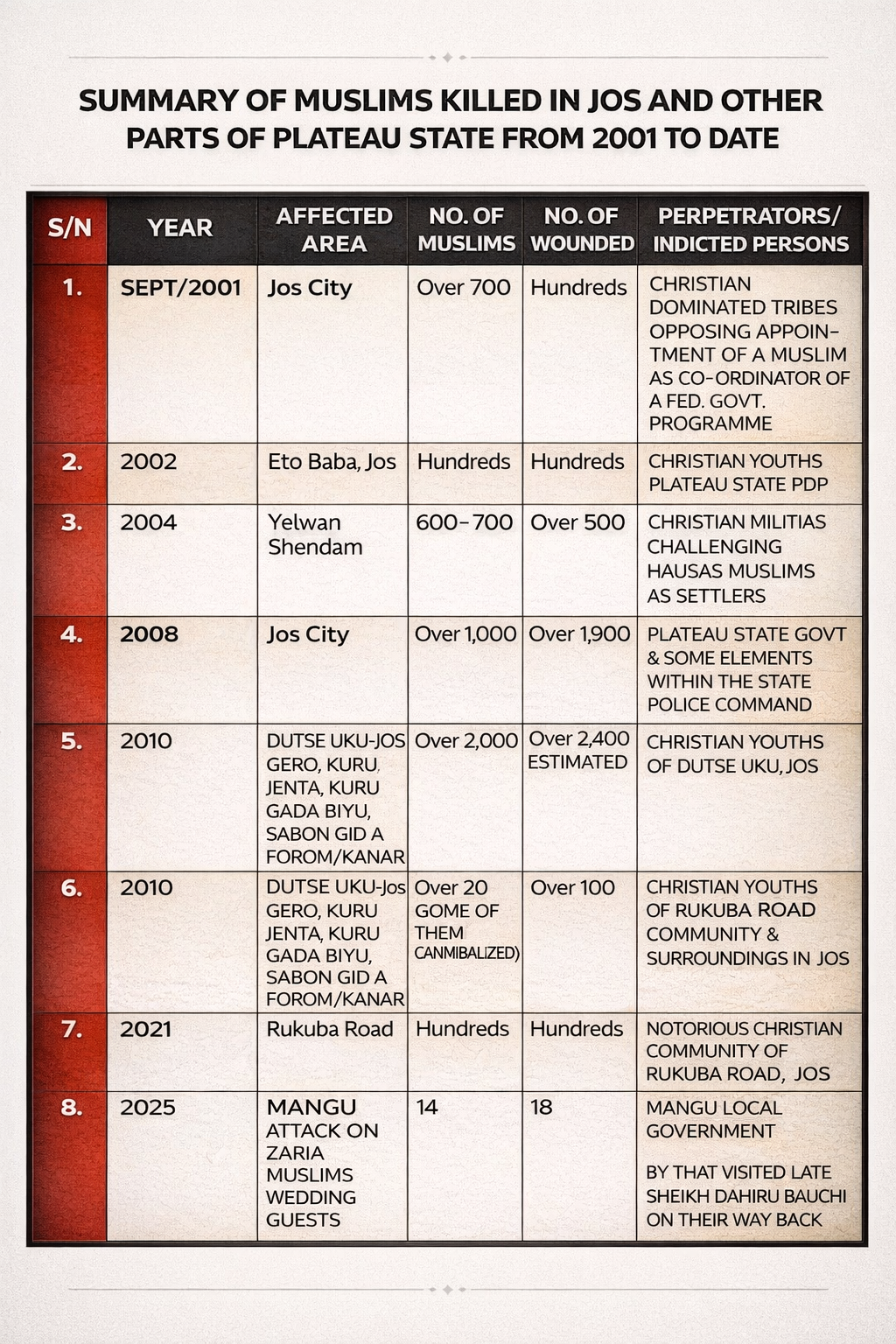
No doubt lives are being lost through violent means in the Plateau every day. However, if any of the happenings of illegal life-taking in the state is going to be referred to as a genocide, then the event of 28th to 30th November 2008 in Jos was the event that is more qualified to be referred to as genocide – Muslim genocide, to put it appropriately. In three days in November 2008, over 600 Muslims were shot dead, as by the Muslim leadership in Jos and corroborated by some international human rights agencies such as Human Rights Watch.
Going a bit back to the 2001 Jos crisis, the state government-owned Commission of Inquiry set up in 2001 under Justice Niki Tobi confirmed the claim of Muslim genocide in Plateau State as well in its report.
Sadly, the Muslims don’t have the media or are not out for propaganda. As such, their mass killing is always unreported or underreported. (See a table of Muslims massacred in different incidents in Plateau with dates and figures).
I was listening to a video clip of an Islamic imam delivering a sermon last Friday in which he logically stated that it is impossible for Muslims to carry out genocide of Christians in a place like Plateau because Muslims are not only in the minority; we are highly marginalised, which incapacitated us following decades of marginalisation and neglect. Muslims are barely living in Plateau State because since the creation of the present Plateau, there has not been a single Muslim civilian governor, deputy governor, secretary to the state government or chief of staff in the state. The Imam asked, ‘How can a minority oppress the majority to the extent of committing genocide against them when they are not even close to the machinery of power? ‘ If Muslims were interested in committing any genocide against the Christians, they could have conveniently done so in places where they are the majority, like Kano or Sokoto!
It is sad that a few people are still telling their people that it is possible to have a plateau without Muslims. This is a nightmare, not a dream. As opined by some eight thinking social media content creators, the day we realise that Christians cannot chase Muslims from Plateau State and vice versa, that day will be the beginning of peaceful coexistence in the state. This fact should be repeated and carried as wide as possible so that we may have a peaceful plateau.
Enough of these lies and propaganda, please. Let’s live and let. Live!
Barr. Lawal Wrote from Jos Plateau State.

Of banditry and a shared sovereignty (3)
By Hassan Gimba
This is the concluding part of this series. The first two editions were published two weeks ago. Although the article was originally written in 2022, its message remains as timely and relevant today as it was then. With insecurity continuing to ravage every region of the country, leaving citizens in constant fear and uncertainty, the issues it raises remain urgent and worthy of renewed attention.
Last week, they attacked an estate within Abuja. Gunmen, bandits, Boko Haram, those who “drag” sovereignty with Nigeria, attacked Genuine Estate, within the vicinity of Gwarimpa, Nigeria’s (some accounts say south of the Sahara’s) largest housing estate. They did this undisturbed and calmly, between 1 and 4 am on Sunday. The police said it was a robbery. Residents, however, said they kidnapped some of their people. Now, we all know that robbers hardly take prisoners. It is now left for people to believe who they want to believe.
But based on precedent, I will want to believe the residents because the police, in more than one case, do not say what we know is the truth. Perhaps, for security reasons.
On Tuesday, May 17, an explosion rocked Winners, a nursery and primary school in the Sabon Gari area of Kano metropolis, in which buildings were destroyed, and about nine people were killed. The police told us it was a gas explosion. A week later, they changed the story: they said an Improvised Explosive Device (IED) caused it, and that they had arrested two people.
However, this doublespeak has become the norm with our government and its agencies while marauders keep terrorising the nation with unperturbed impunity.
We have always seized the opportunity to point out that apart from other parts of the country, “Abuja, the nation’s capital, is itself not exempt. Bandits operating in Niger State to the West, Kogi to the South, Kaduna to the North, and Nasarawa to the East have surrounded Abuja, and there is a need for a clinical onslaught against them. The Fulani settlements in these areas have to be forensically combed. Quite a few of the rugas around Kuje, Lugbe, and close to the Nnamdi Azikiwe International Airport are alleged to be used by bandits to store weapons.”
Within the town itself, you move at your own risk because hoodlums have taken over major spots. Robbery attacks are recurring themes in dark places, especially on bridges, in wooded spots, and at pedestrian crossings. The ever-busy Apo-Maitama expressway, pedestrian bridges, and roundabouts at Area One and Wuse Market, and from Zone 7 down to Berger and up to the Abuja-Kubwa-Kaduna expressway, are among the major areas frequented by criminal elements. From City Gate to Gwagwalada is another dangerous habitat for these criminal elements.
The southern part of Nigeria, too, has its share of warlords. Just as the North is in the grip of terrorists wrongly addressed as bandits, the South West was on the verge of being made ungovernable by a man called Sunday Igboho. He determined who lives there or not.
While Sunday Igboho in the South West has been tamed, all thanks to the Benin Republic authorities, the Indigenous People of Biafra (IPOB) and its armed wing, the Eastern Security Network (ESN), are still strong in the South East.
The South West, which is the most organised geopolitical zone in the country, is now tame, unlike most of the North and South East.
Apart from the killings of indigenes, termed Sabo (for saboteur) and non-indigenes, mostly from the North, there is a lot of propaganda – and insults – coming out from the South East. Some say that’s because they want “independence”, and others say it’s because they want the presidency. Whichever, their method is the wrong one. You can’t fight everyone and yet want them to consider you. Insults, blackmail and threats to life are their major weapons. I pity the judge handling the case of Nnamdi Kanu.
Well, all the happenings in the various regions of the country that have made the Nigerian state share sovereignty with non-state actors are because of the authorities’ inability to punish lawbreakers. Whoever committed whatever crime must not go unpunished.
The way it is now, anything can happen. The most abominable things can occur at any time. While the security agencies are overwhelmed, crime news, too, overwhelms newsmen, so that a lot goes unreported for want of space or time. The sad narrative is becoming the norm. And whenever the President’s spokespersons deem it fit to make any comment, it is the usual “condemnation”. Perhaps they do not know that you condemn the actions of those whose condemnation will hurt, not those who are competing with you for sovereignty.
The president usually ends up with an infuriating, half-hearted, lukewarm order to the security forces to fish out the perpetrators or to move to “the theatre of war”. We have seen how, on more than one occasion, he gave that order to service chiefs. Without hearing a counter order, they would be back in Abuja, and it would be business as usual, only for something to happen for him to renew the ineffective order.
Many security experts believe that the people have to take back their lands by themselves if such a government response to crime continues.
On January 3, 2022, writing on this page under the headline ‘Banditry and our quest for leadership’, we observed that: “One solution is for the government to organise a people’s militia that will flush out all those marauders. It can encourage each local government to muster at least 5,000 of its youth who will be trained to confront the bandits. The Nigerian government should transform the war against the bandits into a people’s war for self-defence by training and arming these youths. We must take the battle to every inch of the space occupied by the bandits. Possibly, all settlements in the bush should be cleared and moved to the main roads.
“That strategy proved successful in both Iraq and Syria. But it is not only in Iraq or Somalia. Here in Nigeria, some communities have stood eyeball to eyeball with bandits and insurgents and, as a result, found themselves some peace. Biu in Borno State and Azare in Bauchi State readily come to mind.
“When Boko Haram members set the people of Biu in their sights, killing them arbitrarily, the elders met and decided to “kill the enemy within”. Known community members who aided the terrorists were arrested in a sting operation and summarily executed. Extrajudicial, of course, but it was a period of war, and self-survival was paramount. Putting sentiment aside, parents gave up their sons, friends pointed at friends, and all culprits were dealt with. Boko Haram chiefs had to send a delegation to the town seeking a truce. Since then, Biu found peace as Boko Haram never attacked them again, leaving them in peace while other northeastern towns whose people cringed in fear have known no respite from Boko Haram.”
This is also what happened in Maiduguri, the capital of Borno State. Tired of being at the mercy of Boko Haram and being at the receiving end of soldiers’ mop-up operations, the youths, backed by elders and approved by the government and with support from the army, formed what came to be known as the Civilian Joint Task Force (CJTF) for short. They drove the insurgents, false jihadists, out of the towns and into the bushes.
I foresee this happening also in the South East. The people will rise to take back their lives. The hurtful sit-at-home orders and the barbarous threat of IPOB/ESN hovering over them like the Sword of Damocles will push them to shake off the fear of their tormentors.
Fighting insecurity and the looming anarchy is too serious to be left in the hands of those who think they are safe and unassailable.
Concluded
Hassan Gimba, ANIPR, is the Publisher and CEO of Neptune Prime.
Striking the Balance
The $2,500 Threshold: Why Raising Nigeria’s GDP Per Capita Is Our Best Non-Kinetic Strategy for Peace
The $2,500 Threshold: Why Raising Nigeria’s GDP Per Capita Is Our Best Non-Kinetic Strategy for Peace
By MS Abubakar, PhD..
One scholar I learnt a great deal from during my short course at Oxford University is Prof. Sir Paul Collier.
In one lecture that has stayed with me, he made a simple but sobering point: democracies with a GDP per capita below $2,500 are statistically prone to crisis and conflict. For democracy to deliver prosperity and stability, a country must cross that $2,500 mark.
That lesson has never felt more urgent than now.
Here in Nigeria, our GDP per capita currently hovers between $1,069 and $1,200 according to 2024 IMF and World Bank data. We are less than half of Collier’s stability threshold. Meanwhile, countries with durable peace and development — the OECD states and Scandinavian countries — operate at between $55,000 and $90,000 per capita.
If Collier is right, and the data suggests he is, then our security problem is, at its core, an economic and human development problem. And the solution cannot be guns alone.
What is GDP per capita, and why should a security man care?
GDP per capita is simply Gross Domestic Product divided by population. It tells us the average economic output per Nigerian in one year.
But it tells us something else too: the size of the national cake per citizen, and by extension, the resources available to the state to keep the social contract alive.
When GDP per capita is low, government revenue is low. When revenue is low, schools are underfunded, hospitals lack drugs, police lack equipment, and courts move slowly. When the state cannot provide, citizens look elsewhere — to ethnic militias, to bandits, to extremist preachers, to “self-help.”
Collier’s research in Wars, Guns and Votes shows this clearly. New democracies that are poor are fragile democracies. Poverty creates grievances. Grievances create recruits. And recruits make conflict sustainable.
Above roughly $2,500 per capita, states begin to have enough fiscal space to pay workers, build roads, fund education, and respond to citizens. Democracy begins to “pay.” People have jobs to lose. Communities have businesses to protect. The cost of violence becomes too high.
Nigeria at $1,100 is therefore not just poor. We are in the danger zone for democratic stability.
Prof Paul Collier: The Oxford Scholar Who Linked Poverty to War
Prof Paul Collier is Professor of Economics at Oxford and former Director of the Development Research Group at the World Bank. He is not a theorist detached from Africa. He spent years studying why some of the poorest countries stay poor.
His book, “The Bottom Billion”, argued that about 50 countries are trapped in poverty. Two of those traps define Nigeria’s reality:
- The Conflict Trap: Civil war destroys growth by about 2.3% per year. But poverty itself also causes war. So you get a vicious cycle.
- The Natural Resource Trap: Countries rich in oil but poor in institutions often grow slower, because resources fuel corruption and conflict instead of development.
In “Wars, Guns and Votes”, Collier showed with hard data that democracy without development is dangerous. The $2,500 per capita figure was not plucked from the air. It is where states historically gained the capacity to tax, spend, and deliver enough to make democracy legitimate.
His core message for Africa has always been ‘You cannot shoot your way out of poverty. You must grow your way out of conflict.
That is what he taught us at Oxford. And that is what Nigeria must now apply.
Nigeria’s Reality: $1,100 and Rising Insecurity
Let us be blunt with the numbers.
In 2014, Nigeria’s GDP per capita was about $2,200. Today it is about $1,100. The drop is due to two things: rapid population growth, and the devaluation of the naira.
Compare that to our aspirations. OECD average is $55,000. Norway is above $80,000. Even Ghana and Kenya are ahead of us on some human development indices.
What has this meant on the ground?
Underfunded schools produce unemployable graduates. Underfunded hospitals push people into poverty. Underfunded police cannot cover our vast territory. And when the state is absent, non-state actors fill the gap.
This is why kinetic operations alone will not end banditry in the North West, insurgency in the North East, or cult and separatist violence in the South. You can degrade a group today. But if the economic conditions that produced it remain, another group emerges tomorrow.
The Non-Kinetic Answer: Grow GDP Per Capita Through Human Development
If the problem is economic, the deepest solution must also be economic. This is the non-kinetic strategy.
How do we move from $1,100 to $2,500 and beyond? Not by oil windfalls alone. By investing deliberately in Human Development Index, HDI — health, education, and decent living standards.
Here is the chain:
- Invest in Health and Education → Productivity Rises
A healthy child attends school. An educated youth gets a skill. A skilled worker earns more. Higher earnings mean higher productivity. Higher productivity raises GDP per capita. When a young man in Zamfara or Benue has a job in agro-processing or tech, he is no longer available for recruitment.
- Raise State Capacity → Security Improves
At $2,500 per capita, government revenue roughly doubles. That means better-paid police, functional courts, rural roads, and primary health centres. Citizens begin to see the state as a provider, not an extractor. Trust in democracy increases, and protests are less likely to turn violent.
- Break the Conflict Trap → Stability Becomes Self-Sustaining
Collier warned that war causes poverty and poverty causes war. By growing the economy and spreading opportunity, we cut that loop. A man with a farm, a shop, or a salary has something to lose in a crisis. Communities police themselves.
- Give Democracy Legitimacy → Politics Stabilizes
Below $2,500, citizens ask, “What has democracy done for me?” Above it, democracy delivers light, water, and jobs. That is when elections stop being existential and start being about policy.
This is not theory. This is what the Scandinavians did after World War II. This is what South Korea did in the 1960s. They did not start with perfect security. They started with human capital, and security followed.
What Must Nigeria Do Now?
Crossing the $2,500 threshold will not happen in one budget cycle. But we must start with deliberate policy choices:
- Prioritise HDI in the budget: Shift spending from consumption to education, primary healthcare, and vocational training. A naira spent on a child’s nutrition today is a naira saved on security tomorrow.
- Create jobs at scale: Agro-value chains, solid minerals, digital services, and manufacturing. Jobs are the fastest way to raise per capita income outside Abuja and Lagos.
- Fix the business environment: Power, credit, and infrastructure. Small businesses are where most Nigerians will cross into the middle class.
- Use oil revenue to diversify, not to subsidise: Save and invest in human capital, as Norway did. Don’t spend it to keep prices artificially low.
None of this replaces the military. We still need our Armed Forces and Police to hold the line. But we must recognize their limits. Soldiers can contain violence. Only prosperity can prevent it.
Conclusion
As Prof. Collier taught us at Oxford, democracy is not self-sustaining. It rests on an economic foundation.
Nigeria is currently trying to run a 21st-century democracy on a $1,100 economy. The result is predictable: instability, protests, and violence.
If we are serious about peace, then the path does not start only in the barracks. It starts in our classrooms, in our clinics, in our factories, and on our farms.
Raise Human Development. Raise GDP per capita. Cross the $2,500 threshold.
That is how we move from a democracy of survival to a democracy of prosperity. That is how we secure Nigeria, not just for one election cycle, but for a generation.
Striking the Balance
A N200 Billion Trust Fund Without Governance Reform Is Another Northern Jamboree
A N 200 Billion Trust Fund Without Governance Reform Is Another Northern Jamboree
By MS Abubakar, PhD, CAS_
Governor Uba Sani of Kaduna State has just spearheaded the launch of the *Northern Nigeria Security Trust Fund*. It will be chaired by *Gen. Martin Luther Agwai (rtd.), with *Alhaji Yayale Ahmad* as a principal figure. The fund is projected to mobilize *about N200 billion* in the long run for security interventions across the 19 Northern states.
On paper it sounds patriotic. In reality, I fear it is another expensive jamboree—heavy on ceremony, light on the root causes.
1. You cannot buy your way out of bad governance
Money was never the missing ingredient. The missing ingredient is accountability.
Insecurity in Northern Nigeria is not primarily a hardware problem. It is a governance problem. The drivers are not mysterious:
Bad governance and exclusion: Political primaries across parties were hijacked. Candidates the people wanted were stepped down so godfathers could impose favorites. When citizens feel the system is rigged at the ballot, they lose faith in the state.
Unemployment and poverty: The North still leads national poverty figures. According to the NBS 2022 Multidimensional Poverty Index, 63% of persons in Nigeria are multidimensionally poor. 72% of those poor people live in the North.
Illiteracy and low HDI: The UNDP Human Development Report consistently ranks several Northern states at the bottom of education and health indices. Over 10.2 million out-of-school children are in Nigeria, with the majority in northern states, according to UBEC/UNICEF data.
Extremism thrives where the state is absent: that absence starts at the local government.
2. The Local Government is Dead. That is where insecurity is born.
Take a walk into any LGA secretariat in the North today. You will find empty classrooms, locked PHCs, non-functional police posts, and abattoirs overrun by weeds.
The 1999 Constitution gave LGAs autonomy for a reason: they are the closest government to the people. In practice in Northern Nigeria, they are appendages of the Governor’s office. Chairmen are installed, not elected. Allocations are diverted.
Result: No government presence. No teachers. No nurses. No jobs. And into that vacuum walk bandits, kidnappers, and recruiters of extremist groups with cash and promises.
You do not need N200 billion to fix this. You need political will to *allow LGAs to work*.
3. Kinetic response without stabilization is a loop
I agree with the military doctrine: Suppress, Stabilize, Consolidate. Yes, we must first suppress the enemy. But what happens after the troops leave?
If we return children to the same dilapidated school, patients to the same clinic without drugs, and youth to the same unemployment line, we are simply preparing the next recruitment pool for criminals.
A Trust Fund focused mainly on vehicles, drones, and allowances for security agencies is a kinetic approach. It treats the symptom. It does not treat the disease.
4. The data is already telling us what to do
If Governors want to reduce insecurity, they already have the roadmap:
1. UNDP Human Development Index: Improve life expectancy, education, and income. States that invest in HDI see direct drops in violence.
2. UN Sustainable Development Goals: SDG 1 – No Poverty, SDG 2 – Zero Hunger, SDG 4 – Quality Education, SDG 8 – Decent Work. These are not slogans. They are security policy.
3. Global Terrorism Index: Countries and regions that improve governance and social inclusion consistently record better scores the following year.
The North does not need another fundraising launch. It needs governors to spend existing FAAC and IGR on the basics: functioning schools, working clinics, rural roads, and jobs.
Imagine if the 19 governors collectively decided that within 24 months, no child in their state will be on the street as an Almajiri without access to Tsangaya + formal education. Imagine if every LGA had a functional primary health center. The security savings alone would dwarf N200 billion.
5. The politics of exclusion.
I am also concerned about how this process was constituted. A project of this magnitude sidelining experienced voices like Lt. Gen. T.Y. Buratai (rtd.) raises questions. Borno chose to field Prof. Babagana Zulum’s representative instead. That is their prerogative. But perception matters.
When a security initiative looks like a club of the politically connected, citizens will not trust it. And without public trust, no Trust Fund will work.
CONCLUSION: Spend political capital, not just money.
Some governors have jokingly told associates they “have so much money they don’t know what to do with it.” If that is true, then the problem is not funding. It is a priority.
Here is what can be done in the short term without waiting for N200 billion:
1. Conduct free and fair LGA elections and grant financial autonomy.
2. Eradicate street begging and Almajiri exploitation* through education and skills programs.
3. Publish LGA allocation and project data monthly for public audit.
4. Align state budgets to HDI and SDGs and measure governors by those metrics.
If we do that, data will vindicate us. The World Terrorism Index will give us a better score next year. If we don’t, the Trust Fund will be remembered like many before it: big launch, big board, big money, zero impact.
The North does not need more jamborees. The North needs working governance.
God bless Northern Nigeria. God bless Nigeria.

Gov. Inuwa Mourns CP Hassan Gwani, Describes Death as National Loss

Ashaka Cement Expansion: Inuwa Demands More Jobs for Gombe Indigenes

AC4D, Gombe Revenue Service Mobilise Stakeholders on New Tax Law, Push for Voluntary Tax Compliance

APC National Chairman Settles Gombe Central Contest, Raises DCP Ahmed’s Hand as Party’s Senatorial Candidate

The $2,500 Threshold: Why Raising Nigeria’s GDP Per Capita Is Our Best Non-Kinetic Strategy for Peace

NGX Ends Week in the Green as ₦1.54 Trillion Boosts Investors’ Fortunes
-
 Politics4 weeks ago
APC National Chairman Settles Gombe Central Contest, Raises DCP Ahmed’s Hand as Party’s Senatorial Candidate
-
 Striking the Balance6 days ago
The $2,500 Threshold: Why Raising Nigeria’s GDP Per Capita Is Our Best Non-Kinetic Strategy for Peace
-
 Economy7 months ago
NGX Ends Week in the Green as ₦1.54 Trillion Boosts Investors’ Fortunes
-

 Environment2 months ago
World Environment Day: NGO Urges Nigerians to Embrace Nature-Based Solutions Against Climate Change
-
 Sport4 months ago
Gombe Aquatic Sports Body Unveils Board, Sets Stage for Competitive Debut
-
 Education7 months ago
Dangote Launches Landmark ₦1 Trillion Scholarship Scheme to Support 1.3 Million Nigerian Students
-

 Economy7 months ago
CBN’s End to Cash Withdrawal Limit
-
 Politics2 months ago
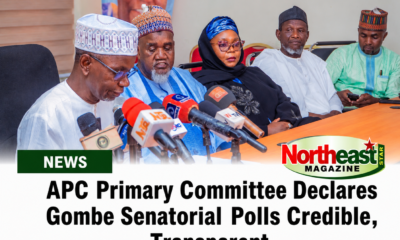
APC Primary Committee Declares Gombe Senatorial Polls Credible, Transparent