
Latest News
Kebbi Youth Group to Malami: Rescue Yourself First


Kebbi Youth Group to Malami: Rescue Yourself First.
By Tukur Abdullahi, Kebbi
The Kebbi Progressive Youths (KEPYO) have dismissed the recent declaration by Abubakar Malami that he is embarking on a “rescue mission” to save Kebbi State, describing the claim as ironic and detached from political reality.
In a statement issued on Tuesday by the group’s spokesperson, Comrade Hamisu Sani, KEPYO said it was both “interesting and astonishing” that a man facing multiple public allegations and lingering legal scrutiny relating to his time in office would speak of rescuing a state the group insists is “already in safe and competent hands”.
The youth group was reacting to Malami’s submission of his governorship nomination and expression of interest forms under the banner of the African Democratic Congress, where a spokesman to the former minister reportedly described Malami’s ambition as a mission to rescue Kebbi from insecurity, poor healthcare, educational decline and economic stagnation.
Sani, however, rejected what it called an exaggerated portrait of the state, arguing that Kebbi people are capable of distinguishing between political messaging and realities on the ground.
“It is curious that someone burdened by mountainous allegations of financial misconduct and public accountability questions would attempt to market himself as the saviour of people who are not asking to be rescued,” the statement said.
The group further advised Malami to focus on addressing his personal and legal challenges instead of adding, in its words, “the rigours of a governorship race he is unlikely to win” to his list of problems.
“Rather than attempting to rescue Kebbi, Malami should first rescue himself,” KEPYO stated, insisting that the people of the state are fine and do not presently require political salvation.
The organisation maintained that Kebbi remains on a path of stability and progress, warning against what it described as politically convenient narratives aimed at manufacturing a crisis where none exists.

By Tada Jutha, Maiduguri
Troops of Operation Hadin Kai (OPHK) have killed six suspected insurgents and recovered a cache of weapons and ammunition after repelling an attack on a military base in Garaha community, Hong Local Government Area of Adamawa State.
The attack targeted the Forward Operating Base (FOB) Garaha at about 9:07 p.m., when suspected Boko Haram and Islamic State West Africa Province (ISWAP) fighters advanced on foot from the LAR axis in an attempt to overrun the military position.
The military said the troops responded with superior firepower and coordinated tactics, forcing the attackers to retreat after an exchange of gunfire that lasted about two hours.
In a statement issued on Tuesday in Tola, the Media Information Officer of Operation Hadin Kai, Lt. Col. Sani Uba Goni, said the troops successfully repelled the assault and recovered weapons and other military equipment.
A subsequent search of the area, he said, led to the discovery of six insurgent corpses, confirming the number of terrorists killed during the encounter.
The recovered weapons included one PKT machine gun, three ammunition belts containing 67 rounds, six AK-47 rifles, 11 AK-47 magazines, 157 rounds of 7.62mm NATO ammunition, 120 rounds of 7.62mm special ammunition and one 60mm mortar bomb.
Other items recovered from the scene were an Infinix Android phone, a Canon portable video recorder, three camelback water bags, a magazine carrier and assorted clothing.
Although some soldiers sustained injuries during the confrontation, the military said the affected personnel were receiving medical attention, while arrangements were being made for their evacuation where necessary.
The troops have since intensified surveillance and search operations around the area to prevent further attacks and identify or recover additional items of operational importance.
The military described the successful defence of the base as a demonstration of the troops’ combat readiness and determination to prevent insurgents from overrunning their positions in the North-East.
It added that Operation Hadin Kai would continue to conduct intelligence-led operations to restrict the movement of insurgents, protect vulnerable communities and support efforts to restore lasting peace and security across the region.

By Auwal Ahmad Umar
Former Chief of Army Staff, Lieutenant General Tukur Yusufu Buratai (Rtd), has expressed appreciation to Alhaji Dr. Dahiru Barau Mangal, CON, for his support towards the launch of Transformational Leadership in Action: The Buratai Era.
Mangal, founder of and a prominent businessman with interests spanning aviation, oil and gas, was the Chief Launcher of the book.
He was represented at the event by Alhaji Inuwa Baba, CON, a former presidential aide who served under multiple administrations.
Buratai described Mangal’s support as a significant contribution to the success of the book launch, noting that his participation added value to an occasion centred on leadership, service and national development.
The former Army Chief also acknowledged Mangal’s contributions to Nigeria’s private sector and his philanthropic activities across the country.
According to Buratai, Mangal’s entrepreneurial journey and commitment to supporting initiatives of national importance reflect some of the leadership values highlighted in the book.
“His support for the launch of Transformational Leadership in Action: The Buratai Era elevates the occasion beyond measure,” Buratai said.
He expressed gratitude to Mangal for accepting to serve as Chief Launcher and for his continued support.
“We are deeply grateful, Chief Launcher, for your presence and your support,” Buratai added.
By Tada Jutha, Maiduguri
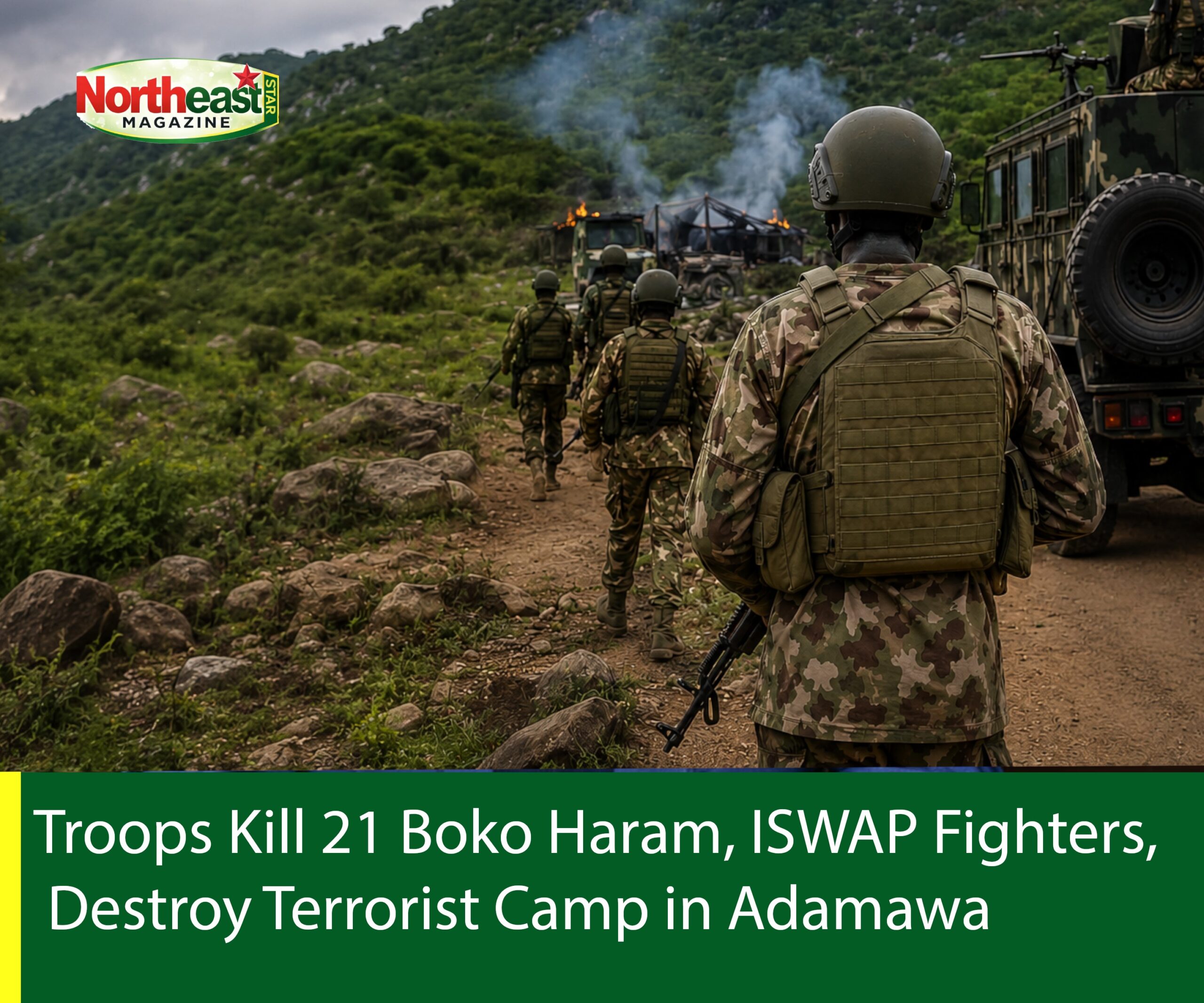
Troops conducting counter-terrorism operations in Adamawa State have killed more than 21 suspected Boko Haram and Islamic State West Africa Province (ISWAP) fighters during an offensive around the Kopre Mountain area of Hong Local Government Area.
The operation, conducted by troops of Operation Hadin Kai (OPHK) alongside the Office of the National Security Adviser’s Tactical Team and personnel of the 226 Battalion, followed intelligence indicating the presence of terrorists in the mountainous terrain.
The Acting Media Information Officer of Operation Hadin Kai, Capt. Mohammed Goni, disclosed this in a statement on Thursday.
According to him, troops moved into the difficult terrain in the early hours of Wednesday and engaged the terrorists in two separate encounters.
“More than 21 suspected terrorists were killed, while others escaped with gunshot wounds,” the military spokesman said.
Goni said the troops subsequently overran the terrorists’ camp, destroying structures, equipment and supplies believed to have been used to sustain their activities in the area.
Items destroyed during the operation included motorcycles, bicycles and jerry cans containing petrol, which the military said were part of the terrorists’ logistical network.
The troops also recovered several weapons and ammunition, including AK-47 rifles, magazines and a substantial quantity of 7.62mm ammunition.
The latest offensive is part of intensified military efforts to locate civilians abducted from communities in the North-East and disrupt terrorist networks operating across the region.
The military said the operation was linked to efforts to trace victims abducted from the Mussa community and the Lassa school following separate incidents reported in 2026.
Hong Local Government Area, characterised by rugged mountains and extensive forest cover, has remained challenging for security forces because of the terrain, which can provide hiding places for armed groups.
The military has increasingly relied on intelligence-driven operations, supported by ground troops, to locate terrorist hideouts, destroy their logistics and rescue civilians held by insurgents.
Goni assured that Operation Hadin Kai would sustain its offensive against terrorist groups, with particular attention to locating abducted persons and dismantling camps and supply routes used by the insurgents.

Gov. Yahaya Hails Professor Faruk Appointment as UMTH Chief Medical Director

Troops Kill Six ISWAP Terrorists, Recover Arms Cache in Adamawa

Nigeria Must Embrace Intelligence, Technology to Tackle Security Threats – Defence Minister

APC National Chairman Settles Gombe Central Contest, Raises DCP Ahmed’s Hand as Party’s Senatorial Candidate

Gombe Eyes Livestock-Led Economic Growth as Inuwa Yahaya Meets Minister

NGX Ends Week in the Green as ₦1.54 Trillion Boosts Investors’ Fortunes

-
 Politics4 months ago
APC National Chairman Settles Gombe Central Contest, Raises DCP Ahmed’s Hand as Party’s Senatorial Candidate
-
 Agriculture2 months ago
Gombe Eyes Livestock-Led Economic Growth as Inuwa Yahaya Meets Minister
-
 Economy10 months ago
NGX Ends Week in the Green as ₦1.54 Trillion Boosts Investors’ Fortunes
-
 Sport6 months ago
Gombe Aquatic Sports Body Unveils Board, Sets Stage for Competitive Debut
-

 Economy10 months ago
CBN’s End to Cash Withdrawal Limit
-

 Education10 months ago
Dangote Launches Landmark ₦1 Trillion Scholarship Scheme to Support 1.3 Million Nigerian Students
-

 Striking the Balance3 months ago
The $2,500 Threshold: Why Raising Nigeria’s GDP Per Capita Is Our Best Non-Kinetic Strategy for Peace
-

 Environment4 months ago
World Environment Day: NGO Urges Nigerians to Embrace Nature-Based Solutions Against Climate Change
Cristal Cline
May 19, 2026 at 2:37 pm
There is definately a lot to find out about this subject. I like all the points you made