
Politics
ADC Launches Nationwide Mobilisation in Gombe, Pledges a People-Driven Rescue Agenda Ahead of 2027

ADC Launches Nationwide Mobilisation in Gombe, Pledges a People-Driven Rescue Agenda Ahead of 2027
By Auwal Ahmad Umar
The African Democratic Congress (ADC) has commenced an intensive grassroots mobilisation in Gombe State, signalling what party leaders describe as a decisive push to reposition the party as a credible alternative ahead of Nigeria’s next general elections.
At the centre of the renewed drive is Muhammad Jibiri Barde, a chieftain of the party. He says the ADC is providing the political platform for a nationwide movement aimed at rescuing the country from deepening insecurity, economic hardship, and the steady collapse of public institutions.
Speaking during an interactive session with party members and supporters in Gombe, Mr. Barde said the mobilisation marks a critical phase in the evolution of the ADC, as it moves from consolidation to active political engagement at the grassroots level.
According to him, the party is now fully hosting a broad-based political movement known as Sabo Ta Fiya—loosely translated as “a fresh beginning”—which has, over the past year, quietly spread across states and regions, drawing support from politicians, professionals and citizens disillusioned with the country’s prevailing governance trajectory.
“ADC today is not just another political party,” Mr Barde said. “It is the vehicle for a rescue movement that has been building momentum across Nigeria. People are tired of excuses, tired of recycled promises, and tired of leadership that feels distant from their daily struggles.”
A Movement Finds a Political Home
Mr Barde explained that Sabo Ta Fiya began as a loose coalition of reform-minded political actors and civic stakeholders concerned about the direction of the country. Over time, he said, the movement found a more stable and structured home within the ADC, which now serves as its official political platform.
He noted that the movement enjoys the backing of several high-profile figures, including a former vice-president, former governors, ex-ministers and other influential stakeholders, though he declined to name individuals.
“What unites us is not ambition for office, but a shared belief that Nigeria can and must do better,” he said. “We have people who have served at the highest levels of government and who understand where things went wrong. They are now willing to be part of a genuine effort to correct course.”
The ADC, he said, has already issued official circulars outlining a nationwide timetable of activities designed to strengthen party structures and expand membership.
These activities include membership registration and revalidation exercises, as well as congresses scheduled to begin at the unit level and progress through wards, local government areas and states by the end of January. A non-elective national convention is also planned for February.
Mr Barde described the timeline as deliberate and strategic, saying it reflects the party’s intention to build from the bottom up rather than impose leadership or candidates from the top.
“This is about rebuilding trust in the political process,” he said. “We want members to feel a sense of ownership, from the polling unit to the national level.”
A call to Party Members and Supporters
Speaking to ADC members in Gombe State, Mr. Barde urged them to fully embrace the revalidation exercise and take responsibility for mobilising new members at the community level.
He said the success of the party’s rescue agenda depends largely on the commitment of ordinary members rather than elite endorsements.
“This is the moment for all of us to return home,” he said. “Return to the party, strengthen its structures and help build something that truly belongs to the people, not a few powerful individuals.”
He added that Gombe State holds strategic importance for the ADC’s broader plans in the Northeast, noting that the region has borne a disproportionate share of the country’s insecurity and economic decline.
“For us, Gombe is not just another state,” he said. “It represents resilience, potential and the urgent need for leadership that listens.”
Emphasis on Internal Democracy
A recurring theme in Mr Barde’s remarks was the party’s emphasis on internal democracy and inclusiveness, which he described as the ADC’s defining values.
According to him, the party operates on a strict principle of “one man, one vote”, with clear rules designed to prevent imposition, godfatherism and the marginalisation of ordinary members.
“This is not a party where decisions are taken in secret rooms,” he said. “There is no imposition. Every member has a voice, and every vote counts.”
He stressed that new members are not treated as outsiders or political tools but as equal stakeholders in the party’s future.
“Whether you joined yesterday or ten years ago, you are welcomed as a VIP,” he said. “What matters is your willingness to contribute to the collective effort of saving and repositioning the country.”
Unity and Factionalisation Claims
Responding to reports of internal divisions within the ADC in Gombe State, Mr. Barde dismisses claims of factionalization, insisting that the party remains united and focused.
“We are not aware of any faction in Gombe,” he said. “What we have are healthy conversations and growing interest, which some people may misinterpret as division.”
He added that the party’s leadership is committed to resolving disputes through dialogue and established internal mechanisms, rather than public confrontation.
“Our strength lies in our unity,” he said. “We are united, committed and determined—not just to rescue Gombe State, but to contribute meaningfully to rescuing Nigeria as a whole.”
A Grim Assessment of Governance
Mr. Barde took the occasion to deliver a scathing assessment of the current state of governance in Nigeria, citing worsening insecurity, decaying infrastructure, and the decline of critical sectors such as healthcare, education, agriculture, and trade.
He said insecurity has become a defining feature of daily life for many Nigerians, with communities living in fear of bandits, insurgencies, and violent crime.
“In too many parts of the country, people go to sleep uncertain of what the next day will bring,” he said. “This is abnormal, and we should reject it.”
He also pointed out the poor state of infrastructure, describing roads, power supplies, and water systems as grossly inadequate for a country of Nigeria’s size and ambition.
“Our infrastructure is collapsing, yet year after year, budgets are passed with little to show on the ground,” he said.
Strain on Ordinary Citizens
Mr. Barde asserts that policy failures, rising costs, and weak institutions are disproportionately impacting ordinary citizens and small-scale traders.
Markets are struggling, small businesses are closing, and young people are becoming increasingly disconnected from economic opportunities, according to him.
He stated, “People desire employment, yet the system works against them.” “Traders are overburdened, farmers are insecure, and young graduates are trapped between unemployment and underemployment.”
He argued that public institutions, which should serve as engines of development, have instead become symbols of inefficiency and frustration.
“Our hospitals lack basic equipment, our schools are underfunded, and our public offices are slow and unresponsive,” he said. “This level of neglect is unacceptable.”
ADC’s Vision for Gombe and Nigeria
Against this backdrop, Mr. Barde outlined what he described as the ADC’s people-centered vision for Gombe State and the country at large.
He said the party is committed to leadership that prioritises security, economic productivity, and social welfare and has policies designed to deliver tangible improvements rather than slogans.
“ADC stands for purposeful leadership,” he said. “Leadership that guarantees equal opportunity, quality education, functional healthcare and a productive economy for all.”
He added that agriculture, trade, and small-scale enterprises would be central to the party’s economic agenda, particularly in states like Gombe, where livelihoods depend heavily on these sectors.
“We believe that if you secure communities and support farmers and traders, you unlock growth,” he said. “Development does not happen in isolation—it starts with people.”
Looking Ahead to the Elections
With mobilisation underway, Mr. Barde said the ADC is positioning itself for sustained engagement ahead of the next general elections.
He stressed that the party’s focus is not merely on winning elections but on rebuilding confidence in democratic governance.
“Nigerians deserve a real choice,” he said. “A choice built on accountability, competence and inclusive governance, not empty promises.”
He acknowledged that the task ahead is difficult, given the dominance of established political parties, but insisted that the growing appetite for change gives the ADC a unique opportunity.
“History shows that when people come together around a clear purpose, change becomes inevitable,” he said.
As the interactive session drew to a close, party members in attendance echoed Mr. Barde’s call for grassroots engagement, with several pledging to take the mobilisation drive back to their wards and communities.
For the ADC, the coming months will test whether its rescue rhetoric can translate into organisational numbers and influence on the ground. For now, the party appears determined to make its case—starting from Gombe and extending across the country—that Nigeria’s political future does not have to look like its troubled present.

By Auwal Abdullah
The Igbo Delegates Assembly (IDA), representing Ndigbo across the 19 Northern States and the Federal Capital Territory, has said it is yet to adopt any presidential candidate ahead of the 2027 general elections.
The Assembly said it was currently assessing the major presidential contenders, their programmes, policies, antecedents and commitments before deciding which candidate would best serve the interests and aspirations of Ndigbo.
The position followed reports claiming that the Igbo Political Movement of the Assembly had endorsed President Bola Ahmed Tinubu for a second term and was targeting two million votes for him in the 2027 presidential election.
However, the IDA, in a statement signed by its President-General, Chief Kenneth Okeugo, and Secretary-General, Hon. Donatus Nwugo, categorically dissociated itself from the purported endorsement.
The Assembly said no individual, group or organisation had been authorised to commit it to any presidential candidate without the approval of its appropriate organs.
According to the leadership, the Assembly has constituted a committee, chaired by one of its Zonal Deputy President-Generals, to undertake a comprehensive assessment of the political landscape and evaluate the presidential candidates and their positions on issues affecting Ndigbo.
The committee’s report, it said, will be considered at the Assembly’s last Quarterly Meeting preceding the 2027 presidential election, after which a decision on whether to adopt or support a candidate will be taken.
The development effectively leaves open the political alignment of a significant bloc of Ndigbo resident in Northern Nigeria and the FCT as the 2027 election approaches.
The Assembly also rejected the reported two-million-vote target, describing it as a gross underestimation of the electoral strength and political value of Ndigbo across the North and FCT.
It warned against attempts to appropriate or present the votes of Ndigbo as already committed to any candidate without due consultation and authorisation.
The IDA urged Ndigbo and the general public to disregard reports suggesting that it had already chosen a presidential candidate, stressing that its eventual position would be guided by the candidate and political platform offering the most credible pathway to advancing the interests, security, unity, dignity and prosperity of Ndigbo.
Politics
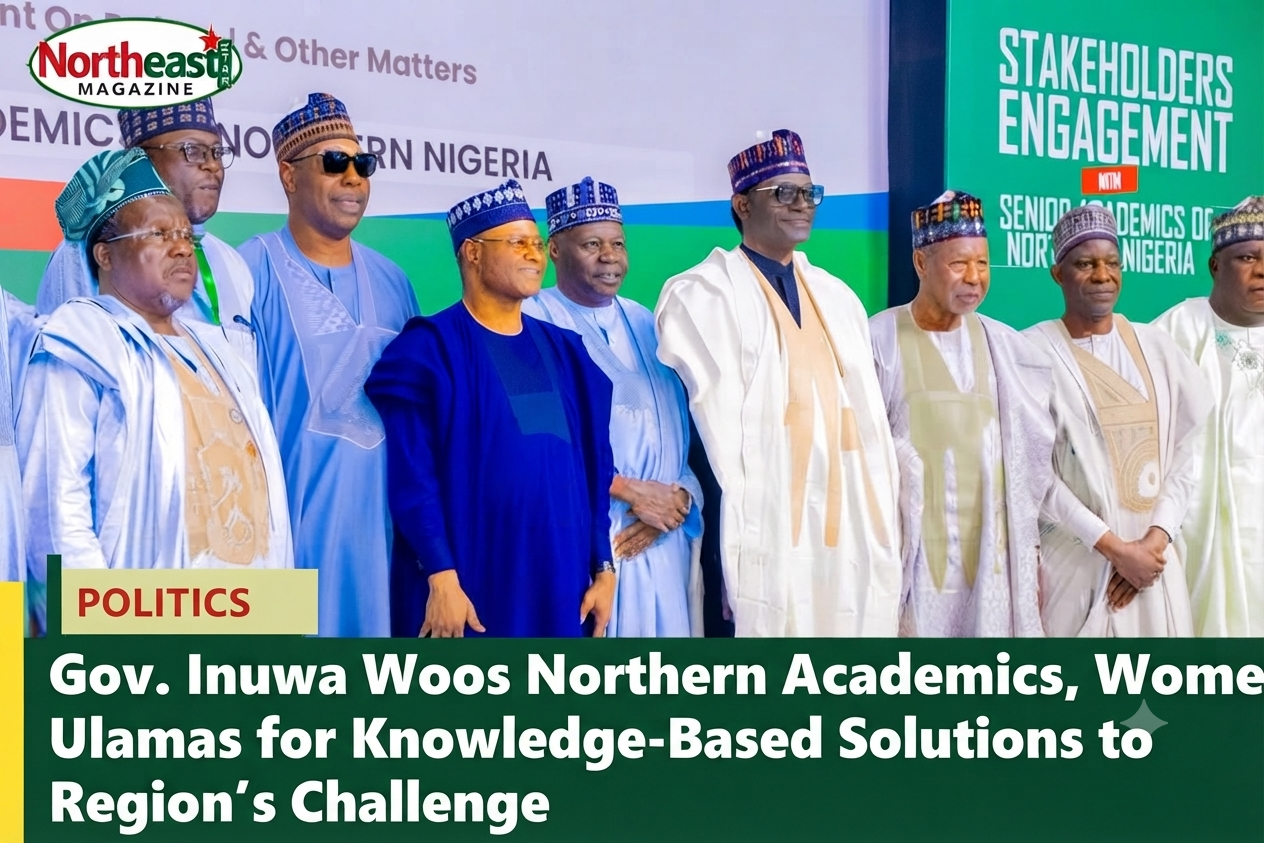
Gov. Inuwa Woos Northern Academics, Women Ulamas for Knowledge-Based Solutions to Region’s Challenge
By Auwal Ahmad Umar
Gombe State Governor and Chairman of the Northern Nigeria Governors’ Forum (NNGF), Alhaji Muhammadu Inuwa Yahaya, has called for stronger collaboration between government and academics to develop knowledge-driven solutions to the security, education and socio-economic challenges confronting Northern Nigeria.
Alhaji Yahaya made the call during separate engagements with senior academics and women Ulamas from across Northern Nigeria held in Abuja at the weekend.
The engagements were organised by the Office of the Special Adviser to the President on Political and Other Matters, Alhaji Ibrahim Kabir Masari, under the theme, “Consolidating the Renewed Hope Agenda: President Bola Ahmed Tinubu’s Achievements and the Road to 2027.”
The meetings brought together hundreds of academics and women Islamic scholars to examine critical challenges facing the region and assess policies and interventions of President Bola Ahmed Tinubu’s administration.
Alhaji Yahaya, who is also the Secretary of the Renewed Hope Ambassadors, said the North could not effectively address its complex challenges without tapping into the knowledge, research and experience of its intellectual community.
He identified insecurity, the growing number of out-of-school children, food security, vocational education, farmer-herder conflicts and peaceful coexistence as some of the areas requiring sustained attention and collective action.
On security, the governor acknowledged the challenges still confronting the region but said there had been gradual improvement since the Tinubu administration assumed office.
He urged stakeholders to deepen their partnership with government to consolidate the gains made and work towards achieving lasting peace.
Addressing the academics, Alhaji Yahaya stressed the importance of evidence-based approaches in tackling the out-of-school children crisis.
“We need to join our understanding with your perspective to deal with this situation,”
he said, urging scholars to deploy their research and expertise in developing sustainable solutions.
The governor also advocated greater attention to vocational and skills-based education, saying it could equip young Nigerians with practical skills, improve employability and create opportunities for self-reliance.
On peaceful coexistence, Alhaji Yahaya said the diversity of Northern Nigeria should be regarded as a strength rather than a source of division.
He called for stronger efforts to prevent and resolve farmer-herder conflicts, noting that peace was critical to agricultural productivity, economic growth and social stability in the region.
The governor also commended President Tinubu for establishing the Ministry of Livestock Development, describing the initiative as a bold policy direction with the potential to transform the livestock sector and address longstanding farmer-herder disputes.
He urged stakeholders to support the initiative and contribute ideas that would enhance its success.
“We need to benefit from your knowledge,” Alhaji Yahaya told the academics, stressing the importance of intellectual contributions to national development.
At a separate engagement with women Ulamas, organised in collaboration with the Muslim Intellectual Forum, the governor commended the participants for their contributions to faith propagation, family values and community development.
He said women Islamic scholars had an important role to play in promoting peaceful coexistence, responsible parenting, moral values and social cohesion, particularly amid growing pressures on families and communities.
Alhaji Yahaya assured the participants that the consultations would be extended across the states of Northern Nigeria to deepen engagement, improve communication and strengthen mobilisation around the Renewed Hope Agenda.
Earlier, the convener of the engagements, Alhaji Ibrahim Kabir Masari, said the initiative was designed to provide a structured platform for government to continuously consult critical stakeholders on national development.
Alhaji Masari said the engagement with academics was not primarily political but aimed at harnessing their knowledge, experience and research to help address Nigeria’s challenges.
He said the government needed the “knowledge, expertise, research and other academic contributions” of scholars to develop sustainable solutions and chart a stronger development path for the country.
Alhaji Masari added that mechanisms would be developed to ensure regular consultation with academics on policy and national development issues.
The engagements were attended by political and government leaders, including the governors of Kaduna, Borno and Yobe states, former governors of Katsina and Zamfara states, serving ministers and other senior government officials.
Communiqués containing resolutions reached at the separate sessions were presented at the conclusion of the engagements.

By Auwal Umar, Gombe
The Peoples Democratic Party (PDP) in Gombe State has suffered another major political setback as several prominent chieftains have defected to the All Progressives Congress (APC), ahead of the 2027 general elections.
Among the defectors is Hon. Hannatu Wakil, who served as PDP State Women Leader for eight years before becoming the party’s State Organising Secretary.
Explaining her decision to join the APC, Mrs Wakil said she was motivated by the need to support what she described as the good work of the present administration and contribute to efforts aimed at sustaining the state’s development.
She also expressed confidence in Dr Jamilu Isyaku Gwamna, the APC governorship candidate, saying she believes he has the capacity and leadership qualities required to take Gombe State forward. She said her decision was based on her conviction that supporting the administration and Dr Gwamna would be in the best interest of the people of the state.
Also joining the APC is Hon. Asabe Baba Nahaya, a former commissioner and former President of the National Association of Women Journalists (NAWOJ), as well as former Special Adviser, Hon. Sarki Alban.
Hon. Yila Y. Mustafa, who contested the Balanga/Billiri Federal Constituency seat under the PDP in the 2011 and 2015 elections, is also among the latest defectors.
The fresh defections come as political activities intensify across Gombe ahead of the 2027 elections, with the major parties working to strengthen their structures and expand their support bases.
The movement of the prominent PDP figures is expected to further reshape the political landscape in the state and increase pressure on the opposition party as the countdown to 2027 gathers momentum.

Alh. Mansur Lawal Isma’il: Twelve Years On, Your Memory Still Lives in My Heart

NUJ Urges INEC to Equip Journalists With Electoral Laws, Procedures Ahead of 2027

Mangal’s Support Elevates Buratai’s Leadership Book Launch, Says Gen. Buratai

APC National Chairman Settles Gombe Central Contest, Raises DCP Ahmed’s Hand as Party’s Senatorial Candidate

Gombe Eyes Livestock-Led Economic Growth as Inuwa Yahaya Meets Minister

Gombe Aquatic Sports Body Unveils Board, Sets Stage for Competitive Debut

-
 Politics3 months ago
APC National Chairman Settles Gombe Central Contest, Raises DCP Ahmed’s Hand as Party’s Senatorial Candidate
-
 Agriculture2 months ago
Gombe Eyes Livestock-Led Economic Growth as Inuwa Yahaya Meets Minister
-
 Sport6 months ago
Gombe Aquatic Sports Body Unveils Board, Sets Stage for Competitive Debut
-

 Economy10 months ago
NGX Ends Week in the Green as ₦1.54 Trillion Boosts Investors’ Fortunes
-

 Striking the Balance2 months ago
The $2,500 Threshold: Why Raising Nigeria’s GDP Per Capita Is Our Best Non-Kinetic Strategy for Peace
-

 Economy10 months ago
CBN’s End to Cash Withdrawal Limit
-

 Education10 months ago
Dangote Launches Landmark ₦1 Trillion Scholarship Scheme to Support 1.3 Million Nigerian Students
-

 Environment4 months ago
World Environment Day: NGO Urges Nigerians to Embrace Nature-Based Solutions Against Climate Change