
Borno
Christmas at the Frontline: Zulum Celebrates with Troops, Spends Night in Resettled Malam Fatori

Christmas at the Frontline: Zulum Celebrates with Troops, Spends Night in Resettled Malam Fatori
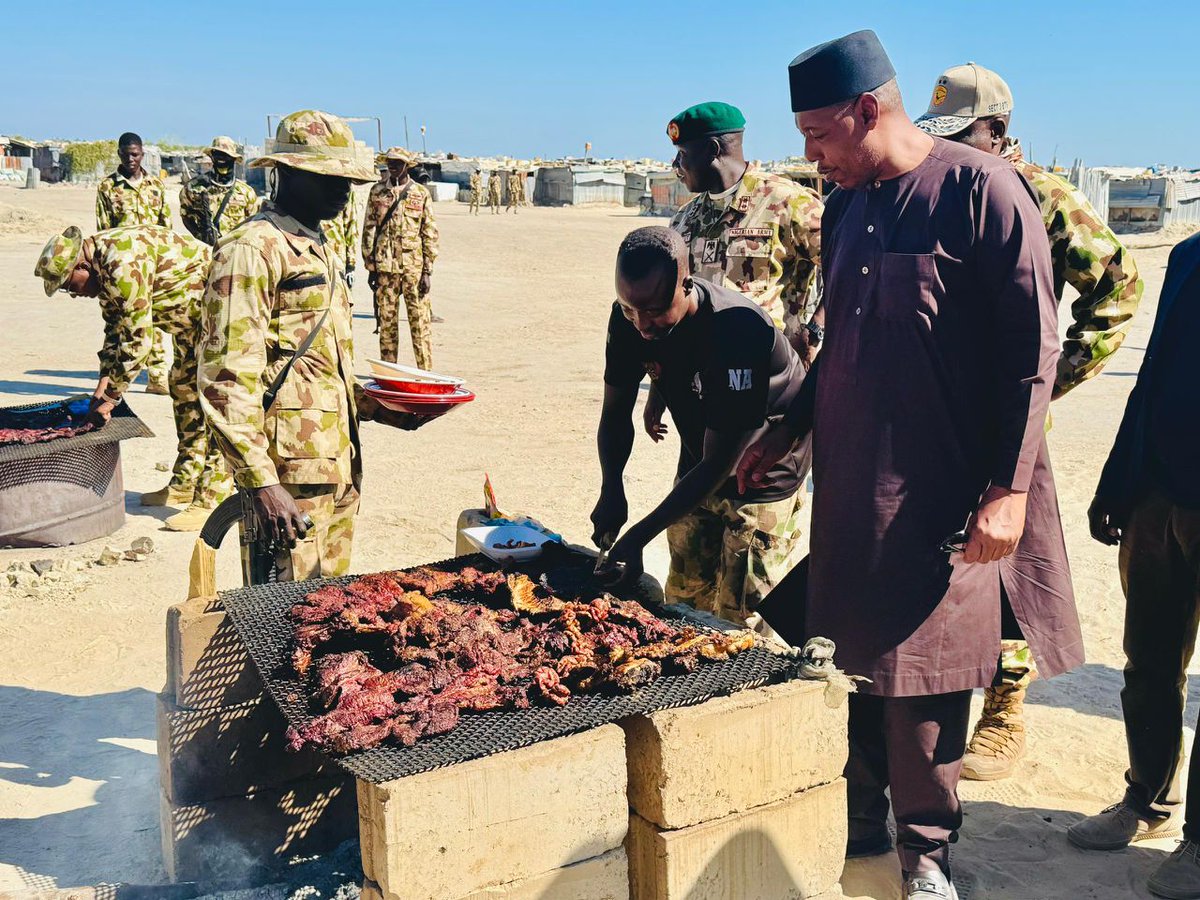
Prof. Babagana Umara Zulum, the Governor of Borno State, marked this year’s Christmas in a unique yet symbolic manner by uniting with Nigerian Army troops on the frontline.
On Thursday, the Governor visited soldiers of the Nigerian Army’s 68 Battalion stationed in Malam Fatori, a strategic border community in Abadam Local Government Area, to celebrate the festive season with them amid ongoing counter-terrorism operations.
The visit came at the end of a four-day security and resilience tour across northern Borno, covering five local government areas, where Zulum personally coordinated measures to strengthen security and support internally displaced individuals (IDPs) who have returned to their communities.
Demonstrating his administration’s commitment to restoring civil authority, the Governor spent the night in the newly resettled Malam Fatori town, holding engagements with community leaders and residents—mostly women and children—who are rebuilding their lives after years of displacement.
Zulum’s Christmas visit to the battalion was both symbolic and reassuring, offering encouragement to soldiers serving far from their families during the festive period. He praised the officers and men for their gallantry, resilience, and professionalism, noting that their sacrifices have been crucial to the survival and stability of Malam Fatori.
Describing the troops as the true custodians of peace, the governor said their courage had made it possible for displaced communities to return home and begin rebuilding.
“Celebrating Christmas with the troops defending our territorial integrity is not just ceremonial,” Zulum said. “It is a deliberate decision to stand with you at the point of sacrifice.”
He added that the bravery displayed by the soldiers in securing Malam Fatori and other frontline locations remains an example of his administration’s resolve to support security agencies until lasting peace is achieved.
Reaffirming his government’s unwavering backing for the armed forces, Zulum assured the battalion of sustained logistical and welfare support to complement federal efforts.
“Security remains the top priority of my administration,” he stressed. “Without peace, there can be no meaningful development or recovery.”
In the spirit of Christmas, the Governor donated five bulls to the battalion to enable the troops celebrate with dignity. In a rare personal gesture, he also joined the soldiers in line to share a meal with them at the Malam Fatori military base.
The visit sparked excitement among the troops, many of whom said the Governor’s presence and personal interaction boosted their morale. The occasion, for soldiers separated from their families, served as a powerful reminder of the recognition, appreciation, and deep value placed on their sacrifices.

CP Abdulmajid disburses N5.51m to families of fallen officers in Borno
By Tada Jutha, Maiduguri
The State Police Commissioner, Naziru Abdulmajid, has disbursed N5,512,280.26 to ten family members of the fallen police officers in the state.
According to the command, the payments are under the Group Life Insurance (GLI) and the Inspector-General of Police Welfare (IGPW) schemes.
The spokesperson of the command, Assistant Superintendent of Police (ASP) Nahum Daso, disclosed yesterday in Maiduguri that “the commissioner’s disbursement of N5.51 million to the families of the fallen officers has underscored the Nigeria Police Force’s (NPF) commitment to the welfare of its personnel and the 10 families of the fallen heroes.”
Daso, in his statement, further assured the families that additional welfare support will also be provided to “sustain and enhance” the well-being of the beneficiaries of the NPF schemes.
Speaking on behalf of the 10 next of kin beneficiaries, Solomon Japhet expressed his profound appreciation to the IGP, Olatunji Dissu, and the Borno state command for the welfare support.
He noted that the gesture serves as a source of relief and encouragement to the respective families of the gallant fallen officers in the state.
The Commissioner of Police, Abdulmajid, reaffirmed the command’s dedication to giving priority to the welfare of officers and men while honouring the sacrifices of those who paid the supreme price in serving the country of Nigeria.

Borno Police Move to Curb Electoral Violence, Warn Youths Against Thuggery
By Tada Jutha, Maiduguri
The Borno State Police Command has intensified efforts to forestall electoral violence in the state, warning residents—especially young people—against political thuggery and other acts capable of undermining democratic processes ahead of the 2027 general elections.
The police gave the warning during a community sensitisation and stakeholder engagement held at the Lamisula Police Divisional Headquarters in Maiduguri, where security officials and community leaders gathered to discuss the need for peaceful participation in the electoral process.
Addressing participants, the Commissioner of Police in Borno State, Naziru Abdulmajid, said the electorate must reject violence and all forms of electoral misconduct if democracy is to thrive at the grassroots and beyond.
He said the police would not tolerate actions such as ballot box snatching, intimidation of voters, disruption of polling activities, or other offences that threaten the credibility of elections.
“Electoral violence and related offences pose a serious threat to democratic values and peaceful coexistence. The public must understand that credible elections can only take place in an atmosphere of peace, order, rights, and sustained community collaboration in ensuring peaceful elections, including in border communities near Cameroon, Chad, and respect for the law,” the commissioner said.
Mr Abdulmajid noted that the command’s engagement with communities was part of a broader strategy to educate residents on their civic responsibilities and strengthen trust between the police and the public before the next electoral cycle.
He also stressed the need for communities to remain vigilant and support law enforcement efforts to prevent political unrest, particularly in vulnerable areas across the state.
The police commissioner further highlighted the importance of adherence to the rule of law, respect for human rights, and sustained community collaboration in ensuring peaceful elections, including in border communities near Cameroon, Chad, and Niger.
The engagement was attended by members of the Police Management Team, including the Deputy Commissioner of Police, Department of Operations, Evans Shem Elam; Deputy Commissioner of Police, State Criminal Investigation Department, Babagana Saje; and Deputy Commissioner of Police, Department of Finance and Administration, Ibrahim M. Sumaila.
Also present were Divisional Police Officers from across Maiduguri and senior officers of the command, alongside political and community stakeholders.
Among them were the Chairman of Maiduguri Metropolitan Council, Ali Umar Bolori; Mala Tijani Ngala; Lucy Dalma; the Chairman of the Police Community Relations Committee, Abatcha Nanabe; district heads; religious leaders; and representatives of various communities.
Speaking on behalf of the stakeholders, Mr Nanabe commended the police for taking what he described as a proactive step toward sustaining peace and stability in Borno.
He said early engagement with the public would go a long way in discouraging violence and improving public confidence in the electoral system.
“This kind of sensitisation is timely and necessary. Communities have a major role to play in promoting peace and discouraging violence before, during, and after elections,” he said.
The police command reiterated its commitment to providing a secure environment for residents and ensuring that future elections in the state are conducted peacefully and in line with democratic principles.
It also urged residents to remain law-abiding and report suspicious activities or movements to the nearest police station.
Zulum Dissolves Cabinet as Borno 2027 Succession Race Begins
By Auwal Ahmad, Maiduguri
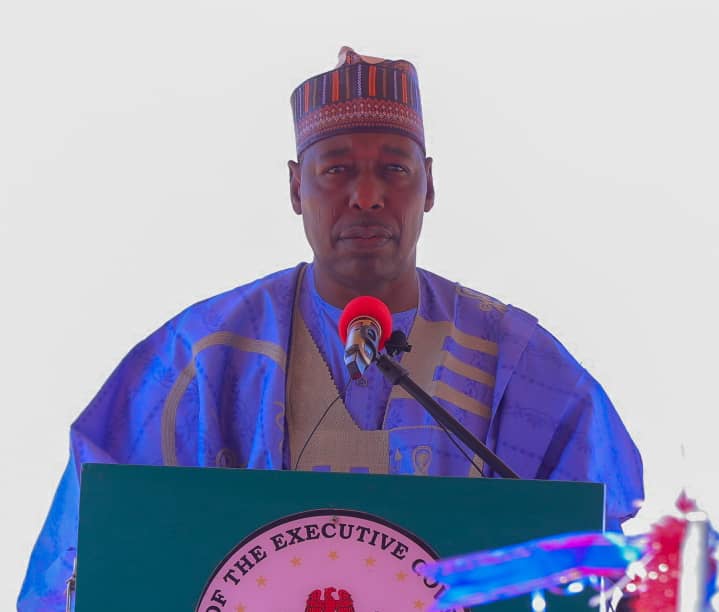
Borno State Governor Babagana Umara Zulum has dissolved the 22-member State Executive Council in a move that signals the beginning of political realignments ahead of the 2027 general elections.
The decision, announced on Sunday, is widely considered a strategic step to allow members of the outgoing cabinet and other political appointees who may be interested in elective offices to prepare for the next electoral cycle.
In a statement issued in Maiduguri, the Secretary to the State Government, Dr Bukar Tijani, said the dissolution takes immediate effect.
He added that all former commissioners have been directed to hand over the affairs of their respective ministries, departments, and agencies to their permanent secretaries on or before Friday, April 3, 2026.
The government stated that the action aimed to create a conducive environment for any former cabinet member aspiring to contest political office in 2027.
Mr Zulum also used the opportunity to commend the outgoing commissioners for their service to the state.
He expressed appreciation for what he described as their dedication, commitment, and contributions to governance, particularly by supporting the administration’s efforts to rebuild and stabilise Borno.
The cabinet shake-up comes at a time when political conversations in the state are increasingly shifting toward the question of who succeeds the governor at the end of his tenure.
Although no formal declarations have been made, there are already indications that some former commissioners and political actors, particularly from Borno North and Borno Central Senatorial Districts, are positioning themselves for the governorship race.
The development has intensified interest in the succession debate, particularly within the ruling All Progressives Congress (APC), where consultations are reportedly accelerating.
Mr Zulum had earlier stirred political discussions when he told party supporters during the APC State Congress in Maiduguri that he did not have a preferred successor.
He believes that God will ultimately determine who becomes the next governor.
“It is the Almighty God that will determine who becomes my successor among the many aspirants from the three senatorial districts,” the governor said.
His comment has since continued to resonate in political circles, with many party loyalists and stakeholders interpreting it as a sign that the succession battle may remain open and competitive.
Political observers say the dissolution of the cabinet may not only free interested appointees to pursue their ambitions but could also mark the start of a broader power contest over the future direction of the state after Zulum.
The stakes are considered high, given the governor’s visible footprint in infrastructure development, the resettlement of internally displaced persons, education, healthcare, and post-conflict recovery since he assumed office in 2019.
For many residents and political stakeholders, the central concern is no longer just who emerges next, but whether the eventual successor will have the political will, administrative depth and public trust to sustain the pace of development already set in motion.
With 2027 still months away, Borno’s political landscape appears to be gradually entering a defining phase—one in which ambition, regional balance, party calculations, and governance legacies are expected to shape the contest ahead.

2027 Elections: SDP Opens Contest to Aspirants, Promises Transparent Primaries

Inuwa Yahaya, NSGF and the Renewed Northern Resolve

AI Boom, Training Bust: Only 10% of Nigerian Journalists Skilled in Emerging Tools – SMI

Dangote Launches Landmark ₦1 Trillion Scholarship Scheme to Support 1.3 Million Nigerian Students

NGX Ends Week in the Green as ₦1.54 Trillion Boosts Investors’ Fortunes

Formal Rebuttal to the Recent Interview Granted by Retired Major General Ali Keffi on Arise TV
-
 Education4 months ago
Dangote Launches Landmark ₦1 Trillion Scholarship Scheme to Support 1.3 Million Nigerian Students
-
 Economy4 months ago
NGX Ends Week in the Green as ₦1.54 Trillion Boosts Investors’ Fortunes
-
 Column4 months ago
Formal Rebuttal to the Recent Interview Granted by Retired Major General Ali Keffi on Arise TV
-

 Economy4 months ago
CBN’s End to Cash Withdrawal Limit
-

 Gombe4 months ago
Gombe Shines Again, Ranks Second in Northeast at 2025 PHC Leadership Challenge
-
 Politics4 months ago
NSGF names Ezekiel Gomos as Director-General, setting stage for stronger regional collaboration
-

 Gombe3 weeks ago
A tribute to Dr Langa Hassan Bangunji (JP) – an icon of Scholarship, Leadership and Community Service
-

 Latest News4 months ago
Anglican Church Expands Footprint with 15 New Dioceses, Total Hits 176