
Latest News
Iran, Beware the Fangs of January, the Scourge of February, and the Ides of March

Iran, Beware the Fangs of January, the Scourge of February, and the Ides of March
By Hassan Gimba (1)
The Arbiter
A few days ago, I woke in the night, anxious and checking the news, half-expecting America and Israel to have attacked Iran.
Given this tension, the central issue is the longstanding American-Israeli effort to destabilize Iran. Even though it cannot be exhausted in one article, I’d like you to come along as we look over the underlying hostility, the motives behind American and Israeli actions, and why both countries believe only a fractured, weakened Iran will serve their interests.
Talk of de-escalation and the apparent lowering of tensions is largely superficial. America—the dog—and Israel—the tail that wags it—will never rest until they see a Balkanized Iran; regime change to install a malleable monarchy is just a ruse. It’s the first step to Iran’s destruction, but first, the people must be tricked into thinking they will have a new government.
The tag team of Donald Trump and Benjamin Netanyahu will not be satisfied with merely installing a malleable regime, because they represent a concept whose custodians plan in decades and think in centuries. As long as Iran remains intact, a future “antagonistic” government could replace their pliable proxy—and that is unacceptable to them. What they aspire to is a shattered Iran, fragmented and at odds with itself.
America wants to neutralize Iran in order to limit China’s growing influence and weaken Russia. Iran currently acts as a buffer and supplies vital energy resources to China. For Israel, Iran obstructs its ambition for a so-called “Greater Israel.” Aware of Iran’s strength and resilience, Netanyahu has worked relentlessly to push America into confronting Iran on his country’s behalf.
China now sources almost all its oil from Iran, with Venezuela no longer a viable alternative. Should America succeed in cutting off Iran’s crude oil exports to China, the Land of the Dragon would lose a critical fuel supply that sustains its economy. Without it, China’s economic stability could face significant threats.
For these reasons, America and Israel—long-time Siamese twins with converging interests—have kept Iran in their sights. During the recent periods of unrest, Iran accused the CIA and Mossad of fomenting it, and both countries reportedly contemplated military action “to save Iranians” with the protests as an excuse. Following events in Venezuela involving Nicolás Maduro, Trump even considered a “limited” and “targeted” strike on Ayatollah Ali Khamenei. Although he publicly declared America to be “locked and loaded,” several factors restrained his actions.
One such factor was Iran’s disruption of internet services and the jamming of Elon Musk’s Starlink system, rendering GPS unreliable. The absence of satellite navigation and insider support could hinder the effective operation of American and Israeli aircraft and missiles, making them susceptible to easy neutralisation.
Another deterrent was Iran’s acquisition of advanced weaponry from China and Russia, as well as the testing of its own Intercontinental Ballistic Missiles (ICBM). This proved Iran could hit back, raising the risk of Mutually Assured Destruction (MAD), recalling the Cold War.
There was also palpable fear in Tel Aviv. After Iranian missiles inflicted significant damage during the 12-day conflict last June, Netanyahu’s aircraft—the Wing of Zion—was reportedly flown to Crete, Greece, with some commentators suggesting he was on board. Israel was unprepared for a direct military confrontation with Iran, goading America, instead, into it. Instead, it favored indirect tactics, including fomenting internal unrest.
Reports indicate that most Gulf states, with the exception of the UAE, informed America that they would not permit the use of their bases for an attack on Iran. Turkey’s president, Recep Tayyip Erdoğan, also urged Trump to avoid military action.
These factors collectively compelled Trump to pause. Initially, he remarked that “they have stopped shooting people,” later adding that “they have stopped the killing of about 800 people,” the majority of whom were reportedly American and Israeli operatives.
Still, Iran must punish lawbreakers according to its laws—just as America, Israel, and all sovereign nations committed to the rule of law do. Failing to act would only embolden the saboteurs and invite other unpatriotic citizens to commit more destabilizing acts.
History is replete with examples of nations weakened by impunity. In Nigeria, people often forgive or even treat Boko Haram members and bandits better than their victims. Perpetrators are “rehabilitated,” while those who lost homes and loved ones are rarely compensated.
That is the civilian reality. Imagine the fate of soldiers, police, and security agents. I remember a harrowing video of a woman in Maiduguri, Borno State, accused—despite her denials—of being a DSS agent, brutally beheaded by Boko Haram. It was devastating.
But to appreciate the long-term planning of the concept the duo of Trump and Netanyahu represent, consider the recent “escape” of about 3,000 ISIS detainees from prisons run by American-backed Syrian Democratic Forces (SDF) in Syria and America’s reported attempt to relocate another 7,000 ISIS prisoners to Iraq, which borders Iran. This could be interpreted as laying the groundwork for a future proxy force to destabilize Iran and push for regime change or fragmentation.
Meanwhile, Trump, who claimed he wanted to help Iranians, recently warned that he would destroy the people if anything happened to him. He remarked, “If anything happens, they’re going to wipe [Iran] off the face of the earth,” and “I’ve left a notification for that.”
Neither Trump nor his ally, Netanyahu, backed down due to a desire for peace. Trump still wants to strike Iran because it is what Netanyahu seeks. Military action remains firmly on the table. They may not have been ready before, but preparations are clearly underway. US carrier groups, fighter jets, and command units—what Trump called “the Armada”—are moving closer, assembling enough firepower for air, sea, cyber, and special-forces operations designed to prevent Iran from mounting an adequate response. However, it could also be a show of force meant to intimidate Iran not to pass judgement on the 800 arrested agents.
However, US activist Calla Walsh captured their mindset succinctly when she said, “Israel (and America) doesn’t need you to like Israel; it only needs you to support them in destroying Iran.”
Others echo this warning, urging the Persians to remain vigilant, as these Siamese twin warmongers appear eager to strike—whether through the fangs of January, the scourge of February, or, at the latest, the ides of March.
Beyond open warfare, covert operations and crushing sanctions aimed to make Iranians suffer economically and so rise against their government; they want to isolate Iran globally. However, despite repeated provocations from both parties urging Iran to fire the first salvo, Iran has resisted taking the bait, remaining consistent with its policy of avoiding war. Yet its leaders have vowed to retaliate decisively if attacked.
The Foreign Ministry stated that Iran is prepared to respond “with everything we have.” President Masoud Pezeshkian warned on X that any American attack would provoke a “severe and regret-inducing” response. Yahya Rahim Safavi, adviser to Imam Khamenei, declared, “We are preparing for the final battle with Israel,” stressing that “we are in a war phase” with no ceasefire or agreements in place.
Major General Mohammad Pakpour, head of the Islamic Revolutionary Guard Corps (IRGC), reinforced the point Thursday, saying Iranian forces “have their hands on the trigger” and warned against miscalculation, citing lessons from June.
Next, we will examine the choices available for both sides and how a military confrontation might unfold. It is worth noting that Israel reportedly contemplated the use of nuclear weapons in its last war with Iran—a doctrine known as the Samson Option. Should such an incident occur, Israel would become only the second nation, after the United States in Hiroshima and Nagasaki in 1945, to deploy atomic weapons in warfare.
Lest I Forget
What is wrong with our politicians that they almost always fail the test of trust, or ‘amana,’ in Hausa? People who were literally licking the feet of governors turn against them the moment the governors elevate them to that seat.
God willing, we will examine how Governor Mai Mala Buni of Yobe State and Vice President Kashim Shettima are exceptional in maintaining trust and remaining loyal to their predecessors.
Hassan Gimba is the publisher and CEO of Neptune Prime.
SAZU Graduates 12,256 Students at Combined Convocation
By Ahmed Muhammad, Bauchi
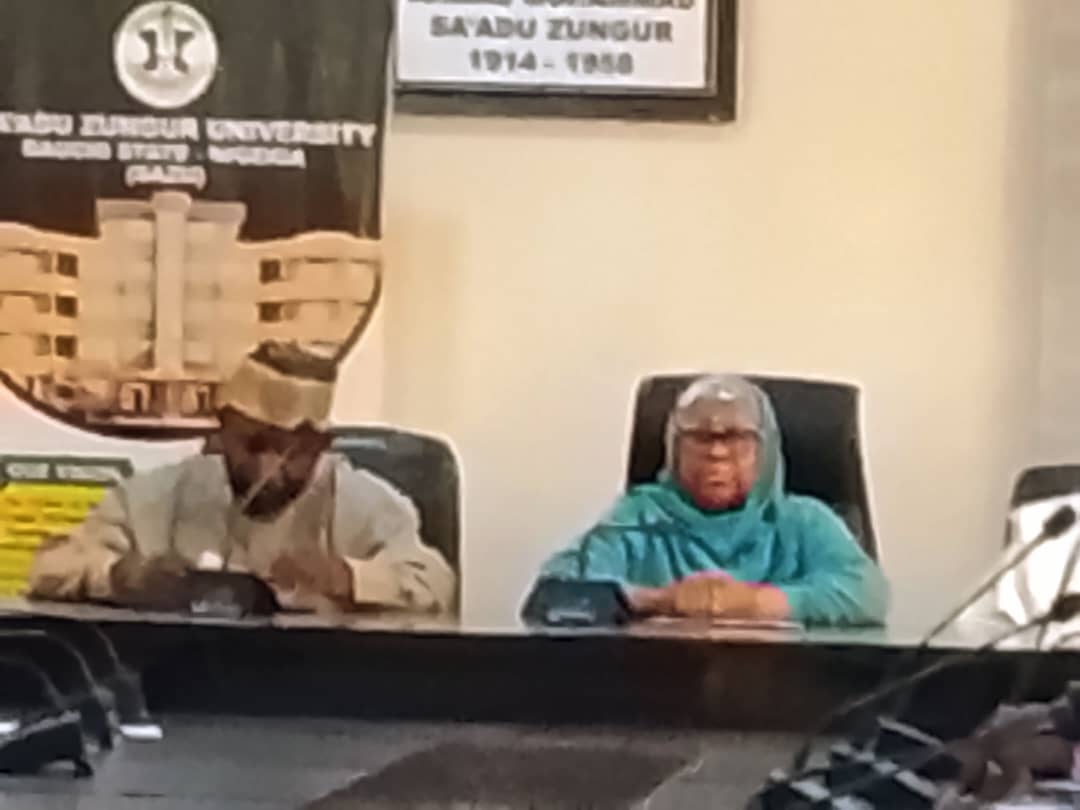
Sa’adu Zungur University (SAZU), Gadau, will graduate 12,256 students during its 8th, 9th, and 10th combined convocation ceremonies, its vicechancellor, Fatima Tahir, has said.
Ms. Tahir disclosed this on Friday during a pre-convocation press conference in Gadau, Azare Local Government Area of Bauchi State.
The graduating students come from the 2022/2023, 2023/2024, and 2024/2025 academic sessions, she said.
According to her, the total number comprises 11,813 undergraduate students and 443 postgraduate students.
She said the undergraduate graduating class includes 8,387 males, representing 71 percent, and 3,426 females, representing 29 percent.
The vice-chancellor said 216 students earned first class honours, while 3,438 graduated with second class upper division and 5,563 with second class lower division.
She added that 2,353 students obtained Third Class degrees, while 243 earned Pass degrees.
Ms. Tahir also said 10,702 of the graduating students are regulars, while 1,111 are from part-time programs.
On postgraduate studies, she said the university would award 25 PhDs, 145 academic masters, 241 professional masters, and 32 postgraduate diplomas.
She said the 2023/2024 academic session recorded the highest number of graduates, with 5,240, followed by 4,064 in 2022/2023, while 2,509 students are graduating from the 2024/2025 session.
As part of activities for the convocation, the university has scheduled a lecture to be delivered by Emeritus Prof. Abubakar Sani Sambo, a former vice-chancellor of Abubakar Tafawa Balewa University (ATBU), Bauchi.
The lecture is titled, “Education, Security, and Sustainable Development: The Role of Universities in Northern Nigeria.”
Ms Tahir said the grand finale of the convocation would hold on 28 March at the university’s stadium, where degrees would be formally conferred on the graduating students.
The convocation is expected to attract academicians, public officials, alumni, parents, and other dignitaries to celebrate the university’s latest graduating class.
FirstBank Golf Tourney Draws 210 Players to Kaduna
By Sani Yakubu, Kaduna
FirstBank’s commitment to sports development will again take center stage in Kaduna, as no fewer than 210 golfers are set to compete in the third edition of its golf tournament, scheduled to kick off on March 26 at the Kaduna Golf Club.
Officials of FirstBank disclosed this in Kaduna during a media briefing held ahead of the competition, describing the event as part of the lender’s enduring support for sports development and community engagement in Nigeria.
Speaking at the briefing, the Group Executive, Retail Banking North, Idris Ibrahim, represented by the bank’s Business Development Manager, Abdullahi Abubakar, said the financial institution had maintained a strong presence in the promotion of golf in the country for over six decades.
He said the bank had continued its collaboration with the Kaduna Golf Tournament since 2023 as part of efforts to deepen interest in the sport and strengthen the golfing culture in Kaduna and beyond.
According to him, the sponsorship goes beyond competition, noting that it reflects the bank’s broader vision of building stronger communities and nurturing long-term relationships.
“For more than 130 years, we have remained committed to initiatives that support communities and create meaningful connections,” he said.
He added that backing the tournament was also in line with the bank’s drive to deepen engagement across Kaduna State and the wider northern region.
Ibrahim noted that golf represents qualities such as discipline, honesty, concentration, perseverance and mutual respect, values he said resonate with the institution’s corporate ideals.
He said the tournament would also serve as an important platform for both seasoned and emerging golfers to showcase their skills, gain visibility and develop their careers.
He explained that the bank’s involvement in the event falls under its First@sports initiative, a platform designed to support talent development and sustain traditional sporting activities such as golf, polo and tennis in Nigeria.
He encouraged participants to compete with determination while also embracing the spirit of sportsmanship throughout the event.
Ibrahim also praised the Kaduna Golf Club for sustaining the competition and contributing to the growth of golf in the northern part of the country.
Also speaking, the captain of Kaduna Golf Club, Nazifi Jibril, said this year’s tournament would feature several categories, including men’s, ladies’, veteran ladies’, super-veterans’, and the overall best performer.
He explained that the event was originally planned for last year but had to be shifted due to unforeseen circumstances.
Jibril announced that representatives from FirstBank and the Kaduna Golf Club would jointly perform a ceremonial tee-off to officially commence the championship.
He commended the bank for sustaining its support for the event, saying the gesture had once again shown its commitment to the advancement of golf in Nigeria.
The club’s captain added that members of the Kaduna Golf Club would continue to strengthen their relationship with the bank by patronising its products and services.
Batting for Glory: Players Hail Nigeria Women’s T20i Invitational as Gateway to Growth
By Ade Oluwa, Lagos
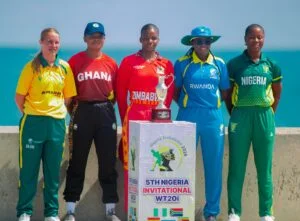
Excitement is building among participating athletes at the ongoing fifth edition of the Nigeria Women’s Invitational T20i tournamentscribing the competition as a vital avenue for skill development, exposure, and international experience.
The event, tagged the Patricia Kambarami Cup, is organised in memory of the late ICC Africa Regional Development Manager and Titans Chief Operating Officer, whose contributions to cricket development across the continent remain widely recognised.
Speaking in separate interviews at the Tafawa Balewa Square Cricket Oval in Lagos, players from different countries shared their impressions of the tournament, praising its organisation and competitive standard.
Captain of Nigeria’s women’s cricket team, Lucky Piety, expressed satisfaction with the quality of the competition, noting that it provides a strong platform for players and teams to improve.
According to her, the tournament has created room for learning and healthy competition among participating nations.
“It has been an exciting experience so far. Every team here is gaining something valuable, and for us, it’s also about enjoying the game while improving,” she said.
Piety reaffirmed Nigeria’s ambition to clinch the title, stressing that the team is determined to make the country proud.
“Our goal is clear — we want to win and give Nigerians another moment of joy, similar to what the U-19 team achieved,” she added.
But she noted that the tournament’s strong teams would make winning the trophy difficult.
“There are strong opponents here with the same ambition. We are approaching each match carefully and staying focused on our targets,” she said.
South Africa’s Filander Jae-Leigh also commended the tournament, describing it as both enjoyable and culturally enriching.
“It’s been a wonderful experience competing here in Nigeria. Beyond cricket, I’m enjoying the environment and learning about the culture,” she said.
She added that her team remains committed to executing its strategies effectively in pursuit of success.
“We’re concentrating on our game plan and aiming to finish strong in the competition,” she noted.
For Zimbabwe’s Bethei Zinyama, the tournament has offered a blend of fun and learning, highlighting the importance of international exposure.
“We’re enjoying ourselves and picking up new ideas from other teams. It’s a wonderful platform to grow,” she said.
Zinyama explained that her focus is on improving her performance and gaining wider recognition through participation.
The tournament, which kicked off on Friday, is scheduled to conclude on Sunday, March 29, at the Tafawa Balewa Square Cricket Oval, Lagos, with teams battling for top honours in what has already proven to be a thrilling contest.

Kebbi Police Arrest 10 Over Killing, Abduction in Birnin Kebbi

Goje Not Leaving APC, Aide Dismisses Defection Rumour as ‘Cheap Political Mischief’

Alkali Resigns as Transport Minister, Eyes Governorship Bid

Dangote Launches Landmark ₦1 Trillion Scholarship Scheme to Support 1.3 Million Nigerian Students

NGX Ends Week in the Green as ₦1.54 Trillion Boosts Investors’ Fortunes

Formal Rebuttal to the Recent Interview Granted by Retired Major General Ali Keffi on Arise TV
-
 Education4 months ago
Dangote Launches Landmark ₦1 Trillion Scholarship Scheme to Support 1.3 Million Nigerian Students
-
 Economy4 months ago
NGX Ends Week in the Green as ₦1.54 Trillion Boosts Investors’ Fortunes
-
 Column4 months ago
Formal Rebuttal to the Recent Interview Granted by Retired Major General Ali Keffi on Arise TV
-

 Gombe4 months ago
Gombe Shines Again, Ranks Second in Northeast at 2025 PHC Leadership Challenge
-

 Economy4 months ago
CBN’s End to Cash Withdrawal Limit
-
 Politics4 months ago
NSGF names Ezekiel Gomos as Director-General, setting stage for stronger regional collaboration
-
 Gombe3 weeks ago
A tribute to Dr Langa Hassan Bangunji (JP) – an icon of Scholarship, Leadership and Community Service
-
 Latest News4 months ago
Anglican Church Expands Footprint with 15 New Dioceses, Total Hits 176