
Latest News
Lagos Hosts Inaugural Schools Tennis Championship as Young Talents Shine


Lagos Hosts Inaugural Schools Tennis Championship as Young Talents Shine
By Ade Oluwa, Lagos
The first edition of the Nigeria Tennis Live (NTL) Lagos Secondary Schools Championship kicked off on Thursday, drawing more than 100 student-athletes from across the state in a vibrant display of youthful talent.
The three-day tournament features participants from about 50 secondary schools and takes place at the Mainland Tennis Club within the National Theatre complex in Surulere. The competition is scheduled to run through Saturday, offering a platform for emerging players to compete and develop their skills.
Early matches delivered exciting performances, with Oluwatishe Ogungbade securing a straight-sets victory over Desmond Sikiru, while Daniel Israel comfortably overcame Godwin Fortune. Tobi Taiye also recorded a convincing win against David Awani, as Oluwajare Farinre and David Usoh triumphed in their respective encounters.
The organisers claim that the championship aims to identify promising young players and offer them opportunities for growth through competitive exposure. The initiative also seeks to strengthen grassroots sports development and inspire wider participation in tennis among students.
Damilare Okunola, the Tournament Director, clarified that the competition’s creation aimed to close the opportunity gap for junior players.
He noted that while many young athletes show outstanding potential, there are limited platforms for them to compete regularly. According to him, the championship represents an important step toward nurturing future champions who could represent Nigeria on global stages, including the Olympic Games.
Okunola described the turnout as encouraging, highlighting the strong participation from schools as a sign of growing interest in the sport. The event, he added, aims to lay the groundwork for long-term talent development.
Despite minor challenges such as late arrivals, he said the tournament has progressed smoothly, aided by favourable weather conditions and strong organisation.
Coach Itandayo Adekale of Corona Secondary School praised the standard of play and the discipline displayed by participants. He noted that competitions like this help young players assess their abilities and improve their performance over time.
A parent, Yvonne Ogunoiki, also commended the initiative, stressing the importance of exposing young athletes to competitive environments beyond their schools.
She said such tournaments allow players to build confidence, test their skills against different opponents, and develop the resilience needed to succeed in the sport.
As the championship continues, organisers and participants alike remain optimistic that the event will become a key fixture in Nigeria’s youth sports calendar, helping shape the next generation of tennis stars.

NDLEA Secures Landmark Conviction of Foreign Crew, Vessel Over Cocaine Smuggling
By Haruna Aliyu
The National Drug Law Enforcement Agency (NDLEA) has recorded a major breakthrough in its fight against drug trafficking, securing the conviction of 10 Filipino sailors alongside their vessel, MV Nord Bosporus, for smuggling 20 kilograms of cocaine into Nigeria.
Details of the development were disclosed in Abuja on Wednesday by the agency’s Director of Media and Advocacy, Mr Femi Babafemi, who confirmed that the court also imposed heavy financial penalties totalling six million dollars and an additional N1.1 million.
According to the agency, the illegal shipment was intercepted at the Apapa Seaport after operatives uncovered the narcotics carefully hidden within the cargo of the vessel, which had arrived from Santos, Brazil. The arrest of the crew and the ship took place on November 16, 2025, following a successful intelligence-led operation.
Reacting to the court ruling, the Chairman of NDLEA, retired Brigadier-General Buba Marwa, described the outcome as a strong affirmation of Nigeria’s commitment to enforcing its drug laws and protecting its borders from criminal networks.
He stressed that the judgement sends a clear warning to international traffickers that Nigeria’s maritime domain is no longer a safe route for illicit drug operations. Marwa noted that the hefty fine should serve as a deterrent to global drug syndicates and their collaborators.
The NDLEA’s boss further warned shipping companies and maritime operators against complicity in drug trafficking, emphasising that offenders risk losing both their liberty and valuable assets.
He highlighted that the agency is now intensifying efforts not only to seize illegal substances but also to dismantle the financial structures that sustain drug cartels.
Marwa also praised officers of the NDLEA Apapa Strategic Command for their vigilance and professionalism in detecting the concealed drugs. He added that the success builds on previous convictions, including that involving MV Chayanee Naree, demonstrating the effectiveness of the agency’s sustained enforcement strategy.
The chairman equally commended the Directorate of Prosecution and Legal Services for diligently handling the case, as well as the judiciary for ensuring a speedy trial.
Reaffirming the agency’s commitment, Marwa said the fight against drug trafficking remains critical to safeguarding Nigeria’s youth and strengthening national security, adding that ongoing improvements in intelligence gathering and technology would further boost operations.

Adamawa Targets One Million Children in Major Immunisation Drive Amid Disease Concerns
By Jamila Muhammed
The Adamawa State Government has unveiled plans to vaccinate at least one million children between the ages of zero and 59 months in an upcoming statewide immunisation campaign aimed at curbing preventable diseases.
Deputy Governor Prof. Kaletapwa Farauta made the announcement known on Tuesday during the first quarter meeting of the State Task Force on Primary Health Care held in Yola. She explained that the gathering assessed the state’s readiness and reinforced collaboration among stakeholders ahead of key health interventions.
Farauta applauded development partners and health sector contributors for their continued backing of primary healthcare services. She reaffirmed the administration’s resolve to strengthen healthcare delivery and protect the well-being of residents.
She highlighted that the Sub-National Immunisation Plus Days (SNIPDs), scheduled for March 28, would play a critical role in boosting child health across the state. According to her, the exercise became imperative following reports of circulating variant poliovirus type 2 (cVPV2) in Gombi Local Government Area and nearby regions.
The deputy governor called on parents, carers, and community leaders to ensure that all eligible children are presented for vaccination, stressing that community participation is vital to the success of the campaign.
Farauta also raised alarm over a confirmed meningitis case in the Maiha Local Government Area, urging swift and coordinated health responses to contain any potential outbreak.
She also mentioned that plans are being made to start the Seasonal Malaria Chemoprevention (SMC) programme and distribute Long-Lasting Insecticide-Treated Nets (LLINs) in certain communities. The initiative is expected to commence in June 2026.
She further emphasised the importance of strengthening emergency preparedness measures, particularly as the rainy season approaches, to minimise the impact of flooding across vulnerable areas.
Meanwhile, the Commissioner for Health and Human Services, Mr. Felix Tangwami, and the Executive Chairman of the Primary Health Care Development Agency, Dr. Suleiman Bashir, noted that the meeting reviewed ongoing health programs, assessed coverage levels, identified challenges, and mapped out strategies to improve service delivery across the state.
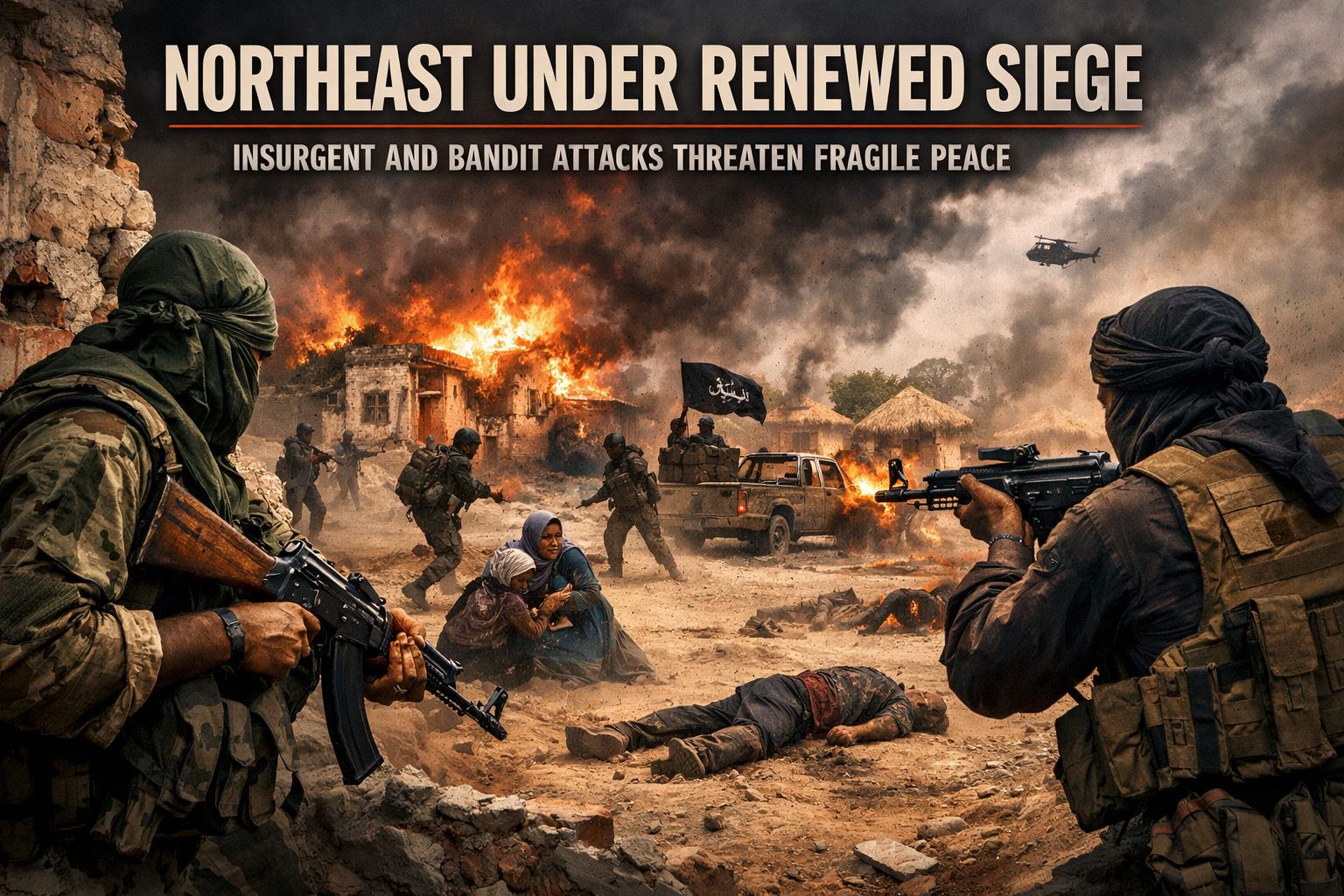
Northeast Under Renewed Siege as Insurgent and Bandit Attacks Threaten Fragile Peace
Fresh violence across Borno, Yobe and Bauchi is displacing communities again while neighbouring states struggle to cope with humanitarian pressure.
By Auwal Ahmad Umar
Across the Northeast, the fragile calm that followed years of insurgency is once again under strain.
In farming villages scattered across Borno, Yobe and Bauchi states, residents who only recently began rebuilding homes destroyed by violence are now fleeing gunfire and uncertainty.
From insurgent raids in Borno to bandit attacks in parts of Bauchi, a pattern of insecurity has re-emerged that security analysts say reflects a troubling evolution of violence across the region.
For communities that endured more than a decade of conflict, the resurgence of attacks has revived painful memories and deepened fears that the region’s recovery remains fragile.
“People thought the attacks had reduced,” said Bukar Madu, a farmer from northern Borno who recently fled his village after gunmen stormed the area.
“When the shooting started, everyone ran into the bush. Families left their houses without carrying anything.”
For many residents, the renewed insecurity represents not just a return to violence but also a threat to livelihoods, food production and community stability.
A Region Still Recovering From a Long War
Nigeria’s Northeast has endured one of the most destructive security crises in the country’s history.
Since the insurgency began more than a decade ago, thousands of lives have been lost and millions of people have been forced to flee their homes.
Entire communities were destroyed, as militant groups targeted villages, markets, schools, and government facilities.
At the height of the conflict, large parts of the Borno, Yobe, and Adamawa states were under the control of insurgent groups.
Nigeria and its neighbouring countries experienced the displacement of millions of residents.
Although sustained military operations eventually reclaimed several towns and weakened insurgent networks, the conflict did not disappear.
Instead, armed groups adjusted their strategies.
Rather than occupying territory, militants began relying on hit-and-run attacks, ambushes and raids in remote communities.
This shift made insurgency less visible in major towns but continued to endanger rural populations.
Security experts say this evolution explains why attacks can still occur even after years of counter-insurgency operations.
Borno: Communities on the Frontline
Among the six northeastern states, Borno remains the epicentre of insurgent activity.
The state’s geography, large forests, sparsely populated villages and porous international borders have long provided opportunities for militant groups to operate.
Several rural communities have reported attacks in recent months.
Residents report that armed fighters frequently launch sudden attacks, specifically targeting villages with limited security presence.
For Bukar Madu, the attack on his community came late at night.
“We heard gunshots, and people started shouting,” he recalled.
“Everyone was trying to escape.”
According to him, several families fled to nearby bushes, while others sought refuge in neighbouring towns.
Some residents have since relocated to camps for displaced individuals.
Local leaders say attacks like this disrupt not only community life but also agriculture.
Farming remains the primary source of income for many rural households.
When farmers cannot safely reach their fields, entire communities face economic hardship.
“If farmers are afraid to go to their land, the harvest will suffer,” Mr Madu said.
A Pattern of Renewed Insurgent Attacks
Security analysts say the recent attacks across parts of Borno suggest that insurgent groups are continuing to test the strength of security operations.
According to Ibrahim Usman, a security analyst who studies conflict dynamics in northern Nigeria, militant groups have become more flexible in their tactics.
“Instead of trying to hold territory, they now rely on mobility,” he said.
“They strike quickly and withdraw before security forces can respond.”
This strategy allows insurgents to maintain a presence even in areas where military operations have improved security conditions.
Usman said insurgent networks often use forest corridors and rural routes to move between communities.
“These movements make it difficult to eliminate their activities,” he explained.
Yobe: Living With the Fear of Uncertainty
Neighbour Yobe State has experienced fewer large-scale attacks than Borno, but insecurity remains a concern in several rural areas.
Residents report occasional sightings of armed groups moving through nearby forests.
Although such sightings do not always lead to attacks, they create anxiety among communities that still remember the years of violence.
For traders who travel between villages, uncertainty about security conditions has become a constant challenge.
Bukar Madu, who also trades agricultural goods in parts of Yobe, said people now avoid travelling at night.
“Most people try to return home before evening,” he said.
“Nobody wants to be on the road if something happens.”
Security officials say patrols have increased in vulnerable areas.
However, the region’s vast rural terrain remains difficult to monitor.
Experts warn that insurgent groups sometimes exploit these landscapes to move undetected between locations, making it challenging for security forces to effectively respond to threats in these rural areas.
Bauchi: Banditry Expands Into Rural Communities
While insurgency dominates headlines in Borno and Yobe, Bauchi State has been facing a different security challenge.
Armed bandit groups have increasingly targeted villages in rural areas, particularly in the Alkaleri Local Government Area.
Residents say gunmen often arrive on motorcycles and raid communities at night.
The attacks usually involve looting livestock and food supplies before the assailants retreat into nearby forests.
For Musa Aliyu, a farmer displaced by one such attack, the violence came without warning.
“We heard gunshots, and people started shouting,” he said.
“Everyone ran into the bush to escape.”
Mr Aliyu said several families lost their homes and livestock.
Some residents have since moved to neighbouring communities.
Bandit attacks across northern Nigeria have displaced thousands of people in recent years.
Security experts say the spread of banditry into new areas poses a serious risk if not addressed quickly.
Humanitarian Pressure on Gombe
Although Gombe State has remained relatively peaceful compared with neighbouring states, it is increasingly experiencing the impacts of violence elsewhere.
Families fleeing attacks in Bauchi have crossed into Gombe seeking safety.
Host communities and temporary shelters are now accommodating displaced residents.
This invasion into the Gombe community has disrupted the lives of many in Kashere town, as the school being used to shelter the displaced persons has been shot, with many of their students now staying at home and at risk of going into drug abuse and other menaces.
For the displaced, it is a painful tale of not knowing when they will return home; it is particularly sad for the economy of the country, as many productive people are now staying idle, waiting for food and other support to stay afloat in life.
For Haruna Yakubu, a volunteer assisting displaced families, the situation is challenging.
“Many people arrived here with nothing,” he said.
“They left their homes suddenly and could not take anything with them.”
According to him, food, shelter and healthcare remain the most urgent needs.
Local authorities say they’re working with humanitarian organisations to assist displaced families.
However, the growing number of arrivals is placing pressure on limited resources, which may lead to inadequate support for displaced families in accessing essential services like food, shelter, and healthcare.

Eid-el-Fitr: Inuwa Yahaya Urges Nigerians to Sustain Ramadan Virtues, Embrace Unity

Drama, Goals and Late Twists Define an Electric Season in World Football

Lagos Hosts Inaugural Schools Tennis Championship as Young Talents Shine

Dangote Launches Landmark ₦1 Trillion Scholarship Scheme to Support 1.3 Million Nigerian Students

NGX Ends Week in the Green as ₦1.54 Trillion Boosts Investors’ Fortunes

Formal Rebuttal to the Recent Interview Granted by Retired Major General Ali Keffi on Arise TV
-
 Education3 months ago
Dangote Launches Landmark ₦1 Trillion Scholarship Scheme to Support 1.3 Million Nigerian Students
-
 Economy3 months ago
NGX Ends Week in the Green as ₦1.54 Trillion Boosts Investors’ Fortunes
-
 Column3 months ago
Formal Rebuttal to the Recent Interview Granted by Retired Major General Ali Keffi on Arise TV
-

 Gombe3 months ago
Gombe Shines Again, Ranks Second in Northeast at 2025 PHC Leadership Challenge
-

 Economy3 months ago
CBN’s End to Cash Withdrawal Limit
-

 Politics3 months ago
NSGF names Ezekiel Gomos as Director-General, setting stage for stronger regional collaboration
-

 Latest News3 months ago
Anglican Church Expands Footprint with 15 New Dioceses, Total Hits 176
-

 Gombe6 days ago
A tribute to Dr Langa Hassan Bangunji (JP) – an icon of Scholarship, Leadership and Community Service