
Latest News
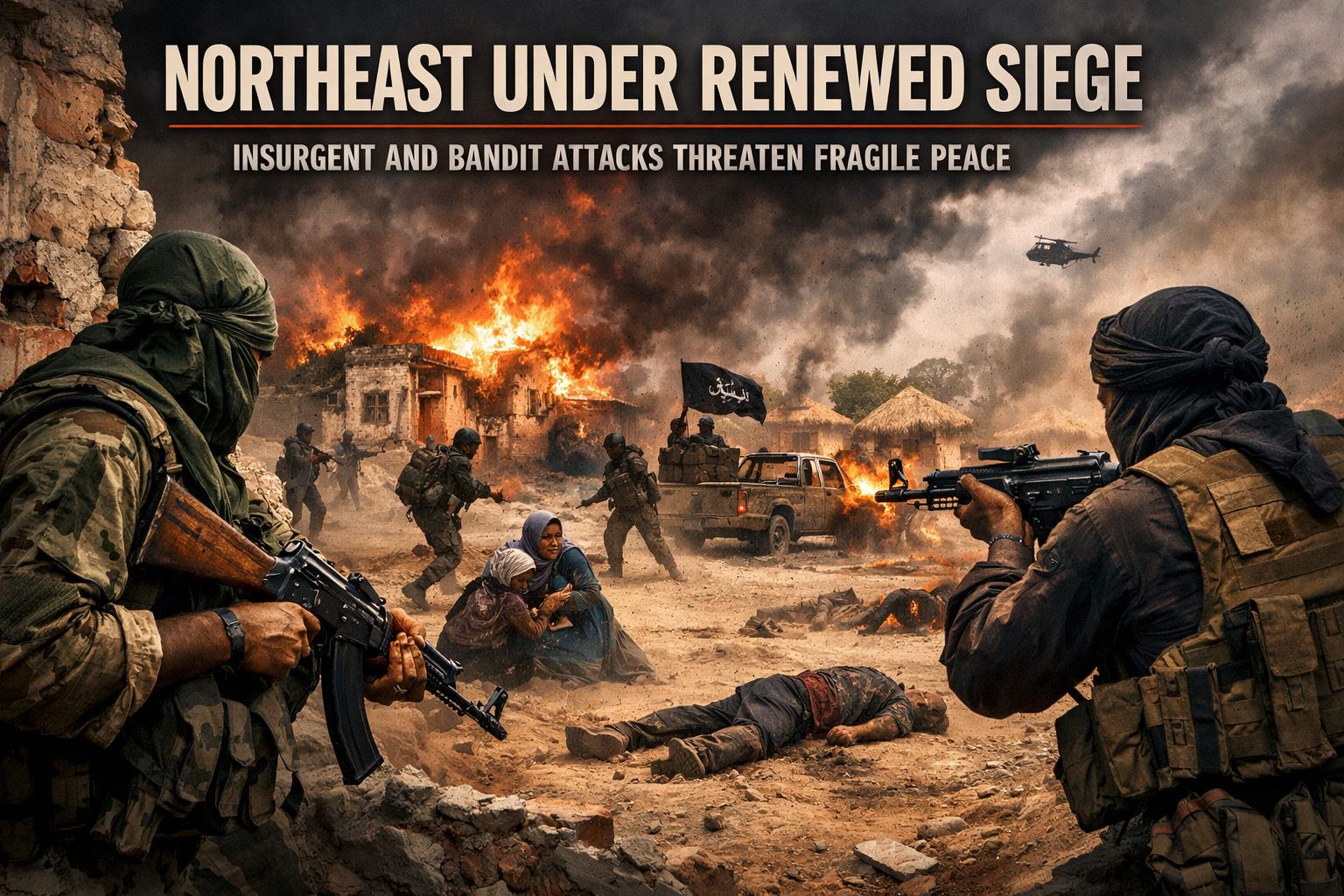
Northeast Under Renewed Siege as Insurgent and Bandit Attacks Threaten Fragile Peace

Northeast Under Renewed Siege as Insurgent and Bandit Attacks Threaten Fragile Peace
Fresh violence across Borno, Yobe and Bauchi is displacing communities again while neighbouring states struggle to cope with humanitarian pressure.
By Auwal Ahmad Umar
Across the Northeast, the fragile calm that followed years of insurgency is once again under strain.
In farming villages scattered across Borno, Yobe and Bauchi states, residents who only recently began rebuilding homes destroyed by violence are now fleeing gunfire and uncertainty.
From insurgent raids in Borno to bandit attacks in parts of Bauchi, a pattern of insecurity has re-emerged that security analysts say reflects a troubling evolution of violence across the region.
For communities that endured more than a decade of conflict, the resurgence of attacks has revived painful memories and deepened fears that the region’s recovery remains fragile.
“People thought the attacks had reduced,” said Bukar Madu, a farmer from northern Borno who recently fled his village after gunmen stormed the area.
“When the shooting started, everyone ran into the bush. Families left their houses without carrying anything.”
For many residents, the renewed insecurity represents not just a return to violence but also a threat to livelihoods, food production and community stability.
A Region Still Recovering From a Long War
Nigeria’s Northeast has endured one of the most destructive security crises in the country’s history.
Since the insurgency began more than a decade ago, thousands of lives have been lost and millions of people have been forced to flee their homes.
Entire communities were destroyed, as militant groups targeted villages, markets, schools, and government facilities.
At the height of the conflict, large parts of the Borno, Yobe, and Adamawa states were under the control of insurgent groups.
Nigeria and its neighbouring countries experienced the displacement of millions of residents.
Although sustained military operations eventually reclaimed several towns and weakened insurgent networks, the conflict did not disappear.
Instead, armed groups adjusted their strategies.
Rather than occupying territory, militants began relying on hit-and-run attacks, ambushes and raids in remote communities.
This shift made insurgency less visible in major towns but continued to endanger rural populations.
Security experts say this evolution explains why attacks can still occur even after years of counter-insurgency operations.
Borno: Communities on the Frontline
Among the six northeastern states, Borno remains the epicentre of insurgent activity.
The state’s geography, large forests, sparsely populated villages and porous international borders have long provided opportunities for militant groups to operate.
Several rural communities have reported attacks in recent months.
Residents report that armed fighters frequently launch sudden attacks, specifically targeting villages with limited security presence.
For Bukar Madu, the attack on his community came late at night.
“We heard gunshots, and people started shouting,” he recalled.
“Everyone was trying to escape.”
According to him, several families fled to nearby bushes, while others sought refuge in neighbouring towns.
Some residents have since relocated to camps for displaced individuals.
Local leaders say attacks like this disrupt not only community life but also agriculture.
Farming remains the primary source of income for many rural households.
When farmers cannot safely reach their fields, entire communities face economic hardship.
“If farmers are afraid to go to their land, the harvest will suffer,” Mr Madu said.
A Pattern of Renewed Insurgent Attacks
Security analysts say the recent attacks across parts of Borno suggest that insurgent groups are continuing to test the strength of security operations.
According to Ibrahim Usman, a security analyst who studies conflict dynamics in northern Nigeria, militant groups have become more flexible in their tactics.
“Instead of trying to hold territory, they now rely on mobility,” he said.
“They strike quickly and withdraw before security forces can respond.”
This strategy allows insurgents to maintain a presence even in areas where military operations have improved security conditions.
Usman said insurgent networks often use forest corridors and rural routes to move between communities.
“These movements make it difficult to eliminate their activities,” he explained.
Yobe: Living With the Fear of Uncertainty
Neighbour Yobe State has experienced fewer large-scale attacks than Borno, but insecurity remains a concern in several rural areas.
Residents report occasional sightings of armed groups moving through nearby forests.
Although such sightings do not always lead to attacks, they create anxiety among communities that still remember the years of violence.
For traders who travel between villages, uncertainty about security conditions has become a constant challenge.
Bukar Madu, who also trades agricultural goods in parts of Yobe, said people now avoid travelling at night.
“Most people try to return home before evening,” he said.
“Nobody wants to be on the road if something happens.”
Security officials say patrols have increased in vulnerable areas.
However, the region’s vast rural terrain remains difficult to monitor.
Experts warn that insurgent groups sometimes exploit these landscapes to move undetected between locations, making it challenging for security forces to effectively respond to threats in these rural areas.
Bauchi: Banditry Expands Into Rural Communities
While insurgency dominates headlines in Borno and Yobe, Bauchi State has been facing a different security challenge.
Armed bandit groups have increasingly targeted villages in rural areas, particularly in the Alkaleri Local Government Area.
Residents say gunmen often arrive on motorcycles and raid communities at night.
The attacks usually involve looting livestock and food supplies before the assailants retreat into nearby forests.
For Musa Aliyu, a farmer displaced by one such attack, the violence came without warning.
“We heard gunshots, and people started shouting,” he said.
“Everyone ran into the bush to escape.”
Mr Aliyu said several families lost their homes and livestock.
Some residents have since moved to neighbouring communities.
Bandit attacks across northern Nigeria have displaced thousands of people in recent years.
Security experts say the spread of banditry into new areas poses a serious risk if not addressed quickly.
Humanitarian Pressure on Gombe
Although Gombe State has remained relatively peaceful compared with neighbouring states, it is increasingly experiencing the impacts of violence elsewhere.
Families fleeing attacks in Bauchi have crossed into Gombe seeking safety.
Host communities and temporary shelters are now accommodating displaced residents.
This invasion into the Gombe community has disrupted the lives of many in Kashere town, as the school being used to shelter the displaced persons has been shot, with many of their students now staying at home and at risk of going into drug abuse and other menaces.
For the displaced, it is a painful tale of not knowing when they will return home; it is particularly sad for the economy of the country, as many productive people are now staying idle, waiting for food and other support to stay afloat in life.
For Haruna Yakubu, a volunteer assisting displaced families, the situation is challenging.
“Many people arrived here with nothing,” he said.
“They left their homes suddenly and could not take anything with them.”
According to him, food, shelter and healthcare remain the most urgent needs.
Local authorities say they’re working with humanitarian organisations to assist displaced families.
However, the growing number of arrivals is placing pressure on limited resources, which may lead to inadequate support for displaced families in accessing essential services like food, shelter, and healthcare.
By Aliyu Isah
Plan International Nigeria has called for sustained investment in teachers’ welfare, professional growth and emotional well-being as it reviewed the outcomes of a two-year education support programme in conflict-affected parts of Sokoto and Adamawa States.
The organisation made the call at the closing ceremony of the Teachers in Crisis Contexts (TiCC) project held in Abuja on Thursday, where education stakeholders examined the programme’s achievements, implementation challenges and prospects for sustaining its interventions.
Supported by the European Union, the initiative, known as Building Resilient Education Systems: Supporting Teachers’ Professional Development, Well-being and Policy Reforms in Crisis-Affected Contexts, was carried out by Save the Child Initiative (STCI) and the Forum for African Women Educationalists (FAWE), in partnership with the Nigeria Union of Teachers (NUT).
Speaking at the event, Plan International Nigeria’s Country Director, Dr Charles Usie, said the programme sought to improve teachers’ professional skills, working conditions and acceptance within communities affected by insecurity and humanitarian emergencies.
He explained that the interventions included capacity-building activities, the provision of teaching equipment and measures to help teachers integrate into schools serving vulnerable communities.
Usie, however, identified the difficulty of getting educators back into classrooms after attacks as one of the major obstacles encountered during the project.
He noted that assaults on schools and other public facilities often leave teachers traumatised, with many reluctant to return to their workplaces because of fears for their safety.
According to him, education and health facilities are frequently among the institutions exposed to attacks during emergencies, making the protection and psychological recovery of their workers a critical concern.
The country director said the project had produced an approach that could be adapted and introduced in other parts of Nigeria facing similar challenges.
He also praised STCI for its role in implementing the programme, describing the organisation as a valuable partner in humanitarian assistance and development initiatives.
However, Usie emphasised that the long-term success of such interventions would depend on government ownership, noting that development organisations could initiate and test solutions but could not independently guarantee their continuation.
He said state and federal authorities needed to incorporate successful interventions into public policies, provide adequate funding and establish institutional arrangements to ensure that the gains were not lost after external support ended.
Also speaking, Sokoto State Commissioner for Basic and Secondary Education, Prof. Ahmad Ala, reiterated the state government’s commitment to improving teachers’ skills, professional development and overall welfare.
Ala stressed that consistent investment in educators was necessary to strengthen teaching standards and improve pupils’ learning outcomes.
The closing ceremony attracted education officials and representatives of relevant institutions from Sokoto and Adamawa States, who reviewed the programme’s performance and discussed lessons that could inform future interventions.
Those present included education commissioners from both states, alongside representatives of the NUT, Teachers Registration Council of Nigeria (TRCN), Universal Basic Education Commission (UBEC), Plan International Nigeria, FAWE and STCI.
At the end of the meeting, stakeholders drew up a Sustainability Action Plan outlining measures to preserve the programme’s achievements and explore opportunities to extend successful interventions beyond the project’s lifespan.
The plan is expected to provide guidance for continued efforts to protect teachers’ welfare, strengthen their professional capacity and improve the resilience of education systems in communities affected by conflict and insecurity.
Latest News
VentCope Reaches Over 400 Displaced Persons with Mental Health Support in Abuja, Adamawa

By Auwal Ahmad Umar
The Vent Cope Relief Initiative (VentCope) has reached more than 400 people in five internally displaced persons (IDP) and resettlement communities in Abuja and Adamawa State with mental health awareness and psychosocial education.
The initiative was organised to commemorate the 2026 World Mental Health Day and the International Day for Disaster Risk Reduction, with support from SelvedgePsych and Mutaru Development Initiative.
The outreach covered Wassa IDP Settlement in Abuja, as well as Damare IDP Camp, Fombina IDP Camp, Salama Resettlement Camp and Labondo Integration Settlement in Adamawa State.
The sessions were designed to help participants understand the emotional and psychological challenges associated with displacement and other adverse experiences, including how these challenges can affect their wellbeing, daily activities and ability to cope with difficult circumstances.
Participants were also sensitised to the importance of psychosocial recovery, particularly for individuals and families who continue to experience emotional distress and other difficulties long after the immediate effects of a crisis have subsided.
The programme aligned with the 2026 World Mental Health Day theme, “Lived experiences heard: real voices, real change,” which emphasises the need to listen to people’s experiences and recognise their mental health needs.
Speaking on the initiative, Sharon Yabilsu-Guyuk, Executive Director of VentCope, said recovery from adversity should go beyond physical survival to include emotional wellbeing and the ability to rebuild lives.
“Surviving adversity is important, but it is not the end of the recovery journey. People can continue to experience distress and face difficulties in their everyday lives long after the immediate crisis has passed,” she said.
Yabilsu-Guyuk stressed the need to give greater attention to psychosocial recovery, noting that people affected by difficult experiences require support to cope with their challenges, regain their ability to function and rebuild their lives.
She added that mental health and psychosocial support should not be overlooked in efforts to assist people affected by displacement and other crises.
The activities marking the International Day for Disaster Risk Reduction also examined the concept of home beyond the provision of physical shelter.
Reflecting the 2026 theme, “Resilience Starts at Home,” discussions highlighted how home represents more than a place to live, particularly for displaced people who may have lost their familiar surroundings and support networks.
For affected individuals and families, home can also represent safety, meaningful relationships, family connections, belonging and a sense of emotional stability — aspects of life that displacement can disrupt.
The outreach underscored the importance of integrating mental health awareness and psychosocial support into humanitarian responses, particularly for displaced populations who may continue to face emotional and social difficulties long after emergencies have ended.
Through the initiative, VentCope and its partners sought to draw attention to the need for sustained support that enables affected communities not only to overcome immediate crises but also to recover, regain stability and rebuild their lives.

By Tada Jutha, Maiduguri
Troops of Operation Hadin Kai (OPHK) have killed six suspected insurgents and recovered a cache of weapons and ammunition after repelling an attack on a military base in Garaha community, Hong Local Government Area of Adamawa State.
The attack targeted the Forward Operating Base (FOB) Garaha at about 9:07 p.m., when suspected Boko Haram and Islamic State West Africa Province (ISWAP) fighters advanced on foot from the LAR axis in an attempt to overrun the military position.
The military said the troops responded with superior firepower and coordinated tactics, forcing the attackers to retreat after an exchange of gunfire that lasted about two hours.
In a statement issued on Tuesday in Tola, the Media Information Officer of Operation Hadin Kai, Lt. Col. Sani Uba Goni, said the troops successfully repelled the assault and recovered weapons and other military equipment.
A subsequent search of the area, he said, led to the discovery of six insurgent corpses, confirming the number of terrorists killed during the encounter.
The recovered weapons included one PKT machine gun, three ammunition belts containing 67 rounds, six AK-47 rifles, 11 AK-47 magazines, 157 rounds of 7.62mm NATO ammunition, 120 rounds of 7.62mm special ammunition and one 60mm mortar bomb.
Other items recovered from the scene were an Infinix Android phone, a Canon portable video recorder, three camelback water bags, a magazine carrier and assorted clothing.
Although some soldiers sustained injuries during the confrontation, the military said the affected personnel were receiving medical attention, while arrangements were being made for their evacuation where necessary.
The troops have since intensified surveillance and search operations around the area to prevent further attacks and identify or recover additional items of operational importance.
The military described the successful defence of the base as a demonstration of the troops’ combat readiness and determination to prevent insurgents from overrunning their positions in the North-East.
It added that Operation Hadin Kai would continue to conduct intelligence-led operations to restrict the movement of insurgents, protect vulnerable communities and support efforts to restore lasting peace and security across the region.

Borno, AU Partner to Get 800,000 Out-of-School Children Back to Classrooms

Plan International Pushes for Lasting Support for Teachers in Crisis-Hit Communities

Newborn Deaths: Gombe, UNICEF Strengthen Skills of 104 Health Workers

APC National Chairman Settles Gombe Central Contest, Raises DCP Ahmed’s Hand as Party’s Senatorial Candidate

NGX Ends Week in the Green as ₦1.54 Trillion Boosts Investors’ Fortunes

Gombe Eyes Livestock-Led Economic Growth as Inuwa Yahaya Meets Minister

-
 Politics4 months ago
APC National Chairman Settles Gombe Central Contest, Raises DCP Ahmed’s Hand as Party’s Senatorial Candidate
-
 Economy10 months ago
NGX Ends Week in the Green as ₦1.54 Trillion Boosts Investors’ Fortunes
-
 Agriculture3 months ago
Gombe Eyes Livestock-Led Economic Growth as Inuwa Yahaya Meets Minister
-
 Sport7 months ago
Gombe Aquatic Sports Body Unveils Board, Sets Stage for Competitive Debut
-

 Education11 months ago
Dangote Launches Landmark ₦1 Trillion Scholarship Scheme to Support 1.3 Million Nigerian Students
-

 Economy11 months ago
CBN’s End to Cash Withdrawal Limit
-

 Striking the Balance3 months ago
The $2,500 Threshold: Why Raising Nigeria’s GDP Per Capita Is Our Best Non-Kinetic Strategy for Peace
-

 Environment5 months ago
World Environment Day: NGO Urges Nigerians to Embrace Nature-Based Solutions Against Climate Change