Humanitarian Service
UNICEF, Gombe Government Step Up Support for Over 7,000 Displaced Persons from Bauchi


UNICEF, Gombe Government Step Up Support for Over 7,000 Displaced Persons from Bauchi
By Auwal Ahmad
Humanitarian efforts have intensified at the Keshiri displacement camp in Gombe State, where thousands of residents fleeing violence from Alkaleri Local Government Area of Bauchi State are currently taking refuge.
Officials from the United Nations Children’s Fund (UNICEF) and the Gombe State Government say coordinated interventions are underway to provide healthcare, sanitation, and education services for the displaced population, which has now exceeded 7,000 people.
Speaking during a visit to the camp, UNICEF Chief of Field Office, Dr Nuzhat Rafique, commended the Gombe State Government and other partners for their prompt response in managing the humanitarian situation.
She noted that from the onset of the crisis, various government departments, including the ministries responsible for health and education, had been actively involved in supporting the displaced persons.
According to her, both the Gombe and Bauchi State governments have been collaborating closely to ensure that the affected families receive adequate assistance.
Dr. Rafique also disclosed that the Governor of Bauchi State recently visited the camp to assess the situation and provide support for the displaced residents from Alkaleri.
She explained that the camp is currently being managed through a host community management structure, working alongside relevant state agencies to ensure effective coordination of relief activities.
The UNICEF official added that the agency is focusing its support on critical areas such as immunisation, maternal healthcare, nutrition, WASH and sanitation services.
“We are supporting immunisation programmes, health services for pregnant and breastfeeding mothers, and ensuring safe deliveries. Fortunately, there is a nearby healthcare facility that provides these services with the support of the Gombe State health authorities,” she said.
Dr. Rafique further revealed that many children in the camp had never been vaccinated prior to their displacement, prompting the initiation of emergency immunisation exercises to protect them from preventable diseases.
She also highlighted concerns about poor sanitation in the camp, warning that it could trigger outbreaks of diseases such as cholera if urgent action is not taken.
To address this challenge, UNICEF distributed nearly 600 hygiene and dignity kits, along with 56 cholera response kits, to help improve sanitation practices among families in the camp.
Beyond health and sanitation interventions, UNICEF is also working to support the education of displaced children who have never attended school.
“We are planning to establish safe learning spaces so that these children can begin their education while they remain here and continue once they return to their communities,” Dr Rafique explained.
Also speaking, the Executive Secretary of the Gombe State Primary Health Care Development Agency, Dr Abdurrahman Shaibu, said the state government had set up a comprehensive incident management system to coordinate activities within the camp.
He explained that the system involves multiple agencies, including the ministries of health, environment, water resources, and special duties, alongside humanitarian partners.
Shaibu said access to healthcare remains a top priority, noting that a primary healthcare centre located near the camp has been designated to provide free medical services to displaced residents.
He added that outreach teams from the facility visit the camp several times each week to administer vaccinations and monitor health conditions among the displaced population.
“As of yesterday, about 300 children have received routine immunisation, while 33 previously unvaccinated children known as zero-dose children have now been vaccinated,” he said.
The health official further disclosed that two nine-year-old girls had also received the Human Papillomavirus (HPV) vaccine, while surveillance officers stationed among the displaced community help identify and refer patients requiring treatment.
Shaibu acknowledged that some cases of child malnutrition had been detected within the camp, adding that the state government is working with UNICEF to provide nutritional support.
He explained that the Gombe State Government recently released ₦500 million in counterpart funding to UNICEF to facilitate the procurement of ready-to-use therapeutic food for malnourished children.
While the supplies are yet to arrive in the state, he said UNICEF has been requested to provide interim assistance to address the immediate nutritional needs of affected children in the camp.
Authorities say the coordinated response between humanitarian partners and state governments remains critical in ensuring the wellbeing of displaced families while longer-term solutions are pursued.







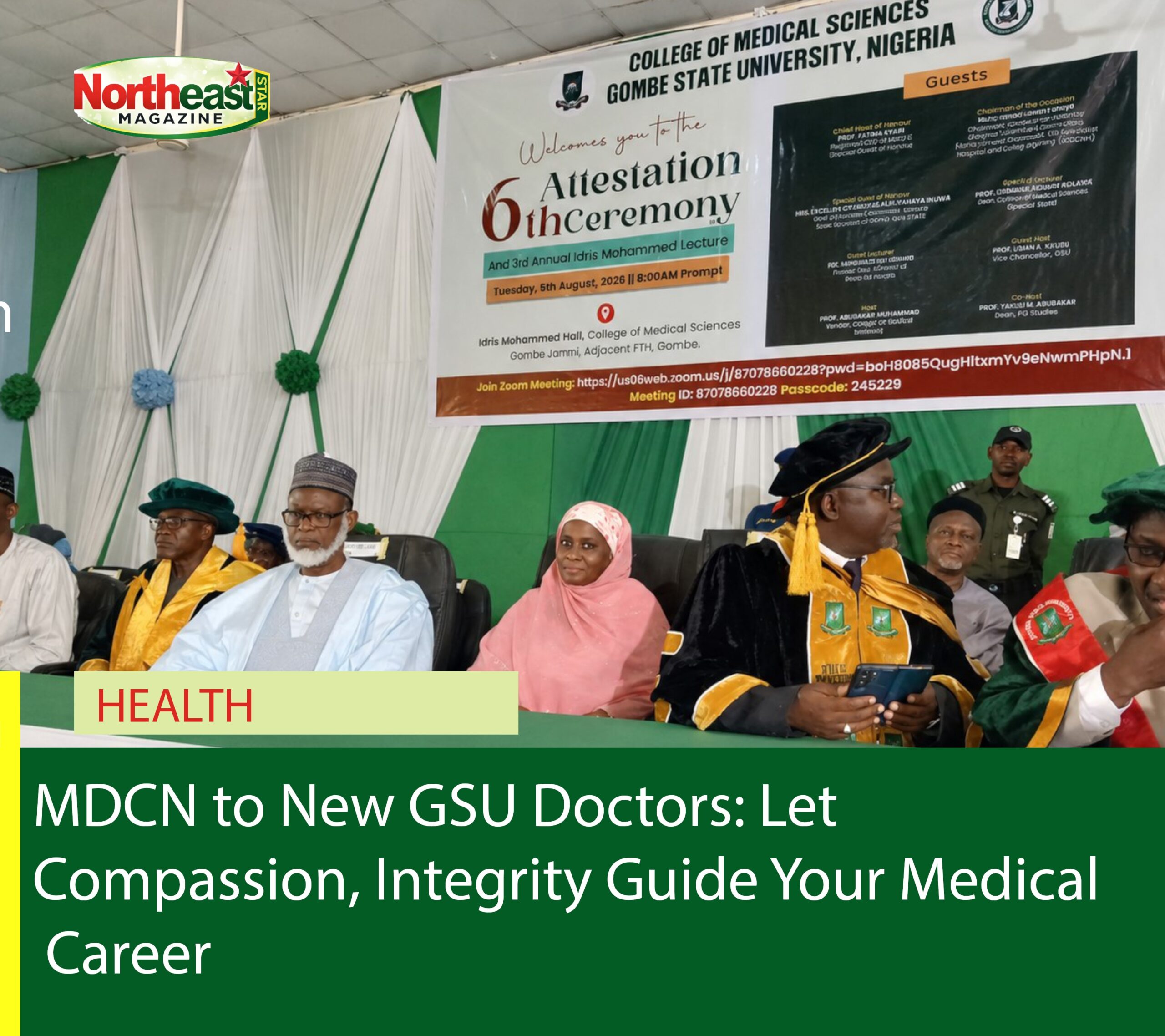
MDCN to New GSU Doctors: Let Compassion, Integrity Guide Your Medical Career
By Auwal Ahmad
The Medical and Dental Council of Nigeria (MDCN) has urged newly qualified medical doctors from Gombe State University (GSU) to build their careers on compassion, professionalism, integrity and collaboration with other healthcare workers.
The advice was delivered during the university’s sixth induction ceremony for medical graduates and the third annual Prof. Idris Mohammed Lecture organised by the College of Medical Sciences in Gombe.
Representing the MDCN Registrar, Prof. Fatima Kyari, Assistant Registrar, Dr Ali Mandaka, described the induction as a major transition from academic training to the realities of professional medical practice.
He congratulated the graduates for reaching an important milestone but reminded them that qualifying as doctors marked the beginning of a lifelong commitment to learning and service.
“The journey into medicine truly begins after graduation. Beyond academic excellence, patients expect compassion, honesty and professionalism from every doctor,” he said.
He praised the College of Medical Sciences for maintaining high standards in medical education and acknowledged the contributions of the university management and academic staff in producing competent healthcare professionals.
Mandaka reaffirmed the council’s commitment to strengthening Nigeria’s healthcare system by supporting institutions responsible for training medical personnel.
Addressing the newly inducted doctors, he urged them to place patients’ welfare at the centre of their practice, stressing that every individual seeking medical attention deserved dignity, empathy and quality care.
He also reminded them that effective healthcare depends on cooperation among different professionals, including nurses, pharmacists, laboratory scientists, physiotherapists and other members of the medical team.
According to him, no healthcare professional can function effectively in isolation, adding that mutual respect among all hospital staff is essential for quality patient care.
He encouraged the graduates to value the experience of senior colleagues while extending courtesy and respect to every worker within the hospital environment, regardless of their role.
On the next phase of their professional development, Mandaka explained that the council would issue provisional registration certificates to the graduates, enabling them to enrol on the centralised housemanship placement portal where they would apply for hospitals to undertake the compulsory one-year internship.
He noted that the internship must be completed within two years of provisional registration, warning that graduates who fail to secure placement within the stipulated period may be required to undergo an assessment by the council before proceeding.
Delivering a lecture at the event, Chairman of the National Emergency Medical Treatment Committee, Prof. Ismail Jibrin, encouraged the young doctors to approach their profession with humility, discipline and a deep sense of responsibility.
He acknowledged that medicine can be physically and emotionally demanding but said the profession offers unique opportunities to save lives, restore hope and make lasting differences in people’s lives.
Jibrin advised the graduates to remain guided by empathy and ethical conduct, especially during difficult moments in their careers, saying the trust placed in doctors comes with enormous responsibility.
A total of 45 medical graduates were inducted during the ceremony, officially qualifying them to begin the process of undertaking their mandatory housemanship in accredited health institutions across Nigeria.
The Provost of the College of Medical Sciences, Prof. Abubakar Difa, congratulated the graduates for successfully completing the demanding academic and clinical training required for the medical profession.
He also commended the parents, lecturers and other stakeholders whose support contributed to the successful training of the new doctors, expressing confidence in their ability to uphold the values of the medical profession
MDCN to New GSU Doctors: Let Compassion, Integrity Guide Your Medical Career
By Auwal Ahmad
The Medical and Dental Council of Nigeria (MDCN) has urged newly qualified medical doctors from Gombe State University (GSU) to build their careers on compassion, professionalism, integrity and collaboration with other healthcare workers.
The advice was delivered during the university’s sixth induction ceremony for medical graduates and the third annual Prof. Idris Mohammed Lecture organised by the College of Medical Sciences in Gombe.
Representing the MDCN Registrar, Prof. Fatima Kyari, Assistant Registrar, Dr Ali Mandaka, described the induction as a major transition from academic training to the realities of professional medical practice.
He congratulated the graduates for reaching an important milestone but reminded them that qualifying as doctors marked the beginning of a lifelong commitment to learning and service.
“The journey into medicine truly begins after graduation. Beyond academic excellence, patients expect compassion, honesty and professionalism from every doctor,” he said.
He praised the College of Medical Sciences for maintaining high standards in medical education and acknowledged the contributions of the university management and academic staff in producing competent healthcare professionals.
Mandaka reaffirmed the council’s commitment to strengthening Nigeria’s healthcare system by supporting institutions responsible for training medical personnel.
Addressing the newly inducted doctors, he urged them to place patients’ welfare at the centre of their practice, stressing that every individual seeking medical attention deserved dignity, empathy and quality care.
He also reminded them that effective healthcare depends on cooperation among different professionals, including nurses, pharmacists, laboratory scientists, physiotherapists and other members of the medical team.
According to him, no healthcare professional can function effectively in isolation, adding that mutual respect among all hospital staff is essential for quality patient care.
He encouraged the graduates to value the experience of senior colleagues while extending courtesy and respect to every worker within the hospital environment, regardless of their role.
On the next phase of their professional development, Mandaka explained that the council would issue provisional registration certificates to the graduates, enabling them to enrol on the centralised housemanship placement portal where they would apply for hospitals to undertake the compulsory one-year internship.
He noted that the internship must be completed within two years of provisional registration, warning that graduates who fail to secure placement within the stipulated period may be required to undergo an assessment by the council before proceeding.
Delivering a lecture at the event, Chairman of the National Emergency Medical Treatment Committee, Prof. Ismail Jibrin, encouraged the young doctors to approach their profession with humility, discipline and a deep sense of responsibility.
He acknowledged that medicine can be physically and emotionally demanding but said the profession offers unique opportunities to save lives, restore hope and make lasting differences in people’s lives.
Jibrin advised the graduates to remain guided by empathy and ethical conduct, especially during difficult moments in their careers, saying the trust placed in doctors comes with enormous responsibility.
A total of 45 medical graduates were inducted during the ceremony, officially qualifying them to begin the process of undertaking their mandatory housemanship in accredited health institutions across Nigeria.
The Provost of the College of Medical Sciences, Prof. Abubakar Difa, congratulated the graduates for successfully completing the demanding academic and clinical training required for the medical profession.
He also commended the parents, lecturers and other stakeholders whose support contributed to the successful training of the new doctors, expressing confidence in their ability to uphold the values of the medical profession.

VentCope Reaches Over 400 Displaced Persons with Mental Health Support in Abuja, Adamawa

Borno Journalists Urged to Promote Accountability in Social Protection Programmes

Gov. Yahaya Hails Professor Faruk Appointment as UMTH Chief Medical Director

APC National Chairman Settles Gombe Central Contest, Raises DCP Ahmed’s Hand as Party’s Senatorial Candidate

NGX Ends Week in the Green as ₦1.54 Trillion Boosts Investors’ Fortunes

Gombe Eyes Livestock-Led Economic Growth as Inuwa Yahaya Meets Minister

-
 Politics4 months ago
APC National Chairman Settles Gombe Central Contest, Raises DCP Ahmed’s Hand as Party’s Senatorial Candidate
-
 Economy10 months ago
NGX Ends Week in the Green as ₦1.54 Trillion Boosts Investors’ Fortunes
-
 Agriculture3 months ago
Gombe Eyes Livestock-Led Economic Growth as Inuwa Yahaya Meets Minister
-
 Sport6 months ago
Gombe Aquatic Sports Body Unveils Board, Sets Stage for Competitive Debut
-

 Education10 months ago
Dangote Launches Landmark ₦1 Trillion Scholarship Scheme to Support 1.3 Million Nigerian Students
-

 Economy10 months ago
CBN’s End to Cash Withdrawal Limit
-

 Striking the Balance3 months ago
The $2,500 Threshold: Why Raising Nigeria’s GDP Per Capita Is Our Best Non-Kinetic Strategy for Peace
-

 Environment4 months ago
World Environment Day: NGO Urges Nigerians to Embrace Nature-Based Solutions Against Climate Change