
Yobe
Death on the Damaturu–Biu Highway: Over 120 Killed as Neglected Road Deepens Northeast Crisis

Death on the Damaturu–Biu Highway: Over 120 Killed as Neglected Road Deepens Northeast Crisis
By Njadvara Musa, Damaturu
At least 120 lives were lost in 2025 alone along the 130-kilometre Damaturu–Buni Yadi–Biu federal highway, as motorists and passengers continued to navigate what many now describe as one of the most dangerous roads in Nigeria’s Northeast.
The ageing road, constructed by the Federal Government in the 1980s, cuts across Yobe State and Borno State, linking several communities and serving as a critical economic corridor. But decades of neglect have turned it into a corridor of tragedy.
Drivers and commuters who ply the route daily say the 45-year-old highway has remained in a deplorable state for over three decades, with deep potholes, eroded shoulders and washed-off portions posing constant danger.
Confirming the situation during an inspection in Buni Yadi over the weekend, the Yobe State Sector Commander of the Federal Road Safety Corps, Andrew Longkam, revealed that although interventions were made in 2023 and 2024 to patch potholes and repair damaged sections, accidents only dropped by 25 per cent in 2025.
“The rate of auto crashes along this road reduced by only 25 per cent in 2025, despite the filling up of multiple potholes and repairs carried out in previous years,” he stated, underscoring the limited impact of temporary fixes.
For victims and survivors, the statistics represent painful realities.
Malam Audu Musa (name changed), who survived a ghastly crash in July 2025, lamented that the road’s poor condition has compounded insecurity in the region. According to him, as military counter-terrorism operations continue, the deteriorated highway has become a soft target for armed groups.
He alleged that insurgents exploit the slow-moving traffic and stranded vehicles to carry out kidnappings and deadly attacks along the Damaturu–Biu axis, a development he said has persisted since the insurgency escalated in 2009.
Journalists who recently accompanied Nigerian troops on a media tour of the route described scenes of despair—vehicles trapped in craters, commuters waiting anxiously by the roadside, and long stretches of broken asphalt stretching toward the fringes of the Sambisa Forest, a known hideout of insurgent groups.
Passengers say the fear of attacks now competes with the risk of fatal crashes.
Hajiya Fatima Ya’u, who was travelling from Damaturu to Gombe, said economic hardship forces many commuters to use the dangerous route.
“This road is very bad,” she said. “I had to travel this way because I cannot afford the longer and safer route through Potiskum and Darazo in Bauchi State.”
She appealed passionately to both federal and state authorities to prioritise a full reconstruction of the highway before the end of 2026.
“We are begging the government to rebuild this road. “We have lost too many lives,” she continued.
Another commuter, Abdullahi Umar, who frequently travels the 66-kilometer stretch between Buni, Gari, and Biu, described the road as both indispensable and unbearable.
“This is the only route I know. It is a key logistics corridor for transporting farm produce from rural communities to major markets like Damaturu,” he explained. “It connects Yobe, Borno, Gombe, Adamawa and Taraba states, helping to reduce transport costs. But the suffering on this road has lasted for decades.”
Despite the risks, many residents say they have no alternative. Farmers, traders and small-scale transporters, abandoning the route is simply not an option.
Stakeholders warn that beyond the tragic loss of over 120 lives in one year, the continued neglect of the Damaturu–Buni Yadi–Biu road threatens economic recovery, undermines security efforts and deepens humanitarian challenges in Nigeria’s conflict-affected Northeast.
As calls grow louder for urgent federal intervention, commuters insist that temporary patchwork is no longer enough. What they demand is a complete overhaul — before more lives are claimed on a highway they say has become a death trap.
Yobe Elevates 1,700 Teachers in Major Boost to Education Sector
By Aliyu Sani, Damaturu
The Yobe State Teachers’ Service Board (TSB) has made a significant move to strengthen the quality of education by approving the promotion of 1,700 teachers across various ranks.
Alhaji Yakubu Dokshi, the Executive Chairman of the board, made the announcement following a management meeting on Tuesday in Damaturu.
Dokshi clarified that the promotion exercise aimed to acknowledge diligent teachers who have exhibited dedication and exceptional performance in their roles.
He noted that acknowledging such efforts would not only motivate educators but also improve teaching standards and students’ academic performance across public schools in the state.
According to him, investing in teachers is a critical step toward revitalising the education sector and ensuring better learning outcomes.
“Improving the welfare and career progression of teachers plays a key role in enhancing the overall performance of our schools,” he stated.
The TSB chairman also praised Governor Mai Mala Buni for his consistent support toward educational development in Yobe.
He said the administration’s policies continue to reflect a strong determination to reposition the sector and build a more skilled and knowledgeable population.
Similarly, the board’s secretary, Mohammed ibn Musa, commended the governor for placing education and teachers’ welfare at the forefront of government priorities.
In the same vein, the Director of Personnel Management, Umar Haruna, congratulated the beneficiaries and encouraged them to justify the confidence reposed in them.
The director called on the promoted teachers to remain disciplined, punctual, and committed to delivering quality education in their respective schools.
Haruna further stressed the need for professionalism and dedication, noting that teachers play a vital role in shaping communities and future generations.
He added that the promotion would inspire greater commitment, foster creativity in teaching, and enhance overall productivity within the education sector.
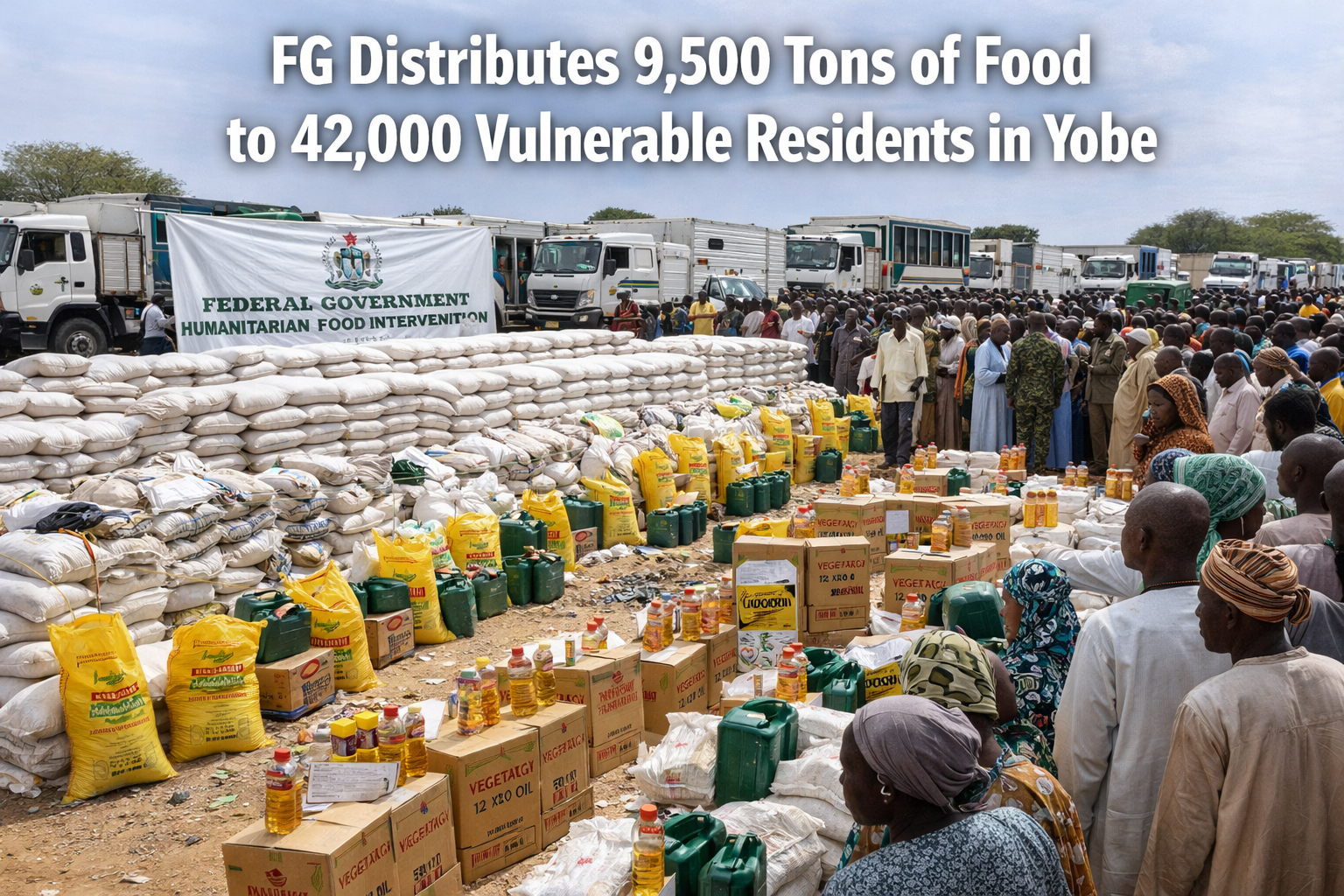
FG Distributes 9,500 Tons of Food to 42,000 Vulnerable Residents in Yobe
By Njadavara Musa, Damaturu
The Federal Government, through the Federal Ministry of Humanitarian Affairs and Poverty Reduction, has distributed about 9,500 tons of food items to more than 42,000 vulnerable residents in Yobe State as part of efforts to address hunger and economic hardship.
The intervention, carried out under the Presidential Emergency Food and Nutrition Intervention Programme, aims to support communities affected by poverty, conflict and rising food insecurity across the country.
Speaking during the presentation of truckloads of food items to the state government at the Government House in Damaturu on Thursday, the Minister of State for Humanitarian Affairs and Poverty Reduction, Yusuf Tanko Sununu, said the initiative was designed to provide urgent relief to vulnerable populations.
According to him, the programme is part of the Federal Government’s response to the growing humanitarian challenges facing northern Nigeria.
“The massive distribution of food to vulnerable populations is aimed at addressing hunger, malnutrition and poverty while supporting those most at risk,” Sununu said.
He noted that the combined effects of prolonged insurgency and climate change have worsened poverty levels and increased the cost of living, particularly in northern states. The minister added that the intervention targets communities severely affected by over a decade of conflict in the North-East.
The food distribution exercise is being coordinated by the Yobe State Emergency Management Agency in collaboration with the Association of Local Governments of Nigeria to ensure the items reach intended beneficiaries.
Sununu explained that the programme is intended to cushion the economic hardship faced by residents, especially during the Ramadan fasting period.
He further stated that the initiative prioritises internally displaced persons in camps and host communities, returning families, female-headed households, malnourished children, the elderly and persons living with disabilities.
The minister also emphasised that the intervention aligns with the broader strategy of the administration of Bola Ahmed Tinubu to strengthen social protection systems, enhance community resilience and support a gradual transition from emergency relief to sustainable livelihoods.
Items distributed during the first phase of the programme include bags of rice, beans, millet, maize and other grains, as well as cooking oil, tomato paste, seasoning cubes and salt.
In his remarks, the Permanent Secretary of the ministry, Olubunmi Olusanya, said the programme is aimed at reducing food insecurity and addressing nutrition-related challenges in the most vulnerable northern states.
He observed that several states in the region, including Yobe, have been severely affected by conflict and other humanitarian crises.
Olusanya urged the state government and relevant stakeholders to ensure strict coordination and accountability during the distribution process to guarantee transparency and ensure the food items reach vulnerable households across the state.

Buni Launches Emergency Health Insurance Scheme for Over 30,000 Vulnerable Yobe Residents
By Njadvara Musa, Damaturu
Yobe State Governor Mai Mala Buni has unveiled a special emergency contributory healthcare enrolment scheme designed to provide life-saving medical services to 30,240 vulnerable residents across the state.
The initiative, launched by the Yobe State Contributory Healthcare Management Agency (YSCHMA), is supported by the Federal Government’s Basic Healthcare Provision Fund (BHCPF) and targets underserved populations with limited access to healthcare.
Speaking at the official launch held on Friday in Damaturu, the Executive Secretary of YSCHMA, Dr. Babagana Tijjani, who represented Governor Buni, described the program as a critical step toward expanding healthcare access and strengthening social protection for the most vulnerable citizens.
According to him, the Emergency Contributory Healthcare Enrolment Scheme (ECHES) is aimed at removing financial and structural barriers that prevent vulnerable groups from accessing quality medical care, while advancing Yobe State’s goal of achieving Universal Health Coverage (UHC) by the year 2030.
“This intervention is designed to improve access to essential healthcare services for vulnerable and underserved populations, particularly those affected by years of insecurity and displacement,” Tijjani said.
He noted that special attention is being given to communities impacted by insurgency, including the Geidam, Gujba, Yunusari, Gulani, Bursari, and Karasuwa local government areas, where access to healthcare has been severely disrupted.
Dr Tijjani explained that the enrolment scheme has been carefully structured to cover key vulnerable groups. Children under the age of five account for 35 per cent of beneficiaries, while pregnant women make up 40 per cent.
Elderly individuals will represent seven per percent, physically challenged individuals three per percent, and about 14.5 per cent will cover widows, orphans, internally displaced individuals (IDPs), indigent residents and sickle cell patients.
He added that the program reflects the Buni administration’s broader vision of building a compassionate, inclusive, and equitable healthcare system that prioritises the well-being of those most in need.
“The governor’s vision is clear: no resident of Yobe State should be denied access to healthcare because of poverty, age, disability or displacement,” Tijjani stressed.
The Executive Secretary further disclosed that enrolment will be conducted across 162 political wards in the state’s 17 local government areas, with the exception of communities still facing serious security challenges.
To ensure transparency, accountability and proper targeting, Tijjani said all beneficiaries will be enrolled and verified using their National Identification numbers (NIN), a measure aimed at preventing duplication and abuse of the scheme.
Meanwhile, the Director of Information, Communication and Technology (ICT) at YSCHMA, Saleh Ibrahim, reaffirmed the agency’s commitment to strict compliance with enrolment guidelines during an inspection visit to selected health facilities.
He described the emergency healthcare scheme as a clear demonstration of Governor Buni’s commitment to inclusive and people-centered governance, especially for the most vulnerable segments of society.
Ibrahim also highlighted the role of traditional rulers, community leaders, civil society organisations, and development partners in supporting the successful rollout of the program, noting that protecting vulnerable populations is both the moral and developmental responsibility of the government.
With the launch of the emergency healthcare scheme, stakeholders believe Yobe State is taking a significant step toward strengthening its healthcare system and restoring hope to thousands of residents who have long struggled to access basic medical services.

Gov. Inuwa Leads Strong Gombe APC Delegation to Abuja Convention

Gombe 2027: As Major Contenders Jostle To Succeed Governor Yahaya

Army Probes Alleged Civilian Killing in Maiduguri, Raises Security Concerns

Dangote Launches Landmark ₦1 Trillion Scholarship Scheme to Support 1.3 Million Nigerian Students

NGX Ends Week in the Green as ₦1.54 Trillion Boosts Investors’ Fortunes

Formal Rebuttal to the Recent Interview Granted by Retired Major General Ali Keffi on Arise TV
-
 Education4 months ago
Dangote Launches Landmark ₦1 Trillion Scholarship Scheme to Support 1.3 Million Nigerian Students
-
 Economy3 months ago
NGX Ends Week in the Green as ₦1.54 Trillion Boosts Investors’ Fortunes
-
 Column4 months ago
Formal Rebuttal to the Recent Interview Granted by Retired Major General Ali Keffi on Arise TV
-

 Gombe3 months ago
Gombe Shines Again, Ranks Second in Northeast at 2025 PHC Leadership Challenge
-

 Economy4 months ago
CBN’s End to Cash Withdrawal Limit
-
 Politics4 months ago
NSGF names Ezekiel Gomos as Director-General, setting stage for stronger regional collaboration
-

 Gombe2 weeks ago
A tribute to Dr Langa Hassan Bangunji (JP) – an icon of Scholarship, Leadership and Community Service
-

 Latest News3 months ago
Anglican Church Expands Footprint with 15 New Dioceses, Total Hits 176
Pingback: Zulum’s Education Drive Bears Fruit as 615 Teachers Graduate