Bauchi
Healing Hearts: Young Women in Dass Embrace Therapy to Reclaim Their Emotional Wellbeing


Healing Hearts: Young Women in Dass Embrace Therapy to Reclaim Their Emotional Wellbeing
A growing number of young women between the ages of 20 and 24 in the Dass Local Government Area of Bauchi State are taking bold steps to prioritise their mental health by enrolling in interpersonal growth therapy sessions.
The initiative, facilitated by Plan International with support from Global Affairs Canada, is providing a safe and structured environment for participants to openly discuss and confront emotional struggles affecting their lives.
During one of the recent sessions held on Thursday, several participants shared deeply personal experiences, revealing how life-altering events such as divorce, heartbreak, the loss of parents or children, infertility, and difficulties adjusting to new environments had taken a toll on their mental wellbeing.
One of the beneficiaries, Hasiya Aliyu, recounted how losing both her parents within a six-month span plunged her into emotional distress.
“After my parents passed away within such a short period, everything changed for me,” she said. “I felt empty and disconnected from the world. I stopped interacting with people and kept to myself.”
Another participant, 24-year-old Fatima Jibrin, spoke about the emotional trauma she endured after her fiancé of seven years ended their relationship and married someone else.
“That experience broke me completely,” she said. “For four years, I avoided any form of relationship. When I heard about these sessions, I decided to give it a try. It was here that I realised I had been battling depression and needed help.”
She added that the weekly meetings, where participants openly share their experiences under professional guidance, have played a significant role in her recovery.
“Our facilitator created a comfortable space for us to speak without fear. The support I received has transformed me. Today, I encourage other young women facing similar struggles to join the program,” she explained.
According to Mohammed Nasir, Senior Project Coordinator at Plan International, the therapy sessions were introduced four years ago across selected local government areas under the Adolescent Sexual and Reproductive Health and Rights (ASPIRE) project.
He noted that the program currently operates in several LGAs, including Bauchi, Dass, Toro, Ningi, Jama’are, Darazo, Misau, Katagum, and Gamawa.
Nasir explained that participants are organised into groups that undergo an eight-week, structured program designed to build confidence, encourage open communication, and strengthen emotional resilience.
He added that trained facilitators guide the sessions and provide support to help participants address personal challenges in a healthy and constructive manner.
The initiative, he said, is focused on improving the emotional wellbeing of young women in the state while equipping them with coping skills to navigate life’s challenges with renewed strength and confidence.


Shehu Emerges Bauchi JUSUN Chairman, Vows Better Welfare for Judiciary Workers
By Ahmed Muhammad, Bauchi
Mohammed Salisu Shehu has emerged as the new Chairman of the Judiciary Staff Union of Nigeria (JUSUN), Bauchi State chapter, promising to champion improved welfare, better working conditions and modern facilities for judiciary workers in the state.
Shehu made the pledge shortly after he was sworn in on Saturday in Bauchi, where he unveiled key priorities of his administration aimed at strengthening the state’s justice system and improving the welfare of judicial staff.
He said one of the immediate concerns of his leadership would be the rehabilitation of courtrooms and the provision of modern facilities to create a more conducive environment for judicial operations.
According to him, improving infrastructure within the judiciary is critical to enhancing staff productivity and ensuring efficient and timely dispensation of justice.
The new JUSUN chairman also assured members that his administration would pursue better salary structures, allowances, housing support and official vehicles as part of efforts to improve staff welfare.
He noted that a more motivated workforce would not only boost efficiency but also help curb corruption within the system.
Shehu further reaffirmed the union’s commitment to protecting the rights and interests of its members while promoting professionalism, fairness and accountability in the discharge of their responsibilities.
He also pledged to work closely with government and relevant stakeholders to ensure the full implementation of financial autonomy for the judiciary at both state and federal levels in line with constitutional provisions.
Earlier, the National Legal Adviser of JUSUN and Chief Returning Officer of the election, Mahmud Ibn-Amin, announced that Shehu won the chairmanship election with 445 votes, defeating Mohammed Jaja, who polled 75 votes.
Ibn-Amin described the election as peaceful, transparent and credible, saying it reflected the confidence reposed in the new leadership by members of the union.
Also elected into office was Abdulhamid Waziri, who emerged as Secretary of the union.
The emergence of the new leadership is expected to usher in renewed efforts toward improving staff welfare and strengthening the justice delivery system in Bauchi State.

Bauchi Moves to Tackle Water Crisis as Stakeholders Endorse New WASH Policy
By Musa Garba
Stakeholders in Bauchi State have validated the state’s Water, Sanitation and Hygiene (WASH) Policy 2026–2030, setting the stage for a coordinated push to improve access to clean water and sanitation services across the state.
The validation workshop held on Friday in Bauchi reviewed and endorsed the policy, which is expected to serve as a strategic guide for addressing persistent challenges in water supply, sanitation infrastructure, and hygiene practices, especially in underserved communities.
Speaking at the event, the Permanent Secretary in the Bauchi State Ministry of Water Resources, Samaila Tela, said the document was developed to provide a sustainable pathway for delivering WASH services to residents across the state.
He explained that the validation process was necessary to allow stakeholders to critically review the policy and ensure that it reflects the realities and priorities of communities.
Tela said the framework offers a broad roadmap aimed at expanding access to safe, reliable and inclusive water, sanitation and hygiene services, while also strengthening the institutions responsible for delivering them.
According to him, the policy also places an emphasis on improving infrastructure, encouraging positive hygiene behaviour, and building resilience against climate-related threats that affect the sector.
He said effective implementation of the policy would not only improve public health but also protect the environment and open up economic opportunities for local communities.
Also speaking, a representative of WaterAid Nigeria, Mashat Mallo, said the policy gives priority to expanding water supply services in rural communities and small towns, where access remains limited.
He noted that the strategy includes the rehabilitation of broken water systems, the extension of piped water networks, and the deployment of renewable energy solutions, such as solar-powered water schemes, to improve service delivery.
Mallo added that the policy also proposes the construction of WASH (water, sanitation, and hygiene) facilities in schools, health centers, and public spaces, particularly in rural and periurban areas where sanitation gaps remain pronounced.
He said the framework aligns with Nigeria’s commitment to Sustainable Development Goal 6, which seeks to ensure access to clean water and sanitation for all.
The validation workshop was organised by the Women’s Development Association for Self-Sustenance (WODASS) with support from WaterAid Nigeria, bringing together government officials, development partners, and sector stakeholders to fine-tune the policy before its implementation.
With the endorsement of the document, expectations are now high that Bauchi State will move from policy formulation to action in addressing long-standing water and sanitation deficits.

Outrage as Journalist Allegedly Assaulted by Police During Eid Durbar in Bauchi
By Auwal Ahmad Umar
The International Press Centre (IPC), Lagos, has strongly condemned what it described as a disturbing case of police brutality against a journalist, Mohammed Adamu, during the Eid Durbar celebrations in Bununu, Tafawa Balewa Local Government Area of Bauchi State.
In a statement released on Monday and signed by its Press Freedom Officer, Melody Akinjiyan, the IPC—through its Safety and Protection of Journalists (SPJ) Hub—expressed deep concern over the incident, which it said highlights the growing risks faced by journalists in Nigeria.
According to findings gathered by the IPC-SPJ Hub, Adamu, who works with Albarka Radio, a partner of Wikki Times, was reportedly subjected to physical and verbal assault while carrying out his professional duties at the event.
Recounting his ordeal, Adamu explained that he was at the venue alongside other journalists and an information officer to cover the traditional celebration when he was stopped by a police officer.
“We were at Bununu for the Eid Durbar with other media colleagues. As I approached the area assigned for journalists, a police constable blocked me,” he said.
He further alleged that the situation escalated when the Divisional Police Officer (DPO) of the area, SP Jamilu Kabir, ordered him to leave the premises.
“I identified myself as a journalist, but instead of allowing me to work, he began insulting me. Despite my explanation, he started beating me, and other officers joined in the assault,” Adamu recounted.
Reacting to the development, the Executive Director of IPC, Lanre Arogundade, described the incident as a grave abuse of authority and a threat to democratic values.
“The excessive use of force against a journalist is unacceptable and undermines press freedom. It also constitutes a violation of fundamental human rights,” Arogundade stated.
The organisation warned that such actions could create a hostile environment for media practitioners, discouraging them from performing their duties effectively.
Calling for accountability, the IPC urged the Bauchi State Commissioner of Police, Sani-Omolori Aliyu, to launch a thorough investigation into the incident and ensure that those responsible are held accountable.
The centre also stressed the need for appropriate compensation for the victim, describing the treatment meted out to him as inhumane.
Furthermore, IPC called on the Nigeria Police Force to intensify the training of its personnel, emphasising professionalism, respect for citizens’ rights, and the critical role of journalists in society.
“The police must be reminded that their core duty is to protect all citizens, including journalists, not to intimidate or harm them,” the statement added.
The incident has once again brought to the fore concerns about the safety of journalists in Nigeria and the urgent need for reforms to safeguard press freedom.

2027 Elections: SDP Opens Contest to Aspirants, Promises Transparent Primaries

Inuwa Yahaya, NSGF and the Renewed Northern Resolve

AI Boom, Training Bust: Only 10% of Nigerian Journalists Skilled in Emerging Tools – SMI

Dangote Launches Landmark ₦1 Trillion Scholarship Scheme to Support 1.3 Million Nigerian Students

NGX Ends Week in the Green as ₦1.54 Trillion Boosts Investors’ Fortunes

Formal Rebuttal to the Recent Interview Granted by Retired Major General Ali Keffi on Arise TV
-
 Education4 months ago
Dangote Launches Landmark ₦1 Trillion Scholarship Scheme to Support 1.3 Million Nigerian Students
-
 Economy4 months ago
NGX Ends Week in the Green as ₦1.54 Trillion Boosts Investors’ Fortunes
-
 Column4 months ago
Formal Rebuttal to the Recent Interview Granted by Retired Major General Ali Keffi on Arise TV
-

 Gombe4 months ago
Gombe Shines Again, Ranks Second in Northeast at 2025 PHC Leadership Challenge
-

 Economy4 months ago
CBN’s End to Cash Withdrawal Limit
-
 Politics4 months ago
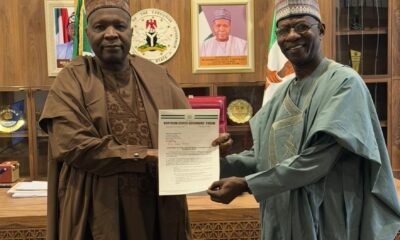
NSGF names Ezekiel Gomos as Director-General, setting stage for stronger regional collaboration
-

 Gombe3 weeks ago
A tribute to Dr Langa Hassan Bangunji (JP) – an icon of Scholarship, Leadership and Community Service
-

 Latest News4 months ago
Anglican Church Expands Footprint with 15 New Dioceses, Total Hits 176