
Yobe
Yobe Boosts Healthcare: Government employs 2,500 workers, upgrades five hospitals to specialist status

Yobe Boosts Healthcare: Government employs 2,500 workers, upgrades five hospitals to specialist status
Njadvara Musa, Damaturu
The Yobe State Government has taken a major step toward strengthening its healthcare delivery system by employing 2,500 health workers and upgrading five General Hospitals to Specialist Healthcare Facilities (SHFT) across the state.
The Executive Secretary of the Yobe Hospitals Management Board (YOHMB), Dr Abubakar Yerima, announced this during an inspection tour and media briefing at the newly upgraded Specialist Hospital, Buni-Yadi, located in Gujba Local Government Area.
He stated that the other upgraded facilities are located in the state capital, Gashua, Potiskum, Geidam, and Damaturu.
“Upgrading these general hospitals to specialist level is expected to significantly improve access to specialised care, reduce unnecessary medical referrals outside the state, save lives and minimise long travel hours,” Yerima explained.
He noted that the initiative is part of a broader strategy that prioritises modern infrastructure, specialised labour, and improved staff welfare—with the goal of reducing medical tourism and preventing avoidable deaths.
State-of-the-Art Facilities
Dr Yerima disclosed that the government has constructed a new maternity complex, complete with a special care baby unit, to address high maternal and neonatal mortality. Additionally, a new Accident & Emergency (A&E) complex has been added to handle trauma cases, terrorism-related injuries, and road traffic accidents.
He added that the specialist hospitals are equipped with advanced twin-theatre and surgical complexes, with only one other facility in the state having a similar setup.
“We are focusing on high-volume centres that can serve as medical hubs for referrals from neighbouring communities, especially the more than 150 primary healthcare centres (PHCs) in the state,” he said.
Training and Manpower Development
The ES further revealed that about 70 healthcare workers are currently undergoing residency training to become specialist doctors. Others are being trained in dialysis, ICU care, perioperative services, and emergency nursing to deepen the state’s professional capacity.
Dr Yerima urged residents to patronise the specialist hospitals rather than relying on unregulated patent medicine stores within communities, assuring them that the upgraded facilities can now provide quality, specialised treatment closer to home.
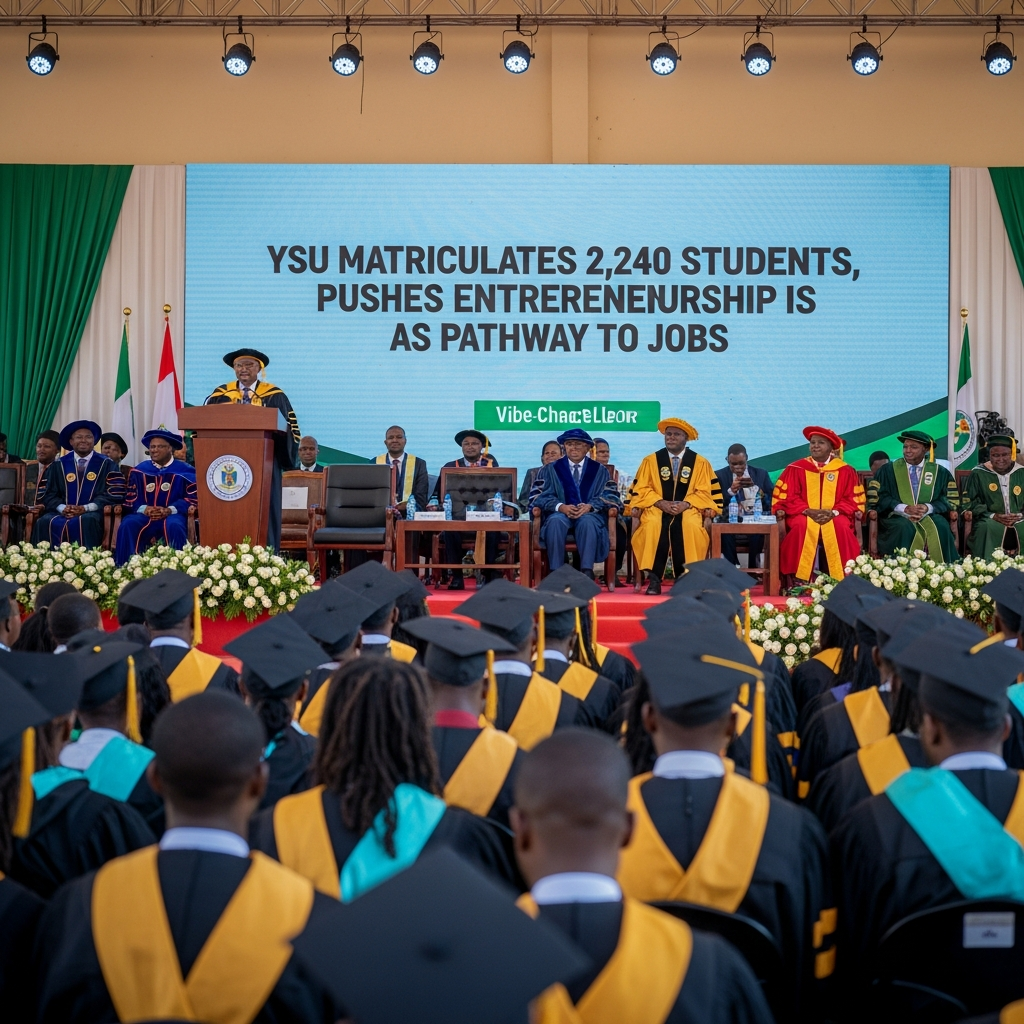
YSU Matriculates 2,240 Students, Pushes Entrepreneurship as Pathway to Jobs
By Njadvara Musa
Yobe State University has matriculated 2,240 students for the 2025/2026 academic session, with a strong call on fresh undergraduates to embrace entrepreneurship as a viable pathway to tackling unemployment and poverty.
The new students, drawn from seven faculties and the College of Medical Sciences (CoMS), were formally admitted during a matriculation ceremony held on Wednesday at the university’s main campus in Damaturu, where authorities also cautioned them against indiscipline and misconduct.
Vice Chancellor Mohammed Bashir Tahir, while addressing the students, highlighted a shifting economic reality in Nigeria, noting that job opportunities are increasingly moving away from the public sector toward a more structured and competitive private sector.
“There is a strategic shift in job creation opportunities, from overdependence on government employment to the organised private sector,” he said, urging students to position themselves for emerging opportunities.
He explained that the institution is intensifying efforts to equip students, especially youths and women, with innovative entrepreneurial skills using available resources, such as workshops, mentorship programs, and partnerships with local businesses.
According to him academic programmes across faculties are designed not only to provide knowledge but also to prepare students for self-reliance.
“Our goal is not just to prepare students for government jobs. We want to nurture individuals who can create employment or integrate seamlessly into innovative private enterprises,” Tahir stated.
The Vice Chancellor also commended the Federal Government’s Nigerian Education Loan Fund, describing it as a crucial support mechanism for students facing financial challenges in completing their education.
However, he issued a stern warning against examination malpractice, drug abuse, and other forms of misconduct, stressing that violators would face strict disciplinary action.
In his remarks, the registrar, Isa Audu Dallari, congratulated the newly admitted students and described the matriculation as a significant milestone in their academic journey. He urged them to adhere strictly to the institution’s rules and regulations.
Similarly, the Dean of Student Affairs, Sani Isah, advised the students to strike a balance between academics and co-curricular activities, cautioning against excessive use of social media and other distractions that could undermine their studies.
A breakdown of the admission figures indicates that the Faculty of Sciences recorded the highest intake with 935 students, followed by the Faculty of Social and Management Sciences with 525. The College of Medical Sciences admitted 465 students, while the Faculties of Education, Arts, Law, and Agriculture recorded 121, 74, 67, and 53 students, respectively. respectively.
The ceremony marks the official commencement of academic activities for the new students, as the university reinforces its commitment to producing graduates equipped with both knowledge and practical skills for Nigeria’s evolving students, respectively. economy. Chancellor Mohammed.
Yobe Secures $5m World Bank Grant to Power Hospitals, Schools with Solar
By Njadvara Musa, Damaturu
The Yobe State Government has secured a $5 million World Bank grant, estimated at N7 billion, to provide solar-powered electricity to six major health and educational institutions across the state.
The intervention, which will deliver rooftop solar photovoltaic (PV) systems, is expected to improve power supply in key public institutions and reduce the burden of unreliable electricity and rising diesel costs.
Announcing the development in Damaturu over the weekend, the Permanent Secretary in the Ministry of Transport and Energy, Dr Mustapha Abba Geidam, said the funding followed a partnership championed by Governor Mai Mala Buni between the Federal Rural Electrification Agency (FREA) and the World Bank.
He stated that the project aims to enhance service delivery in vital sectors, particularly health and education, while promoting sustainable development in the state.
According to him, the institutions selected to benefit from the project include Specialist and General Hospitals in Potiskum, Buni-Yadi, Geidam and Nguru, as well as Umar Suleiman College of Education, Nguru, and Yobe State University, Damaturu.
Dr Geidam explained that the project is aimed at addressing the persistent power challenges affecting the institutions, noting that many of them currently depend on multiple diesel-powered generators to function.
He said the poor and unstable electricity supply has continued to affect healthcare delivery and learning activities, adding that the installation of solar PV (photovoltaic) systems would provide a cleaner, more dependable and more affordable energy source.
He noted that the new solar systems would provide more reliable services, cut operational expenses, and contribute to environmental sustainability in the state.
The permanent secretary also mentioned that the project was based on a thorough study of feasibility and energy needs, which indicated that most of the chosen facilities are suitable for installing solar panels on their roofs, while ground-mounted systems will be used where needed.
He added that the full project proposal had already been formally submitted to the managing director and chief executive officer of YOREA, Engr Abba Aliyu, for immediate consideration and implementation.
The government described the project as another major step in its drive to improve public infrastructure and expand access to clean energy, saying the initiative reflects Governor Buni’s commitment to transforming Yobe’s energy sector and improving the living conditions of residents.
Yobe also expressed his appreciation to the World Bank and the Rural Electrification Agency for their support, while pledging full commitment to the successful execution of the project.
Yobe Elevates 1,700 Teachers in Major Boost to Education Sector
By Aliyu Sani, Damaturu
The Yobe State Teachers’ Service Board (TSB) has made a significant move to strengthen the quality of education by approving the promotion of 1,700 teachers across various ranks.
Alhaji Yakubu Dokshi, the Executive Chairman of the board, made the announcement following a management meeting on Tuesday in Damaturu.
Dokshi clarified that the promotion exercise aimed to acknowledge diligent teachers who have exhibited dedication and exceptional performance in their roles.
He noted that acknowledging such efforts would not only motivate educators but also improve teaching standards and students’ academic performance across public schools in the state.
According to him, investing in teachers is a critical step toward revitalising the education sector and ensuring better learning outcomes.
“Improving the welfare and career progression of teachers plays a key role in enhancing the overall performance of our schools,” he stated.
The TSB chairman also praised Governor Mai Mala Buni for his consistent support toward educational development in Yobe.
He said the administration’s policies continue to reflect a strong determination to reposition the sector and build a more skilled and knowledgeable population.
Similarly, the board’s secretary, Mohammed ibn Musa, commended the governor for placing education and teachers’ welfare at the forefront of government priorities.
In the same vein, the Director of Personnel Management, Umar Haruna, congratulated the beneficiaries and encouraged them to justify the confidence reposed in them.
The director called on the promoted teachers to remain disciplined, punctual, and committed to delivering quality education in their respective schools.
Haruna further stressed the need for professionalism and dedication, noting that teachers play a vital role in shaping communities and future generations.
He added that the promotion would inspire greater commitment, foster creativity in teaching, and enhance overall productivity within the education sector.

2027 Elections: SDP Opens Contest to Aspirants, Promises Transparent Primaries

Inuwa Yahaya, NSGF and the Renewed Northern Resolve

AI Boom, Training Bust: Only 10% of Nigerian Journalists Skilled in Emerging Tools – SMI

Dangote Launches Landmark ₦1 Trillion Scholarship Scheme to Support 1.3 Million Nigerian Students

NGX Ends Week in the Green as ₦1.54 Trillion Boosts Investors’ Fortunes

Formal Rebuttal to the Recent Interview Granted by Retired Major General Ali Keffi on Arise TV
-
 Education4 months ago
Dangote Launches Landmark ₦1 Trillion Scholarship Scheme to Support 1.3 Million Nigerian Students
-
 Economy4 months ago
NGX Ends Week in the Green as ₦1.54 Trillion Boosts Investors’ Fortunes
-
 Column4 months ago
Formal Rebuttal to the Recent Interview Granted by Retired Major General Ali Keffi on Arise TV
-

 Economy4 months ago
CBN’s End to Cash Withdrawal Limit
-

 Gombe4 months ago
Gombe Shines Again, Ranks Second in Northeast at 2025 PHC Leadership Challenge
-
 Politics4 months ago
NSGF names Ezekiel Gomos as Director-General, setting stage for stronger regional collaboration
-
 Gombe3 weeks ago
A tribute to Dr Langa Hassan Bangunji (JP) – an icon of Scholarship, Leadership and Community Service
-

 Latest News4 months ago
Anglican Church Expands Footprint with 15 New Dioceses, Total Hits 176